The remains of the Castle can be visited
CastleBad Liebenstein
Liebenstein Castle
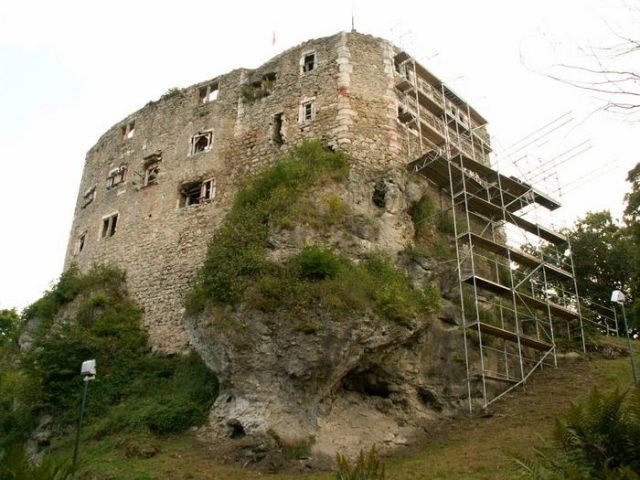
The Liebenstein castle ruin is a former hill castle on the southwestern slope of the Thuringian Forest. It is located north above the town of Bad Liebenstein on the castle hill.
Prehistory
Liebenstein Castle is located only about three kilometers (as the crow flies) east of Altenstein Castle on a moderately steep mountain above the present-day spa town of Bad Liebenstein. Divergent opinions can be found in the literature regarding its builders and their motives. Both the Lords of Stein at Altenstein Castle and possibly the Frankenstein counts are considered. In the 13th century, the power interests of the Landgraves of Thuringia, the Counts of Henneberg, the Bishopric of Würzburg, the Archbishopric of Mainz, and the monasteries of Fulda and Hersfeld, which still held rich land possessions, overlapped in the area between Eisenach and Breitungen/Werra. This led to the construction of numerous castles and fortifications; the disturbed balance of power was a reason for the outbreak of the Thuringian War of Succession. The Neuenburg Castle (novum castrum in lapide), mentioned in 1330, and in 1352 also the nüwe sloz czu dem Steyne, refers to Markgrafenstein Castle located near Altenstein. The Altenstein, immediately adjacent to this castle, was sold in 1360 by Wenzel II von Stein to the militarily successful Thuringian Landgrave Balthasar.
The Liebenstein Line of the Lords of Stein
After the handover of Altenstein, the Knights of Stein are found at Liebenstein from 1386, thus founding the Liebenstein line. The construction should therefore fall within the period from 1360 to 1375. In 1406, the name "Lybinstein" appears for the first time. As proof of the renewed rise of the Knights of Stein, the temporary pledging of the Vogtland of Brotterode (vogetye Brungarterode) by Heinrich von Henneberg to them in 1393 can be regarded. The castle district belonging to Liebenstein cannot result from the former Altenstein possessions, because in the boundary descriptions and protocols for the forest ownership of Brotterode, only their successors in the Altenstein office, the Hunde von Wenckheim at Altenstein, are mentioned as western neighbors.
During the Peasants' War in 1525, Liebenstein Castle was saved because its lord, Lips von Stein, feigned submission to the peasants and was able to save his property from destruction and looting. A fire mentioned in 1567 destroyed parts of the castle. It occurred during the capture of Liebenstein by the Imperial Execution Army, which was deployed to Thuringia to restore peace after the settlement of the Grumbach Feud. Hermann von Stein continued to repair the castle until 1599 and recommended the newly discovered healing spring (1610) to his liege lord Casimir; subsequently, the settlement of Sauerbrunnen developed around this spring. After the extinction of the castle owners von Stein, Liebenstein served as a widow's residence until 1667. All land ownership fell to Ernst the Pious in 1673 as an escheated fief with the extinction of the Liebenstein line of the Lords of Stein.
The Liebenstein Castle Ruin
In the course of the divisions of the Ernestine duchies, the castle came into the possession of the Ducal House of Saxe-Meiningen. Around 1800, Duke Georg I had the first renovation work carried out on the ruin. The missing drawbridge was replaced by a stone arch bridge. With the sights of Altenstein Park and the Liebenstein castle ruin, the flourishing spa town of Liebenstein offered the still predominantly noble spa guests a rich variety of romantic excursion destinations and motifs for souvenir articles. An example is the richly illustrated travel guide by Rohbock and Koelster. The depicted motifs can be found as hand-colored copies on album pages, some were also faithfully colored and reproduced as miniatures on teacups by the ducal porcelain manufactory.
Since 1920, the castle ruin has been owned by the Free State of Thuringia. In 1932, the Liebenstein castle community created an ascent within the ruin for use as an observation tower. A log cabin was built at the foot of the ruin for catering. During the GDR era, the castle ruin was cared for by local history enthusiasts of the Kulturbund der DDR. Regular guided tours for spa guests were organized, and the site was structurally secured and maintained within the limited possibilities. From 1991, a newly founded association of nature and local history enthusiasts of Bad Liebenstein took over the monument. Since 1998, it has been owned by the Thuringian Castles and Gardens Foundation. In the course of necessary renovation work, water and electricity connections were laid to the castle ruin. Since 2006, extensive renovation measures and accompanying archaeological excavations have been taking place.
Take Mobile History with you
You are reading this text for free. Premium adds what matters on the road: descriptions read aloud, sites found through your camera, whole regions taken offline.
- Every description, including the ~17,700 Premium sites
- Audio guide: have descriptions read to you on location
- AR finder: see sites through your camera, with distance and bearing
- Unlimited saved sites
14 days free, then from €2.99 a month. Cancel anytime.
Source: Wikipedia · Licence: CC BY-SA 4.0 · Image: http://www.wehrbauten.de/thread.php?threadid=615
This description draws on the facts documented in the linked Wikipedia article; Wikipedia content is licensed under CC BY-SA 4.0. Wording and editing: Mobile History.
Location: 50.8175, 10.3619