The remains of the Castle can be visited
CastleLiebenburg
Old Castle Liebenburg
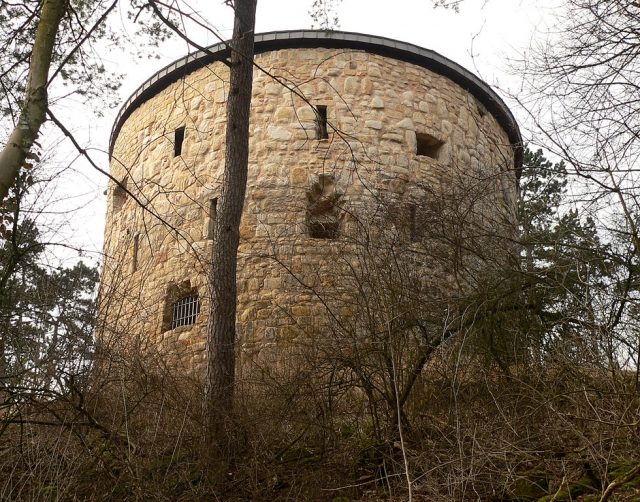
The Liebenburg was a medieval spur castle in Liebenburg in Lower Saxony, built between 1292 and 1302, and with its seven towers, it was considered one of the strongest castles in the Harz foreland. Today, only individual parts of the outer bailey, such as defensive towers and sections of the curtain wall, remain, which have been extensively renovated since the 1990s. The castle complex, which had been severely damaged by acts of war over the centuries, was demolished in 1750 by Prince-Bishop Clemens August of the Hildesheim Prince-Bishopric. In its place, he erected an unfinished Baroque pleasure and hunting lodge with the castle church Mariä Verkündigung, which is now privately owned.
Construction Description+
The castle complex was situated in an elevated position on a mountain spur on the eastern slope of an offshoot of the Salzgitter mountain range. Today, only a few parts of the complex remain. These include three of the seven towers, among them the mighty Hausmannsturm, a defensive tower of the curtain wall, and the base of a defensive tower. In addition, some sections of the curtain wall have been restored during a renovation.
The Hausmannsturm, on an artificial hill with a surrounding rampart, was built as a keep and watchtower outside the former castle complex between 1290 and 1302. It features walls several meters thick and numerous loopholes in wall niches. The tower served for overview and to secure the castle against attacks over the ridge, which was not visible from the castle. As the tower increasingly fell into disrepair, it was closed off for a long time from the 1970s onwards. A local association for the rescue of historical monuments donated a spiral staircase inside in 1991 to allow climbing the tower. In 2005, the masonry of the tower, which was increasingly damaged by weathering, was renovated.
The Flankierungsturm, a prominent defensive tower on the eastern flank of the curtain wall, was built in 1290. It was fitted with a modern flat roof during a complete renovation in 2003 and has since been used as an event venue.
The Schulmeisterturm is a former defensive tower on the curtain wall, of which only the base remains. Since its partial renovation in 2002, it has served as a viewing platform over the surrounding areas.
In 2005, parts of the once mighty curtain wall were renovated. During excavation work, an underground secret passage, 2.2 m high and 0.7 m wide, leading out of the castle, was uncovered. A bricked-up branch presumably led northwards to the external Hausmannsturm and served to supply the tower's crew.
Around 1292, Bishop Siegfried II of Hildesheim had the complex, originally called "Levenborch," built. The castle protected the Prince-Bishopric of Hildesheim on its eastern border against the Dukes of Braunschweig. In 1366, the castle came into the possession of the city of Braunschweig as a pledge, serving as a base for the trade route to Goslar. In the further 14th and 15th centuries, nobles resided in the castle as pledge holders. These included members of the families von Schwicheldt and von Cramm. The Liebenburg, which was not affected by the Hildesheim Diocesan Feud, came to Duke Heinrich the Younger of Braunschweig-Wolfenbüttel in 1523. In 1541/1542, he hid his mistress Eva von Trott with her three youngest children in the castle, where she gave birth to her ninth child.
In 1542, troops of the Schmalkaldic League moved into Liebenburg, having occupied the Braunschweig region and driven out the Duke. In 1547, the Duke returned to his land. In 1552, Count Vollrad von Mansfeld conquered the castle and held it for a short time. During the Thirty Years' War, Liebenburg was Wallenstein's temporary headquarters in 1625. Severe destruction occurred in 1633 when Swedish troops invaded. The imperial garrison had surprisingly left the castle overnight, presumably through the underground secret passage rediscovered in 2005. In 1641, imperial troops recaptured the castle after bombardment. Towards the end of the Thirty Years' War, the castle returned to the Prince-Bishopric of Hildesheim, its original builder, in 1643 through a peace treaty.
The pleasure and hunting lodge with chapel, intended to be built in place of the castle in the 18th century, could not be completed because the Seven Years' War broke out in 1756. Due to lack of funds, only the western part was finished. In the 19th century, the Liebenburg district office and the district court were located in the castle. While the district office was dissolved in 1885, the district court remained in the castle until its relocation to Salzgitter in 1959. Since 1974, the castle has been the residence and workplace of the artist Gerd Winner.
Take Mobile History with you
You are reading this text for free. Premium adds what matters on the road: descriptions read aloud, sites found through your camera, whole regions taken offline.
- Every description, including the ~17,700 Premium sites
- Audio guide: have descriptions read to you on location
- AR finder: see sites through your camera, with distance and bearing
- Unlimited saved sites
14 days free, then from €2.99 a month. Cancel anytime.
Location: 52.0193, 10.4231