The remains of the Castle can be visited
CastleBirgland-Lichtenegg
Lichtenegg Castle
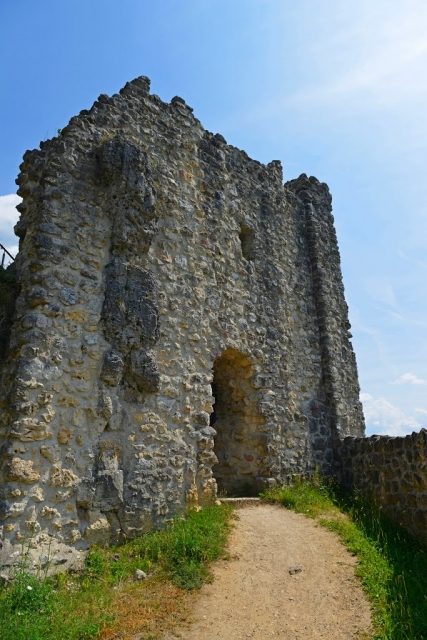
The castle ruin Lichtenegg is a presumably high medieval noble castle above the village of Lichtenegg in the municipality of Birgland in the Upper Palatinate district of Amberg-Sulzbach in Bavaria.
It was first mentioned in a document more than 700 years ago in the Nuremberg Reichssalbüchlein, but is probably much older. The castle temporarily belonged to the Imperial Bailiwick of Nuremberg and frequently changed owners. It was already destroyed in the 15th century. Since 1998, the complex, now owned by the municipality of Birgland, has been restored, also with private funds.
The castle ruin is freely accessible at all times, and from it, one has a view from the Upper Palatinate Jura, a part of the Franconian Alb, to the Fichtelgebirge.
The castle ruin of the hilltop castle is located directly above the village of Lichtenegg on the summit of the 585-meter-high Burgberg (castle hill), which slopes down to the north into the Högenbach valley, and is about 6.4 kilometers east-southeast of the church in Pommelsbrunn.
The castle ruin is easily reached from the village of Lichtenegg.
Nearby is the Lichtenstein castle ruin on the Schleußberg above Pommelsbrunn, also near Pommelsbrunn is the castle site Altes Haus on the Mühlkoppe. To the north is the castle site Breitenthal above the village of Oed, and to the east the castle site Kuhfels south of the village of Bachetsfeld.
Also on the Spitziger Berg, elevation mark 577.5, located immediately east of Lichtenegg, there was a presumably prehistoric fortification, of which only a remnant of a ditch with an outer rampart is still visible.
The Castle+
The area around the castle was already settled 5000 to 5500 years ago. This is evidenced by Corded Ware finds in a prehistoric stone wall.
Despite the early decline of the castle complex, an astonishingly high number of diverse historical records have been preserved. This is closely related to the very changeable ownership and dominion conditions, especially during the time of numerous territorial divisions and fratricidal wars of the House of Wittelsbach.
Nevertheless, the origin of the castle remains hidden in the darkness of history. This is not an unusual phenomenon: due to the very poor source situation for the period before 1300, the construction of most Bavarian castles remains unknown.
The first documented mention of Lichtenegg Castle was found in the so-called Nuremberg Reichssalbüchlein (register of goods and income) from around 1300. According to this, the castle, as former imperial property, belonged to the Imperial Bailiwick of Nuremberg. Already at this time, the Truchsess of Sulzbach is mentioned as the feudal lord.
With some probability, it can be assumed that the fortress originated in connection with the expansion of the Staufer Palatinates and must be older. About the time before 1300, there are only conjectures that go back to the 12th century. A silver coin with the Bruno monogram found on the castle hill was primarily minted by the Würzburg Bishop Otto I von Lobdeburg. That was in the years 1207 to 1223. This find is further evidence that Lichtenegg Castle is older.
The first known feudal lords were the Steinlingers, from 1334 Friedrich and from 1349 Hans Steinlinger. The castle was pledged to Charles IV in 1353, who established a bailiwick here. From 1366, the bailiwick became New Bohemian. However, the castle returned to the Bavarian dukes in 1373, who in turn established a bailiwick. From 1374 to 1381, Heinrich III von Thann served as bailiff. The Bavarian dukes pledged Lichtenegg Castle several times during this period. After being pledged to Count Palatine Ruprecht III, the castle became a Palatine fief.
The bailiwick was dissolved in 1390, and the Sulzbach regional judge Heinrich Kemnater was enfeoffed with Lichtenegg Castle. He was followed in 1411 by Altmann and in 1419 by Friedrich Kemnater. In 1424, a bailiff, Linhart von Hag, was again installed. Friedrich and Jörg Kemnater left behind large debts, among others, to the Nuremberg merchant Heinrich Nöttelein. In 1428, Nöttelein had Lichtenegg confirmed by the Sulzbach regional court as security for his claims. In 1432, Nöttelein ceded the "abandoned fortress" Lichtenegg to the industrialist Ulrich Hegener. Hegener was then enfeoffed by Count Palatine Johann. Ulrich Hegener was enfeoffed again in 1451. After 1452, no enfeoffment is recorded. Lichtenegg was in the hands of the Bauer family Süß von Guntersrieth. Since the castle itself disappears from written tradition before 1443, destruction by the Hussites in 1427 is likely.
The hammer master Hans Teuerl acquired the castle in 1491 and sold it around 1500 to the hammer master Bertold Pfinzing. In 1508, the guardians of the still minor Jörg Pfinzing were enfeoffed by the Neuburg Count Palatine. Lichtenegg was only an "abandoned castle site". However, the associated forest was an important source of raw materials for Haunritz iron production. Jörg Pfinzing was enfeoffed in 1512 after reaching his majority. He died in 1539, and the fief passed to his son Bertold. In 1546, Bertold was heavily indebted and had to provide the estates of Haunritz, Högen, and Lichtenegg as security. In 1552, he had to cede Lichtenegg Castle to his creditors Ott Rau and Hanns Bernkloe.
After the death of Ott Rau in 1559, Count Palatine Wolfgang confiscated half of the Lichtenegg fief. The other half was granted to Hanns Bernkloe as a fief. However, he died in the same year. In 1560, Count Palatine Wolfgang gave Rau's half of Lichtenegg to the regional scribe Sebastian Sedlmayer. In 1562, Sedlmayer bought the Bernkloe heirs' half of the Lichtenegg fief. As a government councilor, he built a new dwelling on the castle in the same year. After a fire accident around 1574/75, at most a makeshift repair was carried out. Sedlmayer sold the castle in 1576 to the Nuremberg merchant Hans von Furtenbach. Furtenbach was then enfeoffed with the obligation to structurally improve Lichtenegg and expand it into a border fortress.
Hans von Furtenbach sold Lichtenegg, Haunritz, and Högen without the consent of the feudal lord in 1580 to Sigmund von Preysing. Hans Sigmund von Preysing was obliged to make structural improvements, but he refused to expand it into a border fortress. In 1581, he had to pay 200 thalers in damages for neglecting his building obligations. Von Preysing lived with his family in Haunritz and Sulzbach until his death in 1584. The castle was handed over by his widow to his eldest son Hans Adolf von Preysing in 1589. He died in 1603, and his brother Hans Erasmus took over the castle. After his death in 1625, Lichtenegg was separated from Haunritz and Högen in 1626. Hans Philipp Jakob von Preysing took over Lichtenegg and established a manor there. He was the first Preysing to reside in Lichtenegg. He died in 1658, and his son took over Lichtenegg.
In 1662, Hans Konrad Adam von Preysing sold the castle hill and ruin to Count Palatine Christian August.
Description of the Castle Ruin+
The castle ruin is located on the summit of the conical Lichtenegg Castle Hill, which slopes moderately steeply on all sides. The ruin is divided into an upper castle, which stood on a rock outcrop rising from the highest point of the castle hill, and a lower castle, which was built in a crescent shape on a terrace around the rock outcrop. Below the lower castle, another crescent-shaped and leveled area can still be seen, which was secured with a rampart towards the hillside.
The lower castle, which stands about one meter above the leveled area on a rock step, extends from west to east. Directly at the rock step, the approximately one-meter-thick ring wall still rises about one to two meters above the surface of the lower castle. The current access is in the middle of the ring wall, but is not identical to the earlier access to the castle, which was on the west side of the lower castle. Only a part of the eastern gate jamb of the castle gate remains.
Not much is known about the buildings of the lower castle; a transverse wall was excavated in the southern part. A now filled cistern was also located here. The entire east side is occupied by the palas, of which three floors are still visible. The lowest floor was probably used as a cellar, followed by a second, rather low and unlit floor, as shown by beam holes and wall recesses. This was followed by a more richly lit floor, which perhaps was followed by another floor, as can be seen in the view from 1603. In this view, at least on the fourth floor on the southwest side of the palas, a machicolation can be seen. In the west of the palas ground floor, under the modern steel staircase, steps carved into the rock can still be seen, which either represent the ascent to the upper castle or only allowed access to the cellar from above.
The upper castle was about 4 to 5 meters above the lower castle on the rock outcrop. It is triangular in shape and drops vertically on all sides. The only visible building is the restored stump of the keep. How the highest part of the upper castle was built is still unknown.
The Village of Lichtenegg+
In the 1720s, Johann Philipp Jakob von Preysing built a manor house and five small houses for his subjects below Lichtenegg Castle in what is now the village. Therefore, he can be considered the founder of the village of Lichtenegg. In 1715, the last Preysing of Lichtenegg, Johann Georg, sold Lichtenegg to the sovereign in Sulzbach, Duke Theodor. In 1730, Baron Johann Friedrich von Wurmrauscher acquired Lichtenegg. From 1755, the Prince of Sulzbach took over Lichtenegg. Lichtenegg was henceforth governed by the sovereign's officials in Sulzbach and Amberg (later Regensburg). The manorial buildings in the village, the so-called Schlosshof with the manor house, were acquired by the farmers Scharrer and Mörtel. The castle hill with the ruin became the property of the local community and later the property of the municipality of Birgland.
Take Mobile History with you
You are reading this text for free. Premium adds what matters on the road: descriptions read aloud, sites found through your camera, whole regions taken offline.
- Every description, including the ~17,700 Premium sites
- Audio guide: have descriptions read to you on location
- AR finder: see sites through your camera, with distance and bearing
- Unlimited saved sites
14 days free, then from €2.99 a month. Cancel anytime.
Source: Wikipedia · Licence: CC BY-SA 4.0 · Image: Jürgen Grösel
This description draws on the facts documented in the linked Wikipedia article; Wikipedia content is licensed under CC BY-SA 4.0. Wording and editing: Mobile History.
Location: 49.4812, 11.5930