The remains of the Castle can be visited
CastlePörtschach am Wörther See
Leonstein Castle
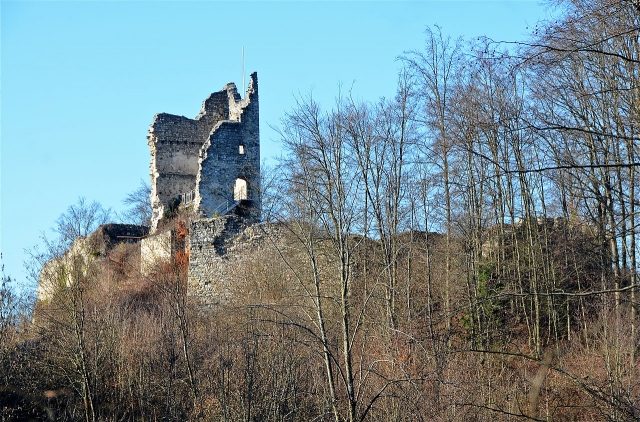
The castle ruin Leonstein in the northwest of the spa town Pörtschach am Wörthersee, a municipality in the district Klagenfurt-Land in Carinthia, documents the remains of a medieval castle complex.
The main castle presents itself with an irregularly running curtain wall, partly still dating from the 12th century, grouped around two courtyards, on an elongated rock plateau northwest of Pörtschach. Access is from the north, along the northern curtain wall. On the south side of the complex, an elongated rock head with a four-story, late Romanesque keep including a residential building, the oldest part of the complex, rises. In the east courtyard, along the northern curtain wall, one can recognize the remains of a late Gothic building from the 14th/15th century. In the west courtyard, in the southeast corner, one can see remains of the former chapel from the 15th century, on the west side there are still remains of a late Romanesque ministerial tower, the eastern half is integrated into the curtain wall.
To the north of the main castle, a spacious, late medieval-early modern economic courtyard opens up.
The former lake castle is located south at the foot of the castle. It was already mentioned in documents in 1202, today only meager wall remains are preserved.
The castle is already mentioned in documents in 1166, at that time in the possession of the Leonsteiners, then Erolzheim and Peuscher. In 1431, the castle was sold to Thomas and Ludwig von Rothenstein and thus passed for a short time into the possession of the Swabian noble family of Rothenstein. Already in the 17th century, the castle had fallen into ruin, as shown by a depiction by Valvasor from 1680.
Name Distinction+
When the "Stöckl" (castle) Leonstain was built on the road around 1550, there were demonstrably no descendants of the Leonsteiners left. Valvasor describes the castle under the name Leonstain around 1688. It is therefore assumed that only the name of the former possession of the Leonsteiners was adopted here in the customary expression of the early 17th century.
Take Mobile History with you
You are reading this text for free. Premium adds what matters on the road: descriptions read aloud, sites found through your camera, whole regions taken offline.
- Every description, including the ~17,700 Premium sites
- Audio guide: have descriptions read to you on location
- AR finder: see sites through your camera, with distance and bearing
- Unlimited saved sites
14 days free, then from €2.99 a month. Cancel anytime.
Source: Wikipedia · Licence: CC BY-SA 4.0 · Image: http://commons.wikimedia.org/wiki/File:Poertschach_Burgruine_Leonstein_28112013_333.jpg
This description draws on the facts documented in the linked Wikipedia article; Wikipedia content is licensed under CC BY-SA 4.0. Wording and editing: Mobile History.
Location: 46.6390, 14.1292