The remains of the Castle can be visited
To be privately owned
CastleLadis
Laudegg Castle
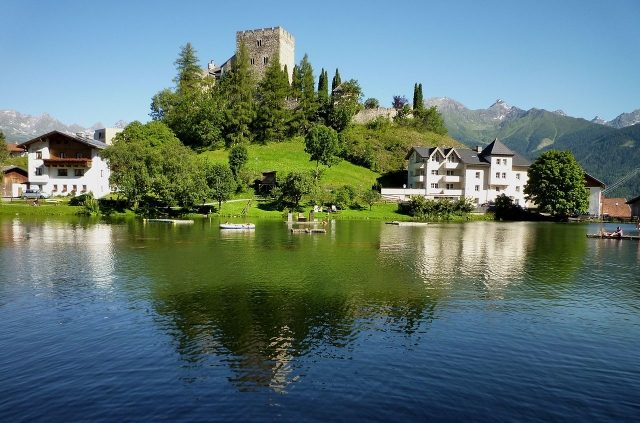
The Lords of Laudeck were first mentioned in 1239 with Kuno von Laudeck. They were ministeriales of the Counts of Tyrol. At that time, the castle consisted only of the residential tower, a small palas, and the connecting curtain wall.
In 1259, Count Meinhard II gifted the "castrum Laudekke" to his wife Elisabeth of Bavaria as a widow's residence. At this time, the castle was probably already the seat of the Prutz regional court. Around 1300, a princely administrator resided here. In 1342, Margrave Ludwig pledged the court and castle to the previous administrator and judge Heinrich Schenk. In 1346, it was reported that the burned-out castle had to be rebuilt. The Bavarians, who had invaded Tyrol in 1363, were able to conquer Laudeck and hold it until the Peace of Schärding in 1369.
After Heinrich Schenk, Hans von Schlandersberg became the pledge holder. In 1396, Duke Leopold IV enfeoffed Rudi the Glotter with the fortress and the court. In the Appenzell War of 1406, the castle was besieged and damaged by the rebels but could not be taken. From 1414 to 1422, the seneschal Hans von Mülinen was the pledge holder of Laudeck. He endeavored to restore the castle to a defensible state. Afterwards, princely administrators were again installed. The administrator Caspar Malitz (1499 – 1530) enlarged the complex by having the north tower and the gate tower built.
The castle, which soon became dilapidated again, mostly served only as a prison and armory. Afterwards, Veit von Wehingen was entrusted with the administration of Laudeck. Maximilian ordered the expansion of the castle for the use of firearms. The Wehingen family served as administrators and pledge holders until 1608. Then they were replaced by the Vintler family. They made the already heavily neglected castle habitable again. In 1655, the pledge was acquired by Count Johannes von Spaur, whose family owned Laudeck for almost 280 years.
By 1744, the castle was already so ruinous that falling masonry endangered the surrounding buildings. In 1933, Baroness Mathilde Handel, née Spaur, sold the complex, which had already become a complete ruin, to Toni Herold. He was followed in 1940 by Kurt and Harald Reinl. They began with a partial restoration of the castle. In 1956, a battlement was added to the residential tower. In 1964, Laudeck came into the possession of Prof. Willi Apel. He continued the restoration work. Since 2005, the castle has been owned by the Möller family.
Take Mobile History with you
You are reading this text for free. Premium adds what matters on the road: descriptions read aloud, sites found through your camera, whole regions taken offline.
- Every description, including the ~17,700 Premium sites
- Audio guide: have descriptions read to you on location
- AR finder: see sites through your camera, with distance and bearing
- Unlimited saved sites
14 days free, then from €2.99 a month. Cancel anytime.
Source: Wikipedia · Licence: CC BY-SA 4.0 · Image: http://commons.wikimedia.org/wiki/File:Ladis_-_Wohnturm_der_Burg_Laudegg_um_1200,_See.jpg?uselang=de
This description draws on the facts documented in the linked Wikipedia article; Wikipedia content is licensed under CC BY-SA 4.0. Wording and editing: Mobile History.
Location: 47.0763, 10.6526