The remains of the Castle can be visited
CastleVolkmarsen
Kugelsburg Castle
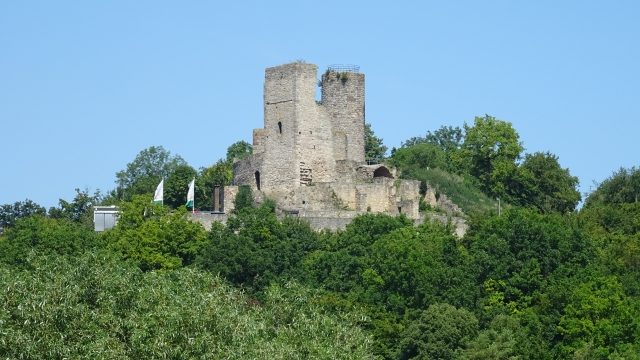
The Kugelsburg is a castle ruin and the landmark of the city of Volkmarsen in the district of Waldeck-Frankenberg in North Hesse.
The ruins of the Kugelsburg stand about 1 kilometer east of the Volkmarsen city center on the western peak (approx. 270 m above sea level) of the Kugelsberg, which is located directly east above the Erpe valley, just under 1.2 km south-southeast of its confluence with the Twiste.
Beginnings
Although first mentioned in a document in 1225, the Romanesque core castle was already built towards the end of the 12th century above the Erpe valley to secure a crossing over the Twiste on the old road Fritzlar – Paderborn on behalf of Abbot Witukind of Corvey, probably by the Lords of Everstein, who as heirs of the first house of the noble lords of Itter had been vassals of Corvey Monastery since at least 1126. A daughter of Gepa von Itter, a relative and ultimately heiress of the first Itter line, which died out in the male line in 1123, probably Mechthild, married the noble lord Konrad I von Everstein, Gograf of Medebach and vice-bailiff of Helmarshausen Monastery, around or before 1128, acquiring the castle and lordship of Itter with this marriage – albeit as a fief from Corvey. One of their sons, Gerlach, became the ancestor of the second house of Itter; the other, Thietmar, founded the lordship of Büren near Paderborn, on allodial property of the Counts of Arnsberg-Werl inherited from his grandmother Gepa.
Albrecht III von Everstein is considered the builder of the castle. After the fall of Henry the Lion in 1180, he became a vassal of the Archbishop of Cologne Philipp von Heinsberg, who had now also become Duke of Westphalia and Engern, bought up the castles of his vassals and then granted them as fiefs. The Eversteiners had held the town of Volkmarsen as a Kurmainz fief since the end of the 11th century, and by around 1200 Albrecht had acquired extensive additional property in the surrounding area. Around the middle of the 12th century, Volkmarsen itself also came into the possession of Corvey, as Pope Hadrian IV confirmed on February 25, 1155. However, the later construction of the castle was not intended to protect the city, but was an attempt by the Corvey abbot to put a stop to Mainz's expansionist ambitions. Already in 1198, Abbot Witukind had concluded a protection treaty with the Archbishop of Cologne Adolf von Altena.
Between Cologne and Mainz
Pope Gregory IX confirmed the possession of the Kugelsburg and the city of Volkmarsen to Corvey Monastery in 1233. From 1239 to 1293, the Lords of Everstein inhabited the castle, and since the city of Volkmarsen was not subordinate to them, there were frequent disputes between the two. Already in 1239, Otto IV von Everstein had transferred his rights to the churches in Volkmarsen, Wittmar and Benfelde to Aroldessen Monastery, which ecclesiastically belonged to the Diocese of Mainz, thus exacerbating the conflict. In 1255, Konrad III von Everstein partially pledged the "Cugelenburg" to Gehrden Monastery. Robberies by the castle men led to the punitive destruction of the castle in 1260, which, however, was soon rebuilt.
In 1297/1303, Otto von Everstein renounced his part of the Kugelsburg to the Archbishop of Cologne Wigbold von Holte, and in 1298 Corvey Monastery itself placed itself under the protection of the Archbishop of Cologne and left him its part of the castle as a pledge for two years. In 1304, Corvey again pledged its half of the castle and the city to the Archbishop of Cologne, who had the complex reinforced and the keep built.
On February 1, 1335, Archbishop Walram granted the Cologne half of the Kugelsburg and the city of Volkmarsen as a fief to the Marshal of Westphalia, Berthold von Büren from the other branch of the Eversteiners. In the following year, 1336, Corvey Monastery pledged its remaining part of the castle and city to Herbold von der nearby Mederich Castle, Johann Runst and the council of the city of Volkmarsen. (A member of the Runst family, Dietrich von Runst, was Abbot of Corvey from 1408-1417.) In 1339, Archbishop Walram gave the pledged Kugelsburg and the city of Volkmarsen to the Westphalian brothers Rabe von Canstein, descendants of "Rave von Papenheim", whose family had been hereditary seneschals of Corvey since at least 1106. From 1346 to 1530, this family resided as castle men in the castle, after which they soon called themselves "Rabe von Coglenberg". During this time, the late Gothic palas was built.
Cologne and Hesse
Since 1351, the Landgraves of Hesse held pledge rights, but around 1440, Kurköln also acquired the pledge right to the second half of the castle. When Hermann IV, Archbishop of Cologne and Bishop of Paderborn, pledged the castle and city to his brother, Landgrave Heinrich III of Hesse, in 1474, both refused to pay homage to the Landgrave. Thereupon, Heinrich first had the castle conquered in 1475 and in 1477, after bombardment from the castle, also the city, which he had set on fire. Archbishop Hermann renewed the Hessian pledge right to the castle and city in 1484, and both remained Hessian occupied until the early years of the 16th century. In 1503/1507, Corvey Monastery finally renounced its rights to the city and castle in favor of Kurköln, which remained the sole owner until the abolition of the electoral state in 1802. The city and district belonged to the Duchy of Westphalia and were included in its administrative structure.
Volkmarsen followed the conversion of the Archbishop of Cologne Gebhard I von Waldburg to the Protestant faith in 1582, but was re-Catholicized in 1590 by the new Archbishop of Cologne, Ernst von Bayern.
Modern Era
During the Thirty Years' War, the garrison of the castle and city of Volkmarsen was initially reinforced in 1622 by Bavarian mercenaries for protection against Christian von Braunschweig-Wolfenbüttel, the "Mad Christian". After his defeat, imperial troops moved in. In 1632, it was conquered by Hesse, culminating in the looting and burning of the city and the destruction of the fortifications. The Seven Years' War brought the same again in 1758, this time with the occupation and partial destruction of the castle by French troops. Afterwards, the ruin fell into disrepair and was partially dismantled in the 19th century for material extraction.
After the secularization of the Electorate of Cologne and the Duchy of Westphalia, Volkmarsen was occupied by Hesse-Darmstadt on August 31, 1802, three weeks later on September 20, 1802 by Landgrave Wilhelm IX of Hesse-Kassel, and finally again on November 13, 1802 by Hesse-Darmstadt. With the Reichsdeputationshauptschluss of February 25, 1803, Volkmarsen and the Kugelsburg came to Hesse-Darmstadt. Three years later, on March 13, 1806, Hereditary Prince Wilhelm of Nassau-Orange, Prince of Fulda and Corvey, transferred Volkmarsen and the Kugelberg to Landgrave Ludwig X of Hesse-Darmstadt.
In 1885, the city of Volkmarsen bought the remains of the castle and the associated lands for 6000 Mark and carried out initial securing work.
Castle Complex+
Today, the castle ruin is a popular excursion and hiking destination. The square residential tower from the 13th century on the steep slope at the southwest corner and the round keep from the beginning of the 14th century on the northern attack side are almost completely preserved. Large parts of the curtain wall also remain. In front of the keep runs the neck ditch, deeply cut into the rock. Of the late Gothic two-story palas next to the keep, a walkable cellar, the so-called "Hexenkeller" (Witches' Cellar), chimney, walls of the ground and upper floors, and the stair tower are preserved. In addition, there are remains of outbuildings and cellars. Nothing remains of the outer bailey, which was located on a plateau to the southwest. In good weather, flight shows with steppe eagles and falcons take place on Saturdays and Sundays (at 3:00 PM each day). An excursion restaurant is located in the immediate vicinity of the Kugelsburg.
Excursion Destinations+
Popular excursion destinations near the Kugelsburg are the "Burgschwimmbad" (Castle Swimming Pool) located on the southern slope of the Kugelsberg and the "Sauerbrunnen" mineral water spring, located just under 1 km south-southeast, with a mini-golf and trampoline facility and a large adventure playground.
Take Mobile History with you
You are reading this text for free. Premium adds what matters on the road: descriptions read aloud, sites found through your camera, whole regions taken offline.
- Every description, including the ~17,700 Premium sites
- Audio guide: have descriptions read to you on location
- AR finder: see sites through your camera, with distance and bearing
- Unlimited saved sites
14 days free, then from €2.99 a month. Cancel anytime.
Location: 51.4136, 9.1303