The remains of the Castle can be visited
CastleBad Karlshafen-Helmarshausen
Krukenburg Castle
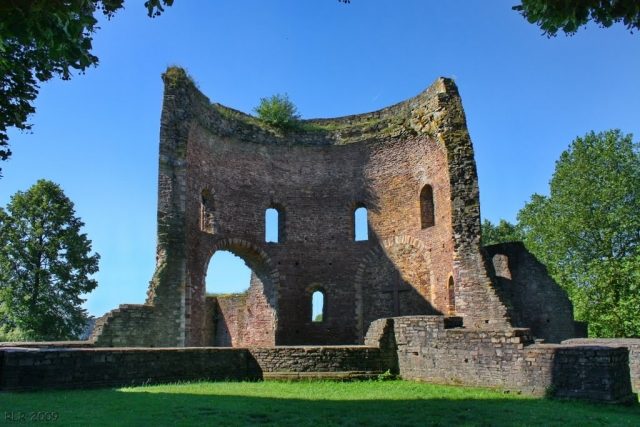
The Krukenburg, along with Sababurg and Trendelburg, belongs to the trio of North Hessian castles in the catchment area of the Reinhardswald forest.
The hilltop castle stands directly north above the village of Helmarshausen, a district of Bad Karlshafen located not far from the northern end of the Reinhardswald. It is situated on the 184.2 m above sea level Waltersberg, which rises about 80 m above a loop of the Diemel river.
The Krukenburg can be reached from Helmarshausen via a side road branching north from the B 83.
Of the three castles mentioned above, it is the one with the oldest history. It is also a special case in terms of architectural history. In the middle of the castle complex stands a church building erected from 1107 onwards, whose floor plan is formed in the shape of a cross around a circular building (rotunda) of over 13 m in diameter. This central building was completed in 1126 and consecrated to John the Baptist by Paderborn Archbishop Heinrich II von Werl, which suggests that numerous baptisms took place here and that an early Christian place of worship existed at this location, possibly long before the founding of Helmarshausen Monastery (997). The building followed the model of the Church of the Holy Sepulchre in Jerusalem. The plans for it are said to have been brought back by one of the first abbots of the monastery, Wino, from a pilgrimage to Jerusalem around 1030 (cf. the Busdorfkirche, Paderborn).
The history of the Krukenburg is closely linked to the history of the town and the monastery of Helmarshausen. Due to disputes between the dioceses of Cologne, Paderborn and Trier, construction of a classic castle complex around the rotunda church and for the protection of the monastery began between 1215 and 1220. The strong walls with towers, a moat, the castle gate and the keep were part of it and are still visibly preserved today. The construction of the fortifications is attributed to the Cologne Archbishop Engelbert I of Cologne. The Diocese of Cologne pledged the castle to Count Hermann von Everstein in 1223. In 1338, the castle was then pledged to the Archdiocese of Paderborn. This built the "Paderborn House" in 1338. Younger buildings included the "Mainz House" (abbot's residence) and a residential tower, which was built between 1401 and 1405. Disputes between the Hessian Landgrave Ludwig II of Hesse and Paderborn led to the conquest of the castle by the former in 1465. The castle came under Hessian protection in 1479. In 1496, Paderborn managed to reacquire part of the castle and appointed an official. Landgrave Moritz of Hesse-Kassel bought back the Paderborn share in 1597. After 1617, the castle gradually fell into disrepair, and large parts were later demolished for material extraction.
Tourism+
The ruins of the Krukenburg were restored in the 1970s and are a popular excursion destination. Today, the keep can be climbed and offers a panoramic view from the top of parts of the North Hessian uplands and the Solling, the old historic town of Helmarshausen and the monastery area, as well as parts of the baroque town foundation of Bad Karlshafen.
Below the castle ruins is the Cafe zur Krukenburg (with photo gallery) and an ensemble of buildings from the early 18th century, the former sheep farm of Bad Karlshafen with over 300 years of tradition in agriculture and sheep breeding. This late baroque farm complex consists of the residential house with its former farmhouse garden and the historic barn building (built 1703, converted into Cafe Schäferscheune in recent years, new design from 2003, awarded the Hessian Heritage Protection Prize 2005).
Take Mobile History with you
You are reading this text for free. Premium adds what matters on the road: descriptions read aloud, sites found through your camera, whole regions taken offline.
- Every description, including the ~17,700 Premium sites
- Audio guide: have descriptions read to you on location
- AR finder: see sites through your camera, with distance and bearing
- Unlimited saved sites
14 days free, then from €2.99 a month. Cancel anytime.
Source: Wikipedia · Licence: CC BY-SA 4.0 · Image: Rainer Gindele
This description draws on the facts documented in the linked Wikipedia article; Wikipedia content is licensed under CC BY-SA 4.0. Wording and editing: Mobile History.
Location: 51.6324, 9.4590