To be privately owned
CastleReith im Alpbachtal-Sankt Gertraudi
Kropfsberg Castle
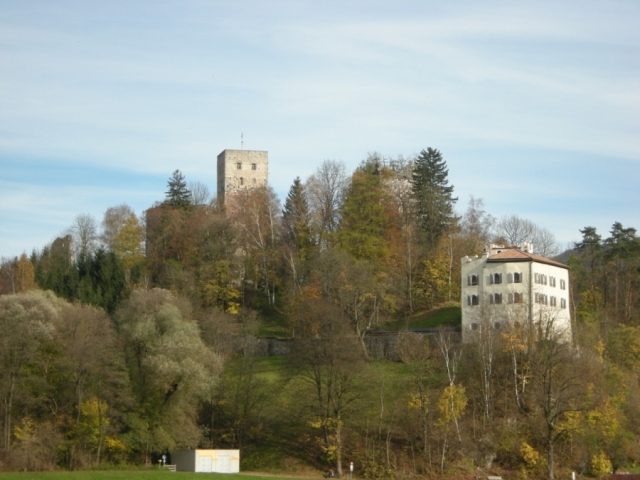
The castle ruin Kropfsberg is located in the municipality of Reith im Alpbachtal on a prominent ridge in the Inn Valley above the village of St. Gertraudi.
The Archbishops of Salzburg received large parts of the Ziller Valley. Under Archbishop Konrad I of Salzburg, the first castle was built in the first half of the 12th century at the entrance to the Ziller Valley. Presumably, it was only a tower surrounded by walls. The castle was used by the archbishops as the seat of the Salzburg court and administration. Kropfsberg was first mentioned in a document in 1286.
Archbishop Eberhard II of Regensburg had the castle further expanded. The castle owes its current appearance to these expansion measures. Above the old tower, the main castle was built, which included two mighty keeps.
In the 15th century, Kropfsberg Castle was the venue for important negotiations. In 1412, a dispute between Tyrol and Bavaria was settled at the "Princely Diet". In 1416, a reconciliation took place there between Duke Frederick IV and his brother Duke Ernst of Austria, which secured Frederick the continued possession of Tyrol.
Over time, Kropfsberg was expanded in Romanesque style twice, but there were no major construction activities in the Gothic period. Archbishop Leonhard von Keutschach had the complex refortified around 1500. 40 years later, the 900 m long, 8 m high, and 3 m thick curtain wall with loopholes and the semicircular bastions were built.
In the following century, Kropfsberg was one of the largest castles in Tyrol. It was protected by a double curtain wall. This expansion was intended to further emphasize the princely power and strength. The area extended to 26,000 m², but it only had accommodation for 60 to 80 people.
In 1592, the court seat was moved from Kropfsberg to Zell am Ziller, which led to the decline of the castle complex. Due to the fact that the castle was only inhabited by people and no longer maintained, the first buildings collapsed as early as 1673. During the "Bavarian Tumult" in 1703, the castle was involved in the fighting, as Bavarian soldiers had entrenched themselves there. However, the Tyrolean riflemen drove out the intruders.
When Tyrol became part of Bavaria in 1809, the castle complex shared the same fate as many others. The castle, which had by then become a ruin, was auctioned off. In 1850, the gate tower was renovated to make it habitable again. In 1905, the material of the still preserved curtain wall was used for the Inn river regulation.
In 1940, Sepp Auffinger from Merano bought the property. He had the gate tower renovated again. In the last year of the Second World War, the western palace wall collapsed due to bombardment in the vicinity. The castle ruin has been preserved and restored since 1985. Therefore, remnants of the cistern and the Gothic castle chapel are still preserved today. Today, the castle is privately owned by Hanno Vogl-Fernheim.
Castle Ruin+
A prehistoric hilltop settlement with flat ramparts and small terraces was largely destroyed by the superstructures of the medieval castle. The castle, equipped with its three almost equally high towers, is unique in Tyrol. Of the first castle, only the freestanding tower, shifted to the west, remains today. The Romanesque keep, built around a hexagonal courtyard, dates from the second construction, of which only the two keeps still exist. The middle tower only has light slits in the lower area. The residential floors with their large windows and different masonry were added by Archbishop Leonhard. The keep was converted into an observation tower after the Second World War. Furthermore, the ruins of the 16th-century Rupertus Chapel are still present. The 47 m deep cistern is located in the middle of the courtyard. The outer curtain wall, including the bastions, is also partially preserved.
Take Mobile History with you
You are reading this text for free. Premium adds what matters on the road: descriptions read aloud, sites found through your camera, whole regions taken offline.
- Every description, including the ~17,700 Premium sites
- Audio guide: have descriptions read to you on location
- AR finder: see sites through your camera, with distance and bearing
- Unlimited saved sites
14 days free, then from €2.99 a month. Cancel anytime.
Source: Wikipedia · Licence: CC BY-SA 4.0 · Image: http://schloesserrundschau.de/tirol/schloesser/kropfsberg.html
This description draws on the facts documented in the linked Wikipedia article; Wikipedia content is licensed under CC BY-SA 4.0. Wording and editing: Mobile History.
Location: 47.4098, 11.8449