The remains of the Castle can be visited
CastleVoitsberg (Krems)
Krems Castle
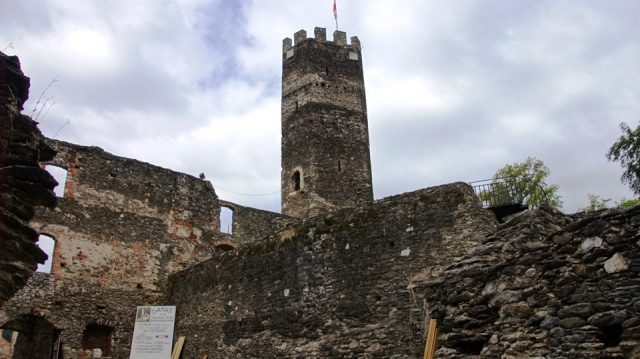
Krems is one of the most significant ruin complexes in Styria. A first modest defensive structure was probably built on its site around the middle of the 12th century, commissioned by the Archbishops of Salzburg.
However, the expansion into a stately castle presumably only took place at the beginning of the 13th century under Otto von Krems-Leonrode. In 1278, it is referred to as castrum Chremse. The northern part of the castle area was a fief of the Archbishopric of Salzburg, while the southern part was a free allodial property. In 1160, a Wulfing von Krems appears in documents. Wulfing's son Otto died in 1234 without descendants. His widow married Hartnit von Rabenstein. He had Krems administered by his ministeriales, who named themselves after the castle.
Around 1300, Krems came into the possession of the Wallsee family, who appointed burgraves. Eberhard von Wallsee sold the castle in 1363 to Leutold von Stadeck. When his family died out, the castle passed to the Counts of Montfort in 1400 through marriage. They also commissioned administrators to manage Krems. In 1589, Sigmund Friedrich Freiherr von Herberstein acquired the castle and lordship. His son Otto Heinrich chose Krems as his residence. He had it converted into a palace and lavishly furnished by 1623. The construction work plunged Otto Heinrich into such debt that he had to sell Krems in 1629 to Max Leymann von Liebenau. Since he and the subsequent buyer in 1634, Salomon Freiherr von Meillegg, lacked the money for payment, Karl Graf Saurau, the then governor of Styria, had the lordship seized. He was subsequently able to acquire it cheaply.
Count Saurau annexed Krems to his lordship of Ligist but no longer took pleasure in the devastated building. It was only inhabited by an administrator. When he also moved to Ligist in 1730, the decay began. In 1817, the southern part of the castle walls slipped, sealing the fate of the palace definitively. With the secularization of the Archbishopric of Salzburg, the feudal rights over the front part of the complex fell to the sovereign in 1805. In 1840, Archduke Johann acquired a part of the lordship and in 1857 also the ruin. Through his heir Franz Graf Meran, Krems passed to the Vordernberg-Köflacher Montan Industrie Gesellschaft in 1869. The castle ruin was bought around 1880 by the cellulose manufacturer Klusemann. The Steiermärkisch-Salzburgische Holzwerke AG, which subsequently acquired it, was not interested in the old masonry but in the timber reserves.
In 1936, a local castle association began securing and making accessible the already largely decayed complex. The ruin has been owned by the association "Licht im Leben" under chairman OSR Alois Volgger since 1988. Since 1993, a castle association has been striving to preserve this significant defensive structure.
Take Mobile History with you
You are reading this text for free. Premium adds what matters on the road: descriptions read aloud, sites found through your camera, whole regions taken offline.
- Every description, including the ~17,700 Premium sites
- Audio guide: have descriptions read to you on location
- AR finder: see sites through your camera, with distance and bearing
- Unlimited saved sites
14 days free, then from €2.99 a month. Cancel anytime.
Source: Wikipedia · Licence: CC BY-SA 4.0 · Image: http://www.wehrbauten.at
This description draws on the facts documented in the linked Wikipedia article; Wikipedia content is licensed under CC BY-SA 4.0. Wording and editing: Mobile History.
Location: 47.0307, 15.1820