The remains of the Castle can be visited
CastleKönigstein im Taunus
Königstein Castle
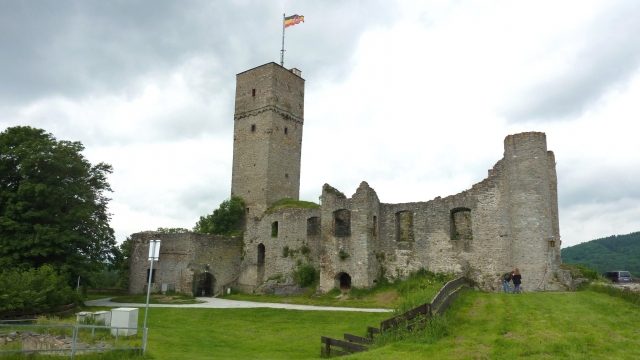
Königstein Castle belongs to the Hessian town of Königstein im Taunus in the Hochtaunuskreis and is its landmark. It is one of the largest castle ruins in Germany.
The ruin of the hilltop castle is located at 506 m above sea level on the western edge of Königstein's old town. The northern and western slopes of the castle hill are forested, with undeveloped landscapes extending further to the west.
Neighboring castle ruins include Falkenstein to the northeast, approximately 1.5 kilometers as the crow flies, and Kronberg Castle to the southeast, approximately 4 kilometers as the crow flies.
Founding Legend
According to legend, King Clovis (4th/5th century) passed by the present-day castle hill and a maiden appeared to him, urging him to become a Christian. After he did so, he founded a castle there, although nothing is documented about it.
Middle Ages and Early Modern Period
The oldest remains of buildings excavated on the castle hill date from the 10th or 11th century. The oldest parts of the core castle, the so-called herringbone masonry, were dated to the first half of the 12th century, among other methods, using the C-14 method. The extent of construction activity under the Staufer emperors was probably relatively small. The castle served, especially from the beginning of the 14th century, to protect the important trade route between Frankfurt and Cologne. The Counts of Nürings (extinct in 1172) are considered as builders, whose successor as feudal tenant, Kuno I von Münzenberg, probably only initiated less significant construction measures. Only after the end of the Staufer period did the castle undergo energetic expansion under the Falkensteins. The lower floors of the keep date from the first decades of the 14th century. It was raised several times over time and now has a height of 34 meters.
Over the centuries, the castle was extensively rebuilt and expanded. In addition to adapting to evolving defensive technology, its development into a Renaissance residential palace for the County of Königstein was also pushed forward. In the 16th century, Counts Eberhard IV von Eppstein and Ludwig zu Stolberg not only erected the three mighty roundels on the eastern flank but also the show facade on the eastern side of the core castle.
With the extinction of the count's family, the castle fell to the Electorate of Mainz in 1581, which only used it militarily. Archbishop Johann Philipp von Schönborn initiated the last major expansion phase between 1660 and 1670, including the angular bastions on the south side.
Revolutionary Wars
In the First Coalition War, on October 21, 1792, the French army under Custine captured Mainz and a few days later Königstein. After the recapture of Frankfurt on December 2 by Prussian troops, part of the French forces retreated to Königstein Fortress, closely pursued by the Prussians under the command of General Friedrich Ludwig zu Hohenlohe. Hohenlohe occupied Oberursel, Falkenstein Castle, the town of Königstein, and on December 6, began shelling the fortress from Falkenstein. On December 8, a fire broke out in the town due to bombs thrown in (their origin remains unclear), destroying 80% of the houses. Since the fortress did not surrender even after shelling, it was besieged. On March 8, 1793, the garrison finally surrendered. The 421 men and 14 officers were taken to Ehrenbreitstein Fortress.
In 1793, Mainz Clubists, actual or supposed supporters of the Mainz Republic, were imprisoned in the castle's cellars, among them Caroline Böhmer, later the "Romantic muse" Caroline Schelling. She wrote about the Clubists' prison conditions:
- They speak of formalities, they presuppose accusation, defense, investigation - where did such a thing take place? Robber formalities are practiced on us - and they do not do well in German zeal to exclusively attribute the robber's trade to one nation. At least they should not tell me, who saw 160 prisoners who went through German hands, were plundered, beaten to death, and despite the fact that very few of them had actually adhered to the Franks [i.e., the French], now had to curse German magnanimity. Königstein forms zealous sons of freedom - everything that stirs with strength in these arms rebels against this procedure.
In the further course of the Coalition War, the castle was significantly damaged in 1796, mainly by a failed attempt at demolition.
Current State
However, the current degree of destruction is largely due to the Königstein population, who obtained building materials here for numerous houses in today's old town. The Duke of Nassau, to whom the castle fell after the Reichsdeputationshauptschluss, refrained from rebuilding and tolerated the continuation of the demolition for another twenty years. Johann Heinrich Liebeskind seems to have expressed a general view in his report on the siege of 1793 when he wrote in 1795:
- If I were the owner of this fortress, I would give the order today to demolish it and give the stones to my unfortunate Königstein subjects for the reconstruction of their buried houses.
While the sovereignty over Königstein passed to Prussia in 1866, the castle remained the private property of Duke Adolph, later Grand Duke of Luxembourg, who built his own small castle (today Königstein District Court) at the foot of the mountain (southeast corner). His daughter, Hilda von Nassau, donated the fortress ruin to the city of Königstein in 1922.
Current Use+
The castle, which is now owned by the city of Königstein, is open to visitors all year round. Both the castle tower and most of the cellars are accessible. Several larger events take place here in the summer months - mostly outdoors. One of the still preserved vaulted cellars (the so-called Zeughauskeller) can also be rented for private events.
The castle is integrated into the 3-Castle Trail Königstein - Falkenstein - Kronberg, created in 2013 by the Taunusklub e.V.
In Königstein's old town, there is a castle museum with finds and a model of the castle.
Events+
Larger and regular events at the castle, everything included?! Musical gathering of the Bund der Pfadfinderinnen und Pfadfinder (Association of Girl Guides and Boy Scouts) Rock auf der Burg (Rock at the Castle) Open-air festival with up-and-coming bands from the region Knight tournament with medieval market Knight tournament, medieval camp life and medieval market Castle festival Historical parade, program in the club cellars at the castle ruin Theater at the Castle Various, partly historical, plays
Take Mobile History with you
You are reading this text for free. Premium adds what matters on the road: descriptions read aloud, sites found through your camera, whole regions taken offline.
- Every description, including the ~17,700 Premium sites
- Audio guide: have descriptions read to you on location
- AR finder: see sites through your camera, with distance and bearing
- Unlimited saved sites
14 days free, then from €2.99 a month. Cancel anytime.
Source: Wikipedia · Licence: CC BY-SA 4.0 · Image: Joachim Schneeleopard
This description draws on the facts documented in the linked Wikipedia article; Wikipedia content is licensed under CC BY-SA 4.0. Wording and editing: Mobile History.
Location: 50.1825, 8.4608