To be privately owned
CastleKienburg
Kienburg Castle
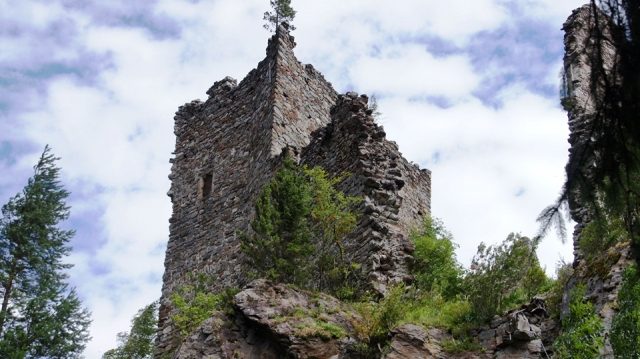
The castle is first mentioned in a document around 1184, in which a Chuno de Chienburch appears. Kuno was probably a vassal of the Counts of Lechsgemünd, who owned property around Matrei and had granted him Kienburg as a fief. The construction of the castle likely took place in the second half of the 12th century.
The small castle had no representative functions but was strategically very valuable. This important position gained great significance in the 13th century during the conflicts between the Counts of Görz and the Archdiocese of Salzburg. In the Peace of Lieserhofen, agreed upon in 1252, it was stipulated that Kienburg, which then belonged to Otto and Weriand of Matrei, would come under the suzerainty of Salzburg. However, the fighting soon flared up again. It was not until 1285 that Ulrich and Heinrich renounced their alleged ownership rights. In 1292, Count Albert of Görz also gave up his claims. Salzburg usually had the castle administered by burgraves, including Pilgrim of Matrei (1338) and Jakob of Rotenstein (1379).
When, at the beginning of the 15th century, the burgraves of Lienz acted as financiers for the Archbishops of Salzburg, Kienburg was handed over to them as a pledge in 1404. Hugo, Burgrave of Lienz, did not want to return it and had to be forced to do so by a court ruling in 1439. Afterwards, it was again administered by appointed stewards of Salzburg. The last burgrave, Christof von Kienburg, moved out of the building in 1513.
In the 16th century, Kienburg and its associated estate were leased out and managed by a tenant farmer. The latter was the only permanent resident of the castle. In 1579, a devastating fire occurred, destroying practically all wooden structures. Afterwards, only the stone residential tower in the west was hastily repaired to secure a dwelling for the tenant farmer. By around 1660, the damage to the buildings and walls was already so severe that a new house with farm buildings was erected for the tenant farmer below the castle, and Kienburg was left to further decay. By 1769, parts had already collapsed.
In 1825, Peter Berger acquired the estate and thus also the ruin from the Austrian state, which had taken over its landholdings after the secularization of the archdiocese in 1803. During the Second World War, an indiscriminately dropped American aerial bomb fell directly into the high medieval residential wing, causing severe damage. Since 1998, conservation work and archaeological excavations have been taking place under the supervision of the Federal Monuments Office. The ruin has belonged to the Stocker family since 1936.
Take Mobile History with you
You are reading this text for free. Premium adds what matters on the road: descriptions read aloud, sites found through your camera, whole regions taken offline.
- Every description, including the ~17,700 Premium sites
- Audio guide: have descriptions read to you on location
- AR finder: see sites through your camera, with distance and bearing
- Unlimited saved sites
14 days free, then from €2.99 a month. Cancel anytime.
Source: Wikipedia · Licence: CC BY-SA 4.0 · Image: http://www.wehrbauten.at
This description draws on the facts documented in the linked Wikipedia article; Wikipedia content is licensed under CC BY-SA 4.0. Wording and editing: Mobile History.
Location: 46.9191, 12.6001