The remains of the Castle can be visited
CastleKelbra
Kelbra Castle
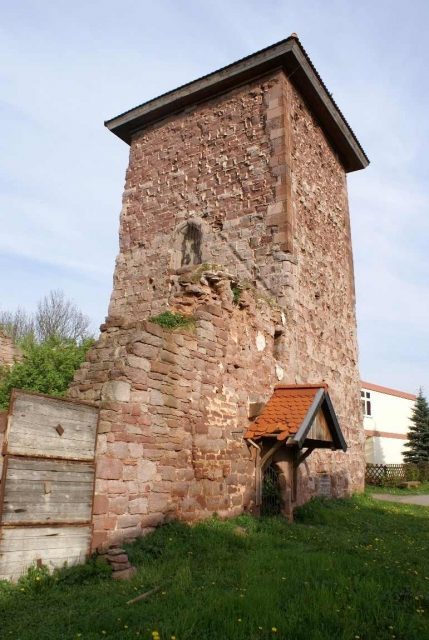
Kelbra Castle was built around 1200 on the northeastern edge of Kelbra and near a floodplain crossing to protect the Helme crossing.
Originally designed as a moated castle, Kelbra Castle consisted of a main castle and an outer bailey. From the almost round main castle, the square keep and the remains of the formerly two-story palas, which adjoins it to the north, are preserved. The chapel, documented in 1476, is completely destroyed. On the north side of the main castle, remnants of the ring wall are still preserved, suggesting a later integration of the castle into the city fortifications of Kelbra. South of the main castle was the spacious outer bailey, which included the area of today's Marktstraße, Lange Straße up to Ziegelhüttenstraße and was completely built over. The builders of Kelbra Castle were the Counts of Rothenburg, who had ruled the surrounding area since about 1100. After the extinction of the Rothenburg line, the castle and lordship of Kelbra also passed to the House of the Counts of Beichlingen in 1209 through the marriage of a Rothenburg heiress. Under the Beichlingen Counts, the castle was further expanded. They also obtained the right to hold markets under the protection of the castle, the right to mint coins (1251) and the town charter granted by the imperial power around 1271.
In 1348, the castle was sold to the Counts of Hohnstein, who resided there themselves from 1394. In 1412, Heinrich von Hohnstein ceded the castle and town to the Margraves of Meissen. These in turn gave them in 1413 and 1417 in equal parts as fiefs to the Counts of Stolberg and Schwarzburg. During the Peasants' War, Kelbra Castle was destroyed and has been a ruin ever since.
In 1561, a fierce dispute erupted over the position of the comital houses of Schwarzburg and Stolberg in relation to Electoral Saxony, whose Elector still exercised feudal sovereignty. In 1568, a settlement was reached between the Stolberg Count and the Saxon Elector, but not with the Schwarzburgs. The concessions subsequently granted to the Schwarzburgs led to them having sole disposal over the castle and town of Kelbra from 1592, but Electoral Saxony retained sovereign rights. The Saxon King Friedrich August had to cede these to Prussia in the aftermath of the Congress of Vienna in 1815.
Take Mobile History with you
You are reading this text for free. Premium adds what matters on the road: descriptions read aloud, sites found through your camera, whole regions taken offline.
- Every description, including the ~17,700 Premium sites
- Audio guide: have descriptions read to you on location
- AR finder: see sites through your camera, with distance and bearing
- Unlimited saved sites
14 days free, then from €2.99 a month. Cancel anytime.
Source: Wikipedia · Licence: CC BY-SA 4.0 · Image: Roland Neubert, Halle (Saale)
This description draws on the facts documented in the linked Wikipedia article; Wikipedia content is licensed under CC BY-SA 4.0. Wording and editing: Mobile History.
Location: 51.4377, 11.0414