Restaurant
CastleBad Kreuznach
Kauzenburg Castle
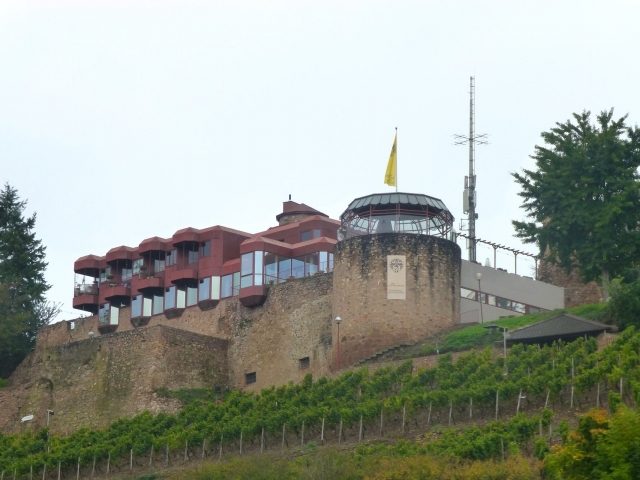
The Kauzenburg is the ruin of a hilltop castle in Bad Kreuznach in the district of Bad Kreuznach in Rhineland-Palatinate.
The Kauzenburg was the residence of the anterior County of Sponheim. The castle was first mentioned in a document in 1206, in which King Philip of Swabia forbade the construction of a castle. From 1206 to 1230, a first castle complex was built by Counts Gottfried III. († 1218) and Johann I of Sponheim († 1266).
In 1417, the castle was divided between the Sponheim counts and the Elector and Count Palatine Ludwig III. In 1437, another division followed under the Heidelberg Count Palatine Ludwig IV, Friedrich III of Veldenz, and the Margrave of Baden. In 1444, Stefan of Palatinate-Simmern-Zweibrücken followed as heir to the Veldenz share. In the Palatinate War between 1450 and 1470, the Margrave lost his share. Elector Philipp expanded the castle. In 1503, Baden became a co-owner again.
In 1620, the Spanish Marquis Spinola conquered Kreuznach and the castle, which he fortified until 1632. In 1632, during the Thirty Years' War, the Swedish king conquered the castle. In 1635, the imperial troops took over the city and the castle. In 1639, the French under General Duc de Longeville recaptured the castle, and in 1641, the Imperials under Gil de Haes took over the fortress.
After the Peace of Westphalia, the castle fell to Baden and the Palatinate. For the first time, the castle was referred to as "Veste Kauzenburg". The French under General Bouffleur conquered the castle in 1688, blew it up, and burned down the building.
Private Sector Use+
In 1803, Andreas van Recum (later ennobled as Freiherr von Recum) acquired the ruin on the Kauzenberg. It thus fell to the Bangert manor. Large vaults and cellars were later found and cleared out in the foundations of the destroyed castle. These were probably intended for weapons depots but then served to store the well-known Schloss Kanzenburger wine.
It remained in the family's possession until 1881 and last belonged to Otto von Recum, then passed to the Kreuznach families Puricelli and Gräff. It was in the possession of the widow Werren when, in 1969, the wine merchant Elmar Pieroth, Burg Layen, acquired the property and the Kauzenburg.
Pieroth wanted to give new impetus to the region's tourism and, in 1970, had the building fabric that had developed in previous years removed. Architect Gottfried Böhm (*1920) was commissioned for the new construction in 1970 and 1971. Architect Gottfried Böhm is the Pritzker Architecture Prize laureate of 1986.
The architect crowned the still visible masonry of the Kauzenburg ruin with cubist bay windows. He used plenty of glass, metal, and the color wine red.
The Kauzenburg Foundation, responsible for the historically valuable castle cellars' use in a historically meaningful way, and the Kauzenburg Betriebsgesellschaft (later Kauzenburg Gaststätten GmbH), responsible for operating restaurants and hotels, took over the property.
The gastronomic program includes the "Great Feast at the Knight's Table". Today, the property is managed by Kauzenburg Gaststätten GmbH.
Take Mobile History with you
You are reading this text for free. Premium adds what matters on the road: descriptions read aloud, sites found through your camera, whole regions taken offline.
- Every description, including the ~17,700 Premium sites
- Audio guide: have descriptions read to you on location
- AR finder: see sites through your camera, with distance and bearing
- Unlimited saved sites
14 days free, then from €2.99 a month. Cancel anytime.
Source: Wikipedia · Licence: CC BY-SA 4.0 · Image: Edgar Leyendecker
This description draws on the facts documented in the linked Wikipedia article; Wikipedia content is licensed under CC BY-SA 4.0. Wording and editing: Mobile History.
Location: 49.8446, 7.8547