The remains of the Castle can be visited
CastleFrojach-Katsch
Katsch Castle
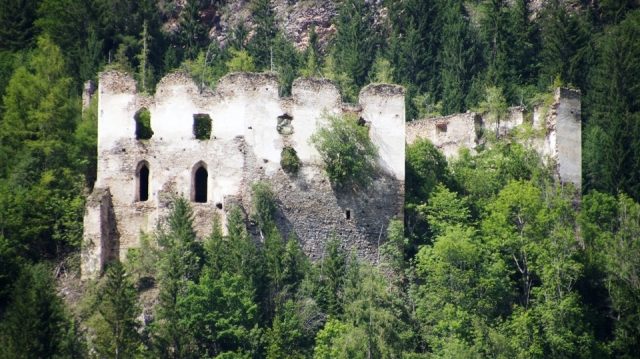
Towards the end of the 11th century, the Bishop of Freising had Katsch Castle built and enfeoffed it to the Lords of Pris. They appointed ministeriales as administrators, who named themselves after Katsch. Dietrich von Katsch is mentioned as the first in the second quarter of the 12th century.
After Heinrich von Pris died in 1207, Freising granted the lordship to the Stubenbergers, who had it administered by burgraves. They also named themselves after Katsch. In 1269, Wulfing von Stubenberg was forced to surrender the castle to King Ottokar II, who subsequently had it demolished. However, the Stubenbergers soon regained Katsch and had the damage repaired. Friedrich von Stubenberg was a leading participant in the Styrian noble uprising against Duke Albrecht I.
After the defeat, the castle was confiscated by the sovereign in 1292, but was returned to the Stubenbergers the very next year. In 1319, Wulfing von Goldeck inherited the lordship. His son Otto sold it back to the Stubenbergers in 1340. Around 1420, the Stubenberg family had the castle expanded and, above all, the fortifications improved. Hans von Stubenberg sold Katsch in 1462 to his father-in-law Andreas Baumkircher. However, the latter lost it in the Baumkircher Feud to Emperor Friedrich III. The Emperor initially handed over the lordship to St. Lambrecht Abbey for administration. The administrator Andree Gibinger was able to repel several attacks by the Hungarians in 1480.
In 1501, Emperor Maximilian I pledged the lordship to Jakob von Windischgrätz. The feudal rights of the Diocese of Freising had by then become obsolete. The Windischgrätz had the castle further expanded and were able to acquire it as a free property in 1575. In the 17th century, the ownership of the already heavily indebted lordship changed hands several times. These included Jakob Hillebrand (1646), Viktor Jakob von Prandegg (1661), and Eva Rosina Countess Steinpeiß (1691). In 1697, Katsch was acquired by purchase by the Princes of Schwarzenberg, who still own it today. In 1818, the castle was still intact, but by 1858 it was already ruinous. At times it had served as a hideout for gangs of thieves and robbers, so it was partially demolished in 1838.
Take Mobile History with you
You are reading this text for free. Premium adds what matters on the road: descriptions read aloud, sites found through your camera, whole regions taken offline.
- Every description, including the ~17,700 Premium sites
- Audio guide: have descriptions read to you on location
- AR finder: see sites through your camera, with distance and bearing
- Unlimited saved sites
14 days free, then from €2.99 a month. Cancel anytime.
Source: Wikipedia · Licence: CC BY-SA 4.0 · Image: http://www.wehrbauten.at
This description draws on the facts documented in the linked Wikipedia article; Wikipedia content is licensed under CC BY-SA 4.0. Wording and editing: Mobile History.
Location: 47.1453, 14.2879