The remains of the Castle can be visited
CastlePelm
Kasselburg Castle
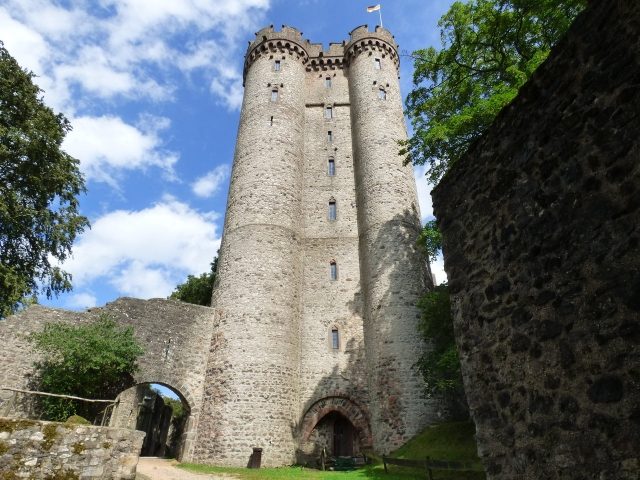
The Kasselburg is the ruin of a hilltop castle on a 490-meter-high basalt rock near the municipality of Pelm, close to Gerolstein in the Vulkaneifel district of Rhineland-Palatinate.
The still-preserved landmark of the Kasselburg today is its 37-meter-high gate and residential tower, designed as a double tower, whose origins are not precisely clear. Previously, it was assumed that the Lords of Blankenheim erected it shortly after 1335, but architectural research has shown that the tower was built in several construction phases and thus cannot be attributed to a single builder. The gate presumably lost its securing function with the expansion of the castle from 1452 onwards. The extensive outer bailey with its burgmann houses and utility buildings dates from that time.
Despite its size, the double tower is not the keep. The latter, built around 1200, is smaller and stands in the eastern part of the core castle. It has a square floor plan and was extended into a residential tower in the 14th century.
Also part of the core castle is the almost 33-meter-long palas, which also dates from the 14th century.
Climbing the gate and residential tower is only advisable for people with either good physical condition or plenty of time, but the view compensates for the strenuous ascent.
Eagle and Wolf Park Kasselburg of the Vulkaneifel District+
The castle is surrounded and permeated by the Eagle and Wolf Park of the Vulkaneifel district, which is also directly responsible for the care of the castle complex. "Permeated" because it contains the cages for the various birds of prey of the park, which have been fitted into the ruins of the core castle. The Kasselburg, like the Eagle and Wolf Park with the exception of the predator enclosures, is accessible to visitors, and a daily feeding of the Timber wolves and on some days a bird of prey flight show takes place.
The castle was built in the 12th century. Its builders were possibly the Lords of Castel, but this is not entirely certain. The castle is first mentioned in a document in 1291 as Castilburg, and in 1314 it is called Castelberch.
Who owned the complex before 1335 is not clear according to the current state of research. However, it is certain that Gerhard V von Blankenheim became its owner in that year as part of an inheritance division, thus founding the Blankenheim-Kasselburg line. Meanwhile elevated to the status of Imperial Count, this line of the Blankenheims died out in 1406 with Count Gerhard VII, and the complex passed by marriage to Wilhelm I von Loen zu Heinsberg.
Further owners followed, such as the Counts of der Mark, the Dukes of Arenberg, and the Electors of Trier. Many interest groups claimed the Kasselburg for themselves over the course of history, so that in 1674 the Imperial Chamber Court in Wetzlar was called upon to end the ownership disputes. When the judges awarded the castle to the Dukes of Arenberg, the buildings served shortly thereafter as barracks for the Ducal Arenberg Artillery. And with that, the decay of the complex began. In the 18th century, it was temporarily still the seat of an Arenberg forester, but already in 1744 it is described as modo, dilapidated.
After France confiscated the castle in 1794, it came into Prussian possession in 1815. An impetus for saving the ruin came unexpectedly in 1838 from King Friedrich Wilhelm IV. After a visit, he suggested restoration work, and after the completion of the Cologne-Trier railway line, the railway company donated 1000 thalers for the development of the already famous double tower, to "offer something" to its passengers.
At the beginning of the 20th century, state monument preservation carried out further restorations. And the state castle administration of Rhineland-Palatinate, which became the owner of the Kasselburg in 1946, also had conservation measures carried out. The complex is now under the care of the organization "Burgen, Schlösser, Altertümer Rheinland-Pfalz" (Castles, Palaces, Antiquities Rhineland-Palatinate), the successor organization to the state castle and palace administration of Rhineland-Palatinate since 1998.
Take Mobile History with you
You are reading this text for free. Premium adds what matters on the road: descriptions read aloud, sites found through your camera, whole regions taken offline.
- Every description, including the ~17,700 Premium sites
- Audio guide: have descriptions read to you on location
- AR finder: see sites through your camera, with distance and bearing
- Unlimited saved sites
14 days free, then from €2.99 a month. Cancel anytime.
Source: Wikipedia · Licence: CC BY-SA 4.0 · Image: http://www.wehrbauten.de/thread.php?threadid=2041
This description draws on the facts documented in the linked Wikipedia article; Wikipedia content is licensed under CC BY-SA 4.0. Wording and editing: Mobile History.
Location: 50.2392, 6.6853