The remains of the Castle can be visited
CastleStadtoldendorf
Homburg Castle
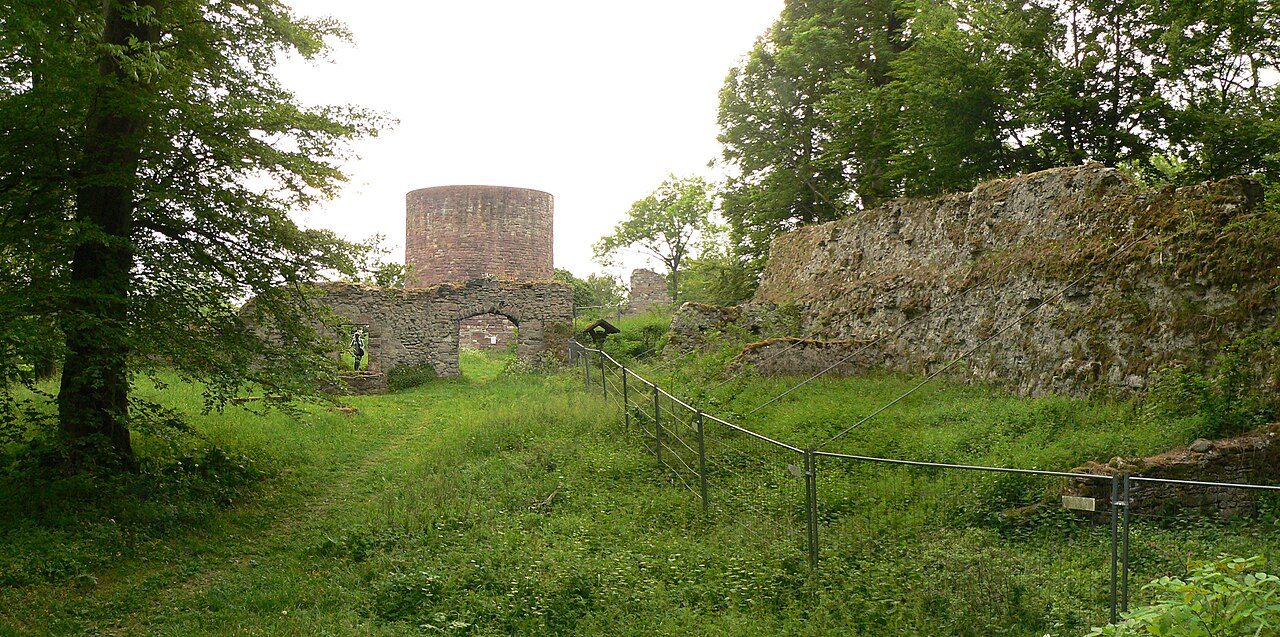
The Homburg is the ruin of a hilltop castle in Stadtoldendorf in the district of Holzminden, Lower Saxony (Germany). The castle stands above or north of Stadtoldendorf in the Homburgwald forest, which is up to 406 m high, on the Großer Homburg.
The castle was a mighty complex with an outer bailey and a small main castle, both parts having their own keep. The entire complex had a length of 100 m with an average width of 30 m. The castle site was probably previously home to the castellum Wikanafeldisten, which is mentioned in a border description of the Diocese of Hildesheim at the end of the 10th century and was named after a Saxon sub-district of the same name.
Siegfried IV von Boyneburg from the House of Northeim had the castle built to protect the Amelungsborn monastery. His complex was in obvious opposition to the castle of the Count of Everstein in Polle. After Siegfried's childless death, the castle and its appurtenances, already comprising around 200 hides, came into the possession of Count Hermann II von Winzenburg in 1145 through purchase. However, Hermann II was forced to enfeoff the Homburg to the Diocese of Hildesheim in 1150 as atonement for a murder committed by his father. In 1150, the associated village of Oldendorp, later Stadtoldendorf, is also mentioned in a document. In 1152, after the murder of Count Hermann II, Duke Henry the Lion of Saxony and Bavaria took possession of it, exercising the Northeim hereditary claims inherited from his mother Gertrud von Süpplingenburg. After Henry the Lion was outlawed in 1180, the Homburg again fell to the Prince-Bishopric of Hildesheim.
In 1183, Bishop Adelog of Hildesheim enfeoffed Bodo von Homburg (Bodo the Elder) with one half of the castle. The second half was granted to the Counts of Dassel as a fief. This division also manifested itself structurally, as airborne laser scanning investigations show. Each half contained a round castle tower. From about 1247, the castle was undivided as a pledge in the hands of the noble lords of Homburg, who had been associated with it as a kind of fortress commanders since the time of Siegfried IV. Feudal lords of the bishops had begun in the late 13th century, in league with the resurgent principality of the Welfs, to systematically expand their influence against the bishops and against the Counts of Everstein in all directions. The castle was the ancestral seat of the noble lords of Homburg until they died out in 1409. In 1255, the noble lords granted Oldendorf town rights as territorial lords, which led to its renaming to the present-day Stadtoldendorf.
From 1409, the noble lords of Homburg left the Welfs a prosperous and vital territory after hereditary purchase and through the marriage of the last Homburger's widow to Duke Otto von Grubenhagen (1415), comprising 6 castles, 3 towns, and about 200 villages. Since the division of 1428, the Homburg remained continuously in Brunswick-Lüneburg possession and served as a princely administrative seat, primarily for administrative and residential purposes. The last bailiff, Wilken Klenke, left the Homburg in 1535, and due to its remote and difficult-to-access location, the castle was dismantled. From its stone material (curbstones, masonry stones from the locally occurring sandstone), the former farmstead of Wickensen was converted into an administrative seat.
In 1897, the ruin was largely excavated by members of the Solling branch associations and subsequently developed into a regionally popular excursion destination. Several state funds were raised to uncover the foundations with a footprint of 103 meters in length and 30 meters in width. Remains of a gate tower with a diameter of 9.9 meters were also discovered. In 1936, the remains of the castle, especially the round keep, were restored by the Reich Labour Service. In addition, a 202-meter-long conveyor belt was built to re-erect the walls of the castle ruin. However, in 2009, the keep had to be closed again due to the risk of collapse. Some of the objects found during the excavations, as well as a historical castle model, can be viewed in the city museum. The newly founded Homburg Ruin Support Association plans to restore the castle ruin and make it accessible. The Homburg is owned by the Braunschweigische Kulturbesitz Foundation.
The Homburg Castle Family
- until 1158 Berthold was the first enfeoffed lord of the Homburg.
- until 1195 Bodo the Elder, Bodo and his brother Berthold only received half of the castle as a fief.
- until 1228 Bodo the Younger, was murdered by Count Everstein.
- until 1289 Heinrich, granted Stadtoldendorf town rights in 1255.
- until 1303 Bodo, the name of the city Bodenwerder refers to this noble lord.
- until 1338 Heinrich
- until 1380 Siegfried, one of his daughters married Count Otto von Everstein in 1339.
- until 1409 Heinrich, died without heirs, thus the Homburg family died out.
Take Mobile History with you
You are reading this text for free. Premium adds what matters on the road: descriptions read aloud, sites found through your camera, whole regions taken offline.
- Every description, including the ~17,700 Premium sites
- Audio guide: have descriptions read to you on location
- AR finder: see sites through your camera, with distance and bearing
- Unlimited saved sites
14 days free, then from €2.99 a month. Cancel anytime.
Source: Wikipedia · Licence: CC BY-SA 4.0 · Image: Axel Hindemith / CC BY-SA 3.0 via Wikimedia Commons
This description draws on the facts documented in the linked Wikipedia article; Wikipedia content is licensed under CC BY-SA 4.0. Wording and editing: Mobile History.
Location: 51.9016, 9.6426