The remains of the Castle can be visited
CastleEngen-Anselfingen
Hohenhewen Castle
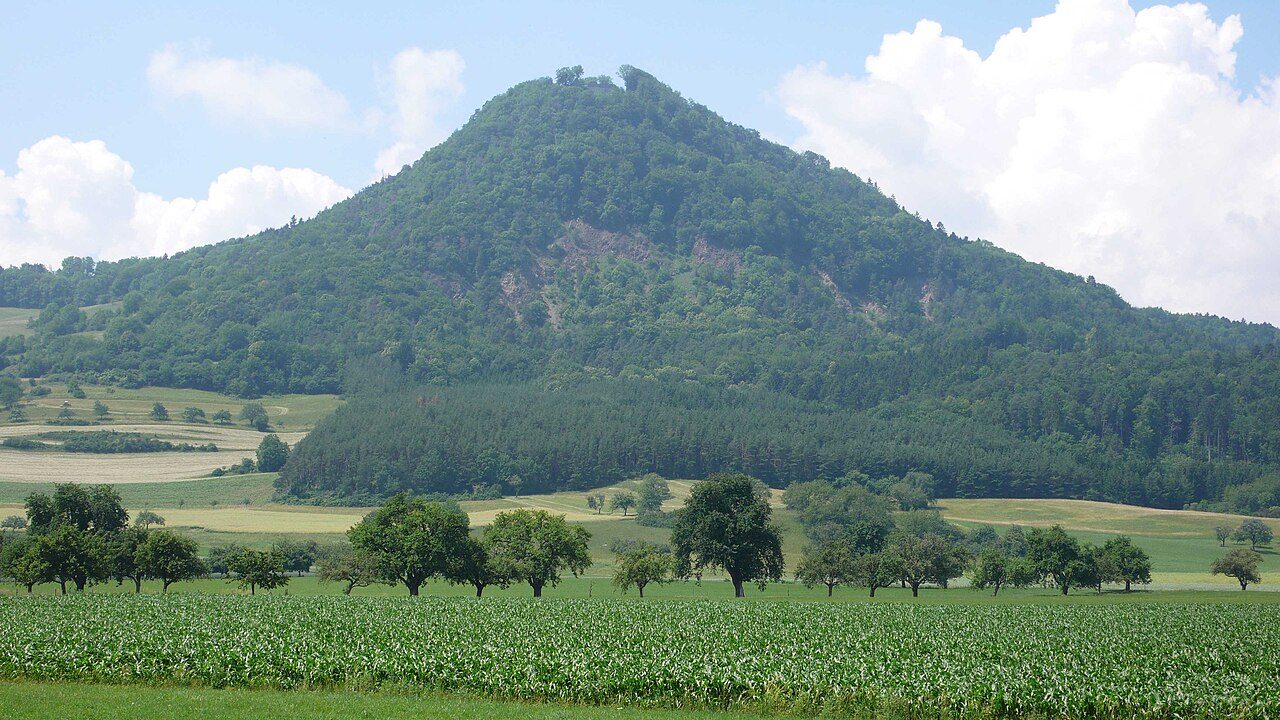
The Hohenhewen ruin, also Hohenhöwen, is a high medieval castle ruin in the southwest of Anselfingen, a district of Engen in the Konstanz district in Baden-Württemberg, Germany. The ruin of the hilltop castle stands on the wooded summit of the 844-meter-high Hohenhewen mountain, a basalt cone that characterizes the landscape of the Hegau. The cone, which rises 300 meters above its immediate surroundings, is steep on its sides. A cross on the south side on the steeply rising path to the castle ruin commemorates the local historian and pastor Josef Hoh, who died in an accident. The ascent from the Anselfingen hiking car park to the ruin takes about 45 minutes.
Today, in good weather, a magnificent panoramic view of the Hegau landscape with its volcanic mountains, Lake Constance, the Black Forest, the Baar, the Vosges and the Swiss Alps is offered from a viewing platform on the highest battlements, accessible via a spiral staircase.
In 1050, the Lords of Engen-Hewen were first mentioned in a document by the Count of Nellenburg.
Presumably at the beginning of the 12th century, at the latest in 1170, the castle on the Hewen was built by the Lords of Engen. A Walter von Hewen is known from 1152; he was one of the former Lords of Engen who first named himself after the new residence. In 1189, the castle was named Hewin or Hewen.
From the 13th century, Engen was the residential town of the Lords of Hewen, whose dominion included Engen Castle, Neuhewen Castle (Stettener Schlössle), Hewenegg (Junghewen), Boll Castle, Tudoburg and Wildenstein Castle in the Danube Valley.
In 1291, the castle was enfeoffed to the Duchy of Austria and in 1398 came from the heavily indebted brothers Peter and Wölflin von Hewen as a pledge to Habsburg.
In 1404, the dominion came from the Habsburgs as a pledge into the possession of the Counts of Lupfen-Stühlingen and around 1415 became an imperial fief. Ultimately, they received it entirely in exchange for the dominion of Tyrol. With them, the Hohenhewen became a notorious robber baron's nest. In 1441, the Counts of Lupfen-Stühlingen attacked Ulm merchants. The Swabian League of Cities, a military alliance of several imperial cities, therefore sought revenge, and during the War of the Cities, the castle was besieged; however, the capture of Hohenhewen failed.
The second siege during the Swiss War in 1499 by the Swiss also remained unsuccessful.
During the German Peasants' War of 1524/25, the castle was also not conquered. In 1570, the Hewen family died out. Today, the name is still occasionally found in Thurgau.
In 1582, with the end of the Engen-Lupfen family, the castle fell as a pledge to Count Conrad von Pappenheim, one of the hereditary marshals of Pappenheim.
In 1639, during the Thirty Years' War, Bavarian mercenaries besieged and destroyed the castle. In the same year, it passed into the possession of the Lords of Fürstenberg through marriage. A reconstruction was not considered by them, and so the ruin was left to decay.
On May 3, 1800, Austrians entrenched in the ruin were driven out by French troops.
In 1937, the ruin was excavated by the Schwarzwaldverein Engen e. V. and between 1957 and 1959 sold by the Fürstenbergs to the state of Baden-Württemberg. In 1963, a TV repeater was erected in the northern part of the main castle.
Since 1999, the Hohenhewen working group has been involved in the care and preservation of the ruin.
Layout+
How the once mighty complex of Hohenhewen Castle, with its size of 250 x 60 meters, looked in its entirety is difficult to reconstruct, as only remnants of its walls remain.
The main castle, which has an elongated, polygonal to oval floor plan, probably consisted of a large residential building on the north side and a tower on the south side. The south and west sides were enclosed by a late medieval curtain wall, while on the east side, the steeply sloping hillside offered sufficient protection. Parts of the castle gate, the outer bailey, foundation walls of the servants' quarters, and a wall of the residential tower, which today serves as a viewing platform, are preserved. Only minor remains of the chapel are still visible.
The complex includes the so-called Hewenhof, a freestanding farmstead about halfway up the Hohenhewen. It was also owned by the Princes of Fürstenberg until 1959.
Two barbecue areas with seating have been set up in the main castle for day-trippers.
Take Mobile History with you
You are reading this text for free. Premium adds what matters on the road: descriptions read aloud, sites found through your camera, whole regions taken offline.
- Every description, including the ~17,700 Premium sites
- Audio guide: have descriptions read to you on location
- AR finder: see sites through your camera, with distance and bearing
- Unlimited saved sites
14 days free, then from €2.99 a month. Cancel anytime.
Source: Wikipedia · Licence: CC BY-SA 4.0 · Image: Prekario / CC BY-SA 3.0 via Wikimedia Commons
This description draws on the facts documented in the linked Wikipedia article; Wikipedia content is licensed under CC BY-SA 4.0. Wording and editing: Mobile History.
Location: 47.8358, 8.7478