The remains of the Castle can be visited
CastleImsbach
Hohenfels Castle
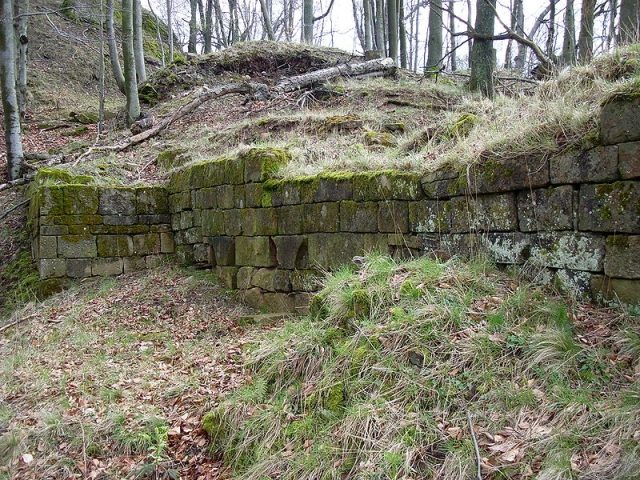
Hohenfels Castle is the ruin of a hilltop castle at 540 m above sea level, in the "Beutelfels" nature reserve north of the municipality of Imsbach in the Donnersberg district in Rhineland-Palatinate. The castle can be reached via a steep path from the "Weiße Grube" visitor mine located in the Langental, past the Iron Man monument.
There are several indications that the old Rockenhausen road, mentioned in records, which came from the Hahnweilerhof area and continued past Hohenfels Castle in the direction of Falkenstein, Rockenhausen to Bad Kreuznach, has existed since Roman times. In 1820, a Roman treasure with 28 coins, dated to around 340 AD, was found in the castle area. Since there are also indications of Roman mining in the lower Langental, it is plausible to assume that a Roman mountain fortress or road station, as was common in late Roman times, was located in the area around Hohenfels Castle.
The statement that Werner von Bolanden and his wife Guda von Hohenfels were mentioned in 1128 and that Guda is believed to be the last member of an old Hohenfels family cannot be proven by documents. Although a Werner von Bolanden is mentioned by name for the first time in a document in this year, his wife is not known by name. However, it is a fact that in the "Bohlander Feudal Books" from the 12th century, the brothers Werner and Philipp von Bolanden were mentioned as feudal lords of a castle, which the former Prüm abbot Caesarius von Milendonk described in 1222 in his commentary on the Prüm Urbar as lat: bonum castrum quod Hoviles appelatur (the Imsbach mining district belonged to the Prüm Abbey Eifel since the 9th century), and that the Bolander family divided into the "Bolanden", "Falkenstein" and "Hohenfels" lines in the first decades of the 13th century. Thereafter, Philipp III von Bolanden-Hohenfels was the owner of the castle until 1277; he was Imperial Chamberlain and "Procurator on the Middle Rhine". His sons Philipp III jun. called von Isenburg and Dietrich von Hohenfels shared the castle as inheritance until 1290. The subsequent owners, the brothers Hermann II the Elder and Werner von Hohenfels, were in a feud with the imperial city of Speyer in 1333, among other things.
According to a document dated July 11, 1287, the Templar Provincial Master Wildgraf Friedrich, as well as the Commander of the Templar Commandery Kirchheim an der Weinstraße, Heinrich von Hohenfels, together with his fellow brothers, sold shares of their estates in the district of the village of Laumersheim to the St. Martin's Abbey in Worms.
Hohenfels Castle was destroyed after a long and extensive siege by Count Walram von Sponheim, Heinrich von Veldenz, and the cities of Speyer and Worms in the spring of 1351, who had allied on October 1, 1350, due to the Hohenfels' brigandage. Thereafter, the castle was, by contractual agreement, not rebuilt. The remains were sold in half to Palatine Count Ruprecht I in 1355, the other half remained in the possession of Hermann III von Hohenfels, the second son of Hermann II. He sold his share in 1386 to Raugraf Philipp II zu Alten- und Neuenbaumburg. Ten years later, Raugraf Philipp II sold his half to Elector Ruprecht II of the Palatinate. The castle ruin came into the complete possession of Palatine Count Johann II von Simmern in 1531. Six years later, the castle stable was exchanged for the County of Falkenstein.
Excavations
During excavations in 1932/33 by the Speyer museum director Dr. Friedrich Sprater, a large number of stone sling balls from this period were found, which were stored in the castle area until the 1960s and gradually disappeared. Today, one or two of the balls can be admired on various private walls in Imsbach. Sprater also found cornice stones, a Romanesque capital, saddle stones, bossed ashlar, ashlar with marginal drafting, weapon parts, and various floor and fireplace tiles, some of which are exhibited in the Historical Museum of the Palatinate in Speyer. The discovery of a sandstone ball indicates a smaller stone cannon that was used during the siege. This is considered one of the earliest pieces of evidence for the use of such a weapon for besieging a castle in Germany.
Take Mobile History with you
You are reading this text for free. Premium adds what matters on the road: descriptions read aloud, sites found through your camera, whole regions taken offline.
- Every description, including the ~17,700 Premium sites
- Audio guide: have descriptions read to you on location
- AR finder: see sites through your camera, with distance and bearing
- Unlimited saved sites
14 days free, then from €2.99 a month. Cancel anytime.
Source: Wikipedia · Licence: CC BY-SA 4.0 · Image: http://de.wikipedia.org/wiki/Datei:Hohenfels3.JPG
This description draws on the facts documented in the linked Wikipedia article; Wikipedia content is licensed under CC BY-SA 4.0. Wording and editing: Mobile History.
Location: 49.6009, 7.8962