The remains of the Castle can be visited
CastleAchkarren
Höhingen Castle
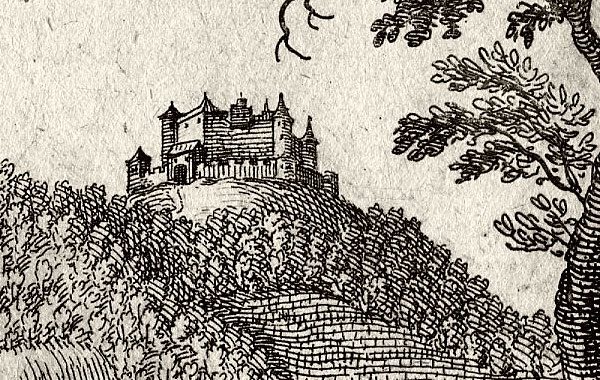
Burg Höhingen is a former early medieval hilltop castle above the village of Achkarren, a district of the town of Vogtsburg im Kaiserstuhl, in the Breisgau-Hochschwarzwald district in Baden-Württemberg (Germany).
It is located on the 352.1-meter-high Schlossberg in the Rhine plain opposite Breisach. The difference in elevation between the current village and the former castle is around 150 meters. Höhingen was an important castle for centuries, only about 7 kilometers from the heavily contested and strategically important fortress of Breisach. Its strategic importance arose from the fact that the north-south trade routes on the right bank of the Rhine led through two bottlenecks, one formed between the fortifications of Riegel and the Black Forest, and the other between Breisach and Achkarren. Furthermore, Burg Höhingen often formed a military counterpoint to the more significant Breisach in the eventful history of wars, especially during the Thirty Years' War.
Not much is known for certain about the beginning of the castle complex on the Schlossberg. However, it is believed that castle complexes already existed in 1064, when Achkarren was first mentioned in writing on the occasion of its transfer to Ottmarsheim Abbey by King Henry IV, and these were then expanded several times in the following centuries. After the ancestral castle of the Lords of Üsenberg, Burg Üsenberg on the Üsenberg near Breisach, was probably destroyed by the people of Breisach in the 1240s, they are said to have provided Burg Höhingen to the Üsenbergers as a replacement. In 1259, it was explicitly mentioned in writing for the first time.
In 1392, Margrave Hesso of Hachberg bought Werner von Hornberg's share of Burg Höhingen; he already owned the other part. In 1415, the castle, along with the Margraviate of Baden-Hachberg, came to Margrave Bernhard of Baden, who bought it from Margrave Otto II of Hachberg, the last of this Baden side line. Otto was allowed to use Burg Höhingen until his death in 1418.
During the Peasants' War
After centuries of its existence, the castle itself was burned down for the first time in May 1525 during the Peasants' Revolt, with the participation of Achkarren farmers. Thus, Burg Höhingen was one of only two margravial castles destroyed by the peasants, although a whole number had been occupied by them. Long-standing disputes between the village of Achkarren and the margraves over forest use are suspected as the motive. The peasants later had to compensate the margrave for the damage.
During the Thirty Years' War
In 1620, the castle was again expanded and put into a state of defense by Margrave Georg Friedrich of Baden-Durlach, as the war events in the Rhine Valley and the fortress of Breisach could be well observed from here. In a contemporary report by the mayor of Breisach to the imperial governor of the Austrian lands in Waldshut, Burg Höhingen, often referred to as a castle, is described as follows:
“Its location was excellent, as it stood in the middle of the mountain's summit on hard rock, which due to its steepness had difficult access and could not be commanded from any of the surrounding places. The building was of strong masonry, surrounded on one side by a deep moat, and on the other it abutted an unscalable precipice [=abyss], which is used from below as a stone quarry. The castle had a good cistern.”
In 1633, an attack was launched from Breisach. The imperial-Catholic troops conquered the castle, currently held by the Swedes and supported by the Protestant Ihringers, and plundered it. According to contemporary records, the loot included around 15,000 liters of wine. Property of Ihringer citizens stored in the castle was also lost. There are even reports of the loss of 200 horses and 300 head of cattle, which allows conclusions to be drawn about the size of the complex. After several subsequent disputes over the castle, it was finally set on fire in 1638 by the now imperial occupation when it could no longer be held militarily.
The Utilization
Margrave Friedrich VI of Baden-Durlach sold the stones of the ruin in 1671 to the Kingdom of France, which used them, among other things, to build the fortress in Neu-Breisach by Vauban. Later, building material for private houses was also extracted from the ruin, which is why remnants of the freely accessible ruins can still be seen on the Schlossberg.
Description+
A presumed impression of the former appearance of the castle is given by a copper engraving by Matthäus Merian from 1644, about whose realism little can be said for certain. However, the access to the castle gate must have been exactly at the spot indicated in the copper engraving, as can still be clearly seen today.
Take Mobile History with you
You are reading this text for free. Premium adds what matters on the road: descriptions read aloud, sites found through your camera, whole regions taken offline.
- Every description, including the ~17,700 Premium sites
- Audio guide: have descriptions read to you on location
- AR finder: see sites through your camera, with distance and bearing
- Unlimited saved sites
14 days free, then from €2.99 a month. Cancel anytime.
Source: Wikipedia · Licence: CC BY-SA 4.0 · Image: Dr. Ralf Thomann / Public domain via Wikimedia Commons
This description draws on the facts documented in the linked Wikipedia article; Wikipedia content is licensed under CC BY-SA 4.0. Wording and editing: Mobile History.
Location: 48.0708, 7.6208