The remains of the Castle can be visited
CastleVelden am Wörther See-Köstenberg
Hochwart Castle
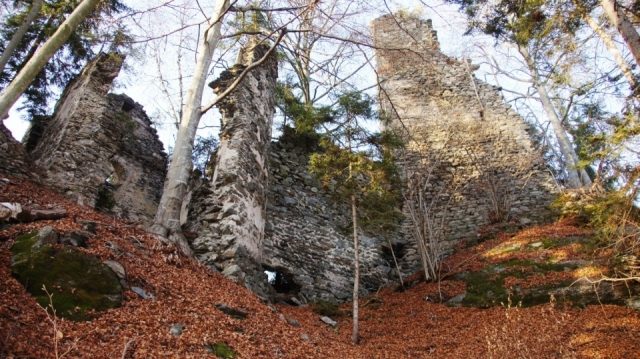
Hochwart Castle (also: Hohenwart, Slovenian Črni Grad) is a castle ruin south of the village of Köstenberg (Slovenian Kostanje) in the municipality of Velden am Wörthersee in Carinthia. The castle is also known as the "Black Castle", which corresponds to the meaning of its Slovenian name.
The ruin of the former hilltop castle lies on the rocky, partly forested summit of the Kleiner Sternberg at an altitude of 802 m above sea level.
In the middle of the 12th century, Duke Henry V of Carinthia received the castle and lordship of Hohenwart as a gift from Pilgrim of Pozzuolo. Henry's brother Duke Hermann sold the castle to Bishop Roman I of Gurk in 1162. In 1365, the Bishop of Gurk enfeoffed the Counts of Ortenburg with the castle. Subsequently, the Counts of Cilli were the owners, but they died out, whereupon the castle fell into the hands of Emperor Frederick III's troops in 1456; however, it remains unclear whether the castle was destroyed then or only in the 16th century.
Layout+
Three Courtyards
The castle complex is divided into three successive courtyards. From the former old castle from the first half of the 12th century, sections of walls are preserved in the south of the complex around the inner courtyard, while most of the still recognizable building parts in the northeast of the complex (outer courtyard) date from the second half of the thirteenth century.
Main Tower
The formerly square keep (dated from the second half of the thirteenth century), whose eastern part has collapsed, is connected to the outer castle wall; on the west side of the first upper floor of the tower, a pointed-arch entrance gate is preserved, a bay window projection on the fourth floor is visible on the south side, as well as pointed-arch windows.
Castle Chapel
It stands in the outer courtyard: one enters a double chapel with a partially preserved semicircular apse, probably from the first half of the twelfth century, originally flat-roofed, later protected by a steep gabled roof. In the lower chapel, a pointed-arch triumphal arch is still visible, whereas that of the upper chapel no longer exists. The choirs were vaulted but are now in danger of collapsing; on the west wall are two rose windows.
Other Masonry
Remains of residential buildings and defensive walls are still clearly recognizable.
Take Mobile History with you
You are reading this text for free. Premium adds what matters on the road: descriptions read aloud, sites found through your camera, whole regions taken offline.
- Every description, including the ~17,700 Premium sites
- Audio guide: have descriptions read to you on location
- AR finder: see sites through your camera, with distance and bearing
- Unlimited saved sites
14 days free, then from €2.99 a month. Cancel anytime.
Source: Wikipedia · Licence: CC BY-SA 4.0 · Image: http://www.wehrbauten.at/ktn/kaernten.html
This description draws on the facts documented in the linked Wikipedia article; Wikipedia content is licensed under CC BY-SA 4.0. Wording and editing: Mobile History.
Location: 46.6381, 13.9956