The remains of the Castle can be visited
CastleNeckarsteinach
Hinterburg Castle
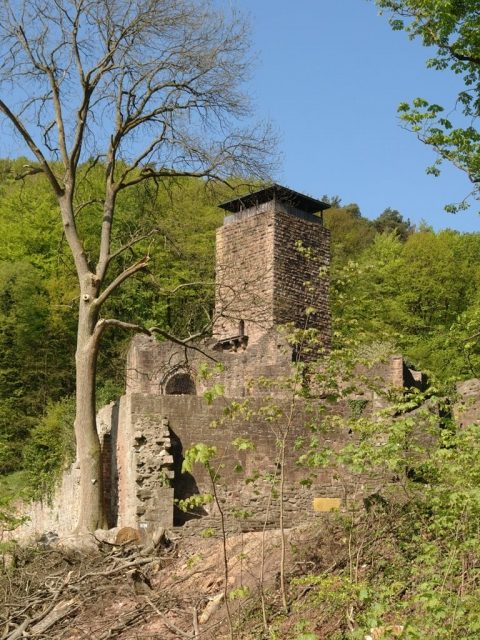
The Hinterburg, also known as Alt-Schadeck, is the ruin of a spur castle at 165 m above sea level near Neckarsteinach in the Bergstraße district. It is the oldest of the four castles Vorderburg, Mittelburg, Hinterburg and Schwalbennest and the ancestral castle of the noble free lords of Steinach.
Construction of the castle began around 1100, probably as a fief of the Diocese of Worms or the Diocese of Speyer. From 1142–1165, Bligger von Steinach is documented as the lord of the castle. His son, the minnesinger Bligger II von Steinach, expanded it into an extensive Staufer complex. After the extinction of the older line of Steinach around 1270, the castle was pledged by Bishop Heinrich von Speyer to his creditors in 1272. By 1344, the castle is said to have been abandoned or fallen into disrepair, as Bishop Gerhard von Speyer concluded a contract with the Wimpfen provost Peter von Mur for the reconstruction of the castle, for which he received 20 pounds Heller and two fuder of wine annually. In 1366, Charles IV confirmed ownership of the castle to Bishop Lambert von Speyer. In 1375, Contz Münch von Rosenberg received the castle as a fief. In 1418, Bishop Raban von Speyer granted his cousin Wilhelm von Helmstatt the castle and his part of the city for life, and after his death in 1426, in the same way, to his nephew Weiprecht III von Helmstatt, who also had to renovate the apparently by then again dilapidated castle. In 1427, after a dispute between the Helmstatt and the Landschad von Steinach, a common castle peace was negotiated for the castle and city of Steinach. Larger alterations to the castle date back to Weiprecht von Helmstatt. After his death in 1490, the fief passed to his nephew Martin von Helmstatt († 1490) and from him to his daughters Mia, who was married to Blicker XIV Landschad von Steinach, residing in the Vorderburg, and Gertrud, who was married to Heinrich VI von Handschuhsheim, whereby the castle was divided into two halves of ownership. Already in 1497, Heinrich VII von Handschuhsheim acquired the Landschad's half with a quarter of the city of Steinach and half of the village of Epfenbach. Heinrich's eldest son Philipp carried out further construction work on the castle in 1529 and died in the same year. During the settlement of his estate, disputes arose and a lawsuit before the Palatine court, which decided that the castle was the property of the Speyer Cathedral Chapter. In 1541, the brothers Hans, Hans Pleikard and Christof Landschad von Steinach were enfeoffed with the castle by Bishop Philipp von Speyer. In 1545, a judgment ordered the von Handschuhsheim to vacate the castle, which happened after a confirmation of the judgment in 1549. The castle remained in their possession until the extinction of the Landschad von Steinach in 1635.
After the extinction of the Landschad, the chapters of Worms and Speyer repossessed the former fiefdom (Hinterburg, Vorderburg and half of Mittelburg), briefly placed it under self-administration, and in 1657 transferred it as a fief to Wolf-Heinrich von Metternich zu Burscheid. In the same year, he acquired from Dieter VIII Landschad's daughter Eva Elisabeth the former Landschad allodial property and also the remaining half of the Mittelburg from the Barons von Venningen, so that from the late mid-17th century, the ownership of the four castles was again united in one hand. After the extinction of the Metternich line in 1753, the former fiefs and even the former allodial property were confiscated by the chapters of Speyer and Worms. In 1803, all property came to the state of Hesse as part of the mediatization, which reached a settlement with the heir of the allodial property, Baron von Dorth, and ceded to him not only the Mittelburg, which was used as an official residence, but also the ruin of the Hinterburg. In 1910, the Lords von Dorth renounced the ruin of the Hinterburg, whose maintenance was too costly, and it consequently reverted to the Hessian state.
Layout+
A pentagonal castle complex on a rock spur, which drops steeply on three sides. Secured against the mountain with an angled shield wall and a keep over 20 m high in the angle of the shield wall. Starting from the ends of the shield wall, a 3 m thick curtain wall made of bossed ashlar encloses the castle complex. It also features an elaborate palas with Gothic windows.
Furthermore, there are remains of a second, newer palas, which was probably built in the middle of the 14th century. According to written sources, this is said to have been underpinned with a vault in the 15th century.
The fully brick-lined well, at least 23 m deep, in the castle courtyard has an accessible branch at a depth of 18 m in the direction of Mittelburg.
Take Mobile History with you
You are reading this text for free. Premium adds what matters on the road: descriptions read aloud, sites found through your camera, whole regions taken offline.
- Every description, including the ~17,700 Premium sites
- Audio guide: have descriptions read to you on location
- AR finder: see sites through your camera, with distance and bearing
- Unlimited saved sites
14 days free, then from €2.99 a month. Cancel anytime.
Source: Wikipedia · Licence: CC BY-SA 4.0 · Image: Dr. Gebhard Gaukler
This description draws on the facts documented in the linked Wikipedia article; Wikipedia content is licensed under CC BY-SA 4.0. Wording and editing: Mobile History.
Location: 49.4096, 8.8274