The remains of the Castle can be visited
CastleIlsfeld-Auenstein
Helfenberg Castle
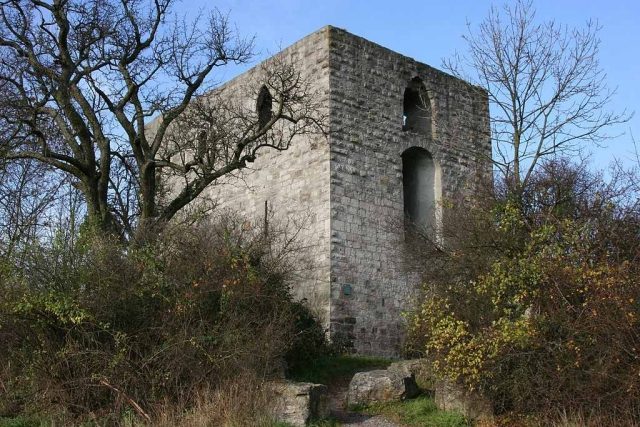
The Helfenberg castle ruin is the ruin of a medieval castle above the village of Helfenberg, part of Ilsfeld, in the Heilbronn district in northern Baden-Württemberg.
The ruin is located east of Abstatt and southwest of the nearby Wildeck Castle, as well as northeast of Auenstein, on a ridge extending from west to east. South below the castle hill lies the hamlet of Helfenberg, historically belonging to the castle. The castle hill is now used for viticulture, except for the high plateau around the castle and a small wooded incision in the terrain to the west.
The castle was built around 1250 during the Staufer period and first documented in 1259 with the Baden ministerialis Albertus de Helfenberg. Other representatives were Hartmann called Bruche de Helfenberg (1293) and Albrecht von Helfenberg (1310). The Helfenbergs already ceded possessions in the early 14th century, such as an estate in Siglingen to Schöntal Monastery and in 1344 a share of the forest in Talheim to the Lords of Neipperg. The last representative was a Hans von Helfenberg, who sold a tithe share in Lauffen am Neckar in 1354.
The inheritance of the Helfenbergs was divided by the Lords of Sachsenheim and the Lords Sturmfeder, who, due to their identical coats of arms, presumably descended from the Helfenbergs or were related to them by lineage. From 1339 to 1370, Werner Sturmfeder was the castellan, and around 1400, Hans Sturmfeder. At that time, the Sachsenheim part went to Heinrich von Hohenriet.
A Konrad von Hohenrieth later owned the entire castle and in 1456 sold Helfenberg Castle with estates and people, the Alt Helfenberg castle site behind the castle, estates and people in Helfenberg and a forest, as well as estates and tithes in Abstatt, tithes, rents and estates as well as people in Ostheim, in Ilsfeld and Beilstein, as well as a fief with forest in Söhlbach, rents in Oberstenfeld and Etzlenswenden with the Farnersberg forest, the Abstetter Hof and serfs in 13 closer and more distant locations to Württemberg.
As a Württemberg fief, the castle was owned by various noble families from 1457. Dieter von Weiler granted the castle as a sub-fief in 1464 to Hans von Talheim, and he or his heirs sold the property in 1482 to Werner Notthafft, who had the old desolate tower at the eastern tip of the castle hill demolished. From Daniel Notthafft, part of the castle went in 1521 to Wolf Ruch von Winnenden, who had further construction work carried out and was murdered by peasants in 1525 during the Peasants' War at the Weinsberg Bloodbath.
In 1527, the castle came into the possession of Conrad von Wittstatt. Philipp von Wittstatt expanded the castle in 1579. The coat of arms of the Lords of Wittstatt adorns the portal of the preserved residential tower.
The building remains preserved today originate from the residential tower built against the former shield wall. To the east, the rest of the castle complex once extended over an area of about 40 x 25 meters. Economic buildings and the castle chapel were probably located there.
By 1625, another manor house was built in the village of Finkenbach below the castle; the village was probably named after the castle hill during the construction of Unterhelfenberg Castle. The castle on the hill was henceforth called Oberes Schloss (Upper Castle) or Oberhelfenberg to distinguish it from the castle in the village. In 1625, Philipp Christoph von Hoheneck (son-in-law of Philipp von Wittstatt) resided at Oberhelfenberg, and Johann Christoph von Buchholz (son-in-law of Philipp von Wittstatt's daughter) at Unterhelfenberg.
The castle was destroyed in the Thirty Years' War and subsequently restored under Colonel and Württemberg Councillor Peter von Pflummern, who had been enfeoffed by Duke Eberhard with the Hoheneck share of the castle and at that time also owned the neighboring Wildeck Castle. The castle chapel dated from that period. After Pflummern's death, the castle passed as a distaff fief to his daughter Elisabeth, who was married to Claus Jacob Böcklin von Böcklinsau. After his death, the property passed in 1681 to their common daughter Maria Dorothea, who had been married to Wolf Ernst Horneck von Hornberg since 1671, so that ownership of the castle passed to the Horneck von Hornberg family. In 1702, an inheritance succession mentions the partial demolition of the Upper Castle, in place of which a vineyard had been laid out.
In 1746, the Helfenberg lordship came into the possession of the von Gaisberg family, represented in the Knightly Canton of Kocher, through the marriage of a Horneck daughter, who took up residence in the Lower Castle. The castle, however, was already a ruin when ownership passed to the von Gaisberg family, from which stones were quarried for buildings in the village of Helfenberg. In 1817, the castle chapel was demolished. The Lower Castle in the village of Helfenberg was destroyed by a bombing raid in 1945; the community center now stands in its place.
The ruin of Helfenberg Castle remains in the possession of the von Gaisberg family to this day, has been restored with the help of the monument office, the Heilbronn district, and the former municipality of Auenstein, and is publicly accessible.
Take Mobile History with you
You are reading this text for free. Premium adds what matters on the road: descriptions read aloud, sites found through your camera, whole regions taken offline.
- Every description, including the ~17,700 Premium sites
- Audio guide: have descriptions read to you on location
- AR finder: see sites through your camera, with distance and bearing
- Unlimited saved sites
14 days free, then from €2.99 a month. Cancel anytime.
Source: Wikipedia · Licence: CC BY-SA 4.0 · Image: https://commons.wikimedia.org/wiki/File:Ilsfeld_Ruine_Helfenberg_2_20061126.jpg
This description draws on the facts documented in the linked Wikipedia article; Wikipedia content is licensed under CC BY-SA 4.0. Wording and editing: Mobile History.
Location: 49.0633, 9.3122