The remains of the Castle can be visited
CastleFelsberg-Gensungen
Heiligenburg Castle
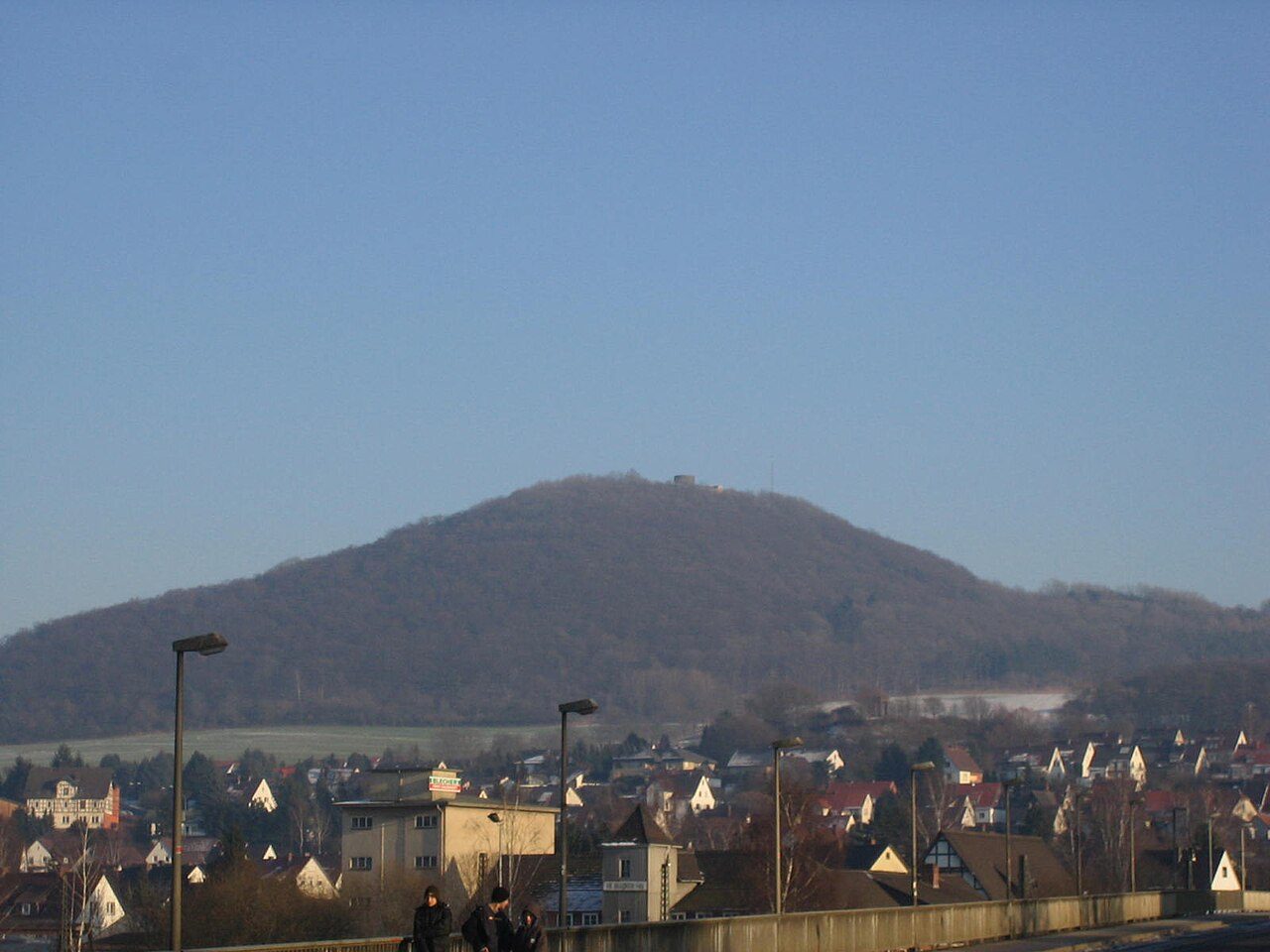
Heiligenburg Castle (German: Burg Heiligenburg) is a castle on the mountain of Heiligenberg in the district of Schwalm-Eder-Kreis, Hesse, Germany.
Heilgenberg is a 393 m (1,289 ft) high mountain close to the town of Felsberg-Gensungen in North Hesse. The mountain is the remains of an extinct Miocene volcano, of which only the basalt that filled the neck of the volcano remains. The name of the mountain stems from one of the oldest churches in Hesse.
A magnificent view of the surrounding area can be seen from the ramparts of the ruins, so that it is a much-visited tourist attraction. The entrance to the ruined castle and tower is free.
Early History+
In prehistoric ages there was probably an Iron Age (La Tène B) fortress on the mountain. Excavations by archeologists from Marburg University found two rounded bow fibulae (La Tène A/B) and a possible wall structure with ceramics that were dated at La Tène B. In early Christian times, there was a chapel on the Heiligenberg. This was proved by finding an old bell clapper during excavations, which probably came from the chapel.
Construction+
Before the castle was built, the mountain of Heiligenberg belonged to the nobles, especially the viscounts (German: Vizegrafen) of Felsberg, who lived in the Felsburg castle at Felsberg. In the 12th Century, the Thuringian and Hessian Landgraves argued with the Archbishop of Mainz over possession of the mountain. Archbischop Conrad I had constructed a strong fortification on the Heiligenberg between 1180 and 1186 as protection against Louis III, Landgrave of Thuringia. Shortly after the building of the castle, there was bitter fighting, because the fort lay strategically between Felsberg, Gudensberg, and Melsungen, and therefore combined they threaten the strongly-fortified Fritzlar, which was the centre of the Electorate of Mainz power in North Hesse and the geographical heart of the Landgraviate of Hesse. In 1193 a knight named Heinrich von Heiligenberg was documented, who was probably an offspring of the nobles from Uttershausen (close to Wabern), and from 1196 until their demise in 1263 the family Isfried von Heiligenberg were castellans (German: Burgmannen) of the castle and had to protect it in the name of Mainz.
Destruction, Reconstruction and Decay+
In 1232, Conrad of Thuringia, who since 1231 had been responsible for the hessian lands of the Landgraves of Thuringia, conquered and destroyed the town of Fritzlar as well as Heiligenburg Castle. In 1247 the castle was reconstructed by Mainz castellans from Wolfershausen. In 1273 the castle was destroyed again by Henry I, Landgrave of Hesse. The castle was not immediately restored and lay in ruins for many years.
From 1401 to 1403, Landgrave Hermann II built a smaller castle on Heiligenberg. This building stood until 1471, when the landgrave's nephew, Landgrave Louis II charged the nearby Eppenberg Charterhouse with the care of the castle. The landgrave ordered the monks to pray for the castle's soul at least one a week in the church on the mountain. Nevertheless the wall of the castle and the chapel fell in to decay. In the 15th Century, the church was documented as a chapel.
Modern Times+
During the Seven Years' War, there were numerous small battles on Heiligenberg. French troops camped out in 1761 for seven weeks on the Heiligenberg. Their allies pitched their camp on the Felsburg. Two hills with trenches on the sides of the mountain are reminders of the French occupation.
Around 1860, the forester Faber started afforestating the Heiligenberg. A refuge hut and working quarters were constructed. To protect the buildings and location a so-called Heiligenberg club was started. In 1885 a larger refuge hut was constructed and shortly afterwards it was extended to include a restaurant. From 1902 to 1992 there was a wooden lookout tower on the summit of the mountain. In 1934 planning began to excavate the ruins, and from 1935 to 1939 excavations and partial renovation were carried out under the direction of the government buildings inspector Georg Textor.
Present Day Use+
In 1952 a castle gate with a bell was installed and dedicated to the displaced people of World War II. From 1956 to 1960 the Heiligenberg club began restoration again. On the festival ground a hotel and restaurant were constructed. In 2002 a sculpture trail - Ars Natura- was initiated. Local artists have put various pieces of art on a path around the Heiligenberg. Once a year there is a rock festival on the Heiligenberg.
Take Mobile History with you
You are reading this text for free. Premium adds what matters on the road: descriptions read aloud, sites found through your camera, whole regions taken offline.
- Every description, including the ~17,700 Premium sites
- Audio guide: have descriptions read to you on location
- AR finder: see sites through your camera, with distance and bearing
- Unlimited saved sites
14 days free, then from €2.99 a month. Cancel anytime.
Source: Wikipedia · Licence: CC BY-SA 4.0 · Image: Armin Schönewolf / Copyrighted free use via Wikimedia Commons
This description draws on the facts documented in the linked Wikipedia article; Wikipedia content is licensed under CC BY-SA 4.0. Wording and editing: Mobile History.
Location: 51.1327, 9.4585