To be privately owned
CastleLiebenfels-Zweikirchen
Hardegg Castle
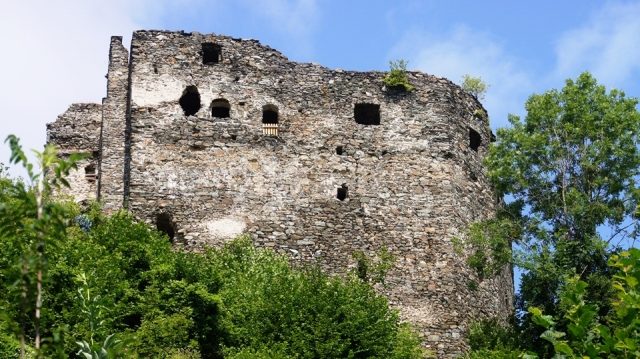
The castle ruin Hardegg is located near Zweikirchen southwest of the main town of the municipality of Liebenfels in Carinthia. The remains of the former twin castle are 34609!listed as a historical monument.
The castle was a small Romanesque twin castle complex on a wooded hill north of the village of Zweikirchen. Nearby are the castle ruins of Liebenfels, Gradenegg, and Liemberg, which, together with Hardegg, are among the main castles of the castle ring that surrounded the ducal capital of St. Veit.
Hardenegg was first mentioned in a document in 1134, when Mengotus de Hardeche et filius eius Gotpoldus was mentioned. His lineage died out with Hertwig von Hardegg, a ministerialis of the Duke of Carinthia, as early as 1176. Seifried von Mahrenberg, a later owner of Hardegg, redeemed it in 1264 from the Bishop of Bamberg as a donation for the construction of a Cistercian monastery. However, the construction of the monastery did not materialize because Seifried died soon after, but the castle remained in Bamberg's possession until it returned to the possession of the Carinthian dukes at the beginning of the 14th century. In 1346, it was granted by Duke Albrecht of Austria to Friedrich and Konrad von Auffenstein, followed by the Khevenhüller, and at the beginning of the 16th century, the Leininger brothers were lords of the castle. In 1527, it came as a fief to the Carinthian mint master Hieronymus Puecher. This was followed by rapid changes of ownership, in the course of which the castle began to decay as early as the 17th century. The decay may have been accelerated by the roof tax introduced in the 18th century.
The area where the ruin is located is now private agricultural property, and entering the ruin is prohibited due to the acute danger of collapse and constantly loosening stones.
Construction Description+
The complex, which was last rebuilt and expanded during the Renaissance, originally consisted of two mighty Romanesque towers, which over time had been connected by residential buildings and together with these formed a small courtyard. Strongly walled remains of the northeastern tower are preserved, the southwestern one has collapsed. The tower site was already occupied in prehistoric times, as corresponding finds prove. A rampart system near the so-called Fallturm is still recognizable. Also recognizable is the forecourt with a drawbridge gate south of the castle, and a round watchtower with a high entrance, as well as a round chapel with a semicircular apse. During a restoration from 1978, late Gothic, ornamental wall painting fragments were uncovered here.
Take Mobile History with you
You are reading this text for free. Premium adds what matters on the road: descriptions read aloud, sites found through your camera, whole regions taken offline.
- Every description, including the ~17,700 Premium sites
- Audio guide: have descriptions read to you on location
- AR finder: see sites through your camera, with distance and bearing
- Unlimited saved sites
14 days free, then from €2.99 a month. Cancel anytime.
Source: Wikipedia · Licence: CC BY-SA 4.0 · Image: http://www.wehrbauten.at/ktn/kaernten.html
This description draws on the facts documented in the linked Wikipedia article; Wikipedia content is licensed under CC BY-SA 4.0. Wording and editing: Mobile History.
Location: 46.7172, 14.2581