The remains of the Castle can be visited
CastleHainburg an der Donau
Hainburg Castle
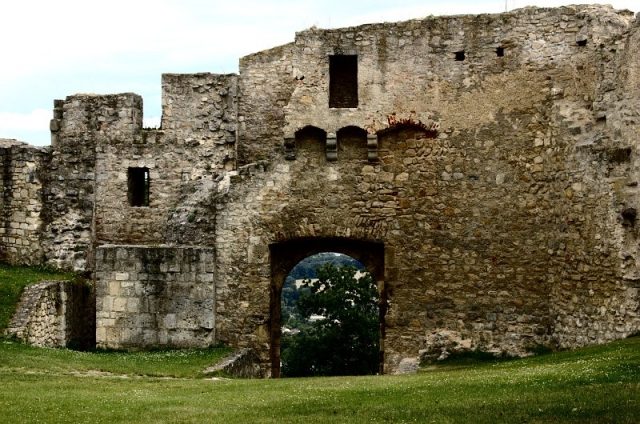
Emperor Henry III ordered the construction of an imperial castle above the city in 1050. Around 1060, the castle was given as a fief to followers of the Diepoldinger family.
Duke Leopold VI carried out a representative expansion in several phases between 1190 and 1240. In 1226, he handed over the castle to his wife Theodora. In 1248, the castle became the residence of Frederick II's sister, Margaret. After his death, Ottokar II Przemysl married the 41-year-old Babenberger in 1252. The expansion work on the residential tower in 1260 is attributed to him. In 1282, Hainburg came into the possession of the Habsburgs, who had it administered by captains.
From the mid-14th century, the castle was almost always pledged. Among the pledge holders were the Dörr von Deutsch-Altenburg, the Enzersdorfer von Röthelstein, and the Kranichberger von Petronell. In the first fratricidal war between Frederick and Otto, the latter succeeded in taking possession of Hainburg. Extensive construction measures took place between 1376 and 1382. Ulrich von Eytzing, who led the noble uprising against Emperor Frederick III, devastated the castle in 1452. In 1482, the castle was captured by the Hungarian King Matthias Corvinus. He had the severely damaged fortress renewed and expanded. It was not until 1490 that Maximilian I succeeded in recapturing Hainburg.
In 1514, the lordship was pledged to the Zelkinger family. Since then, Hainburg was no longer used as a residence and began to decay. In 1529, the Turks under Sultan Suleiman devastated the castle. From 1554, massive expansions of the Zwinger facilities took place. In 1683, the Turks again succeeded in storming the castle. In 1703, Emperor Leopold I sold the castle to Count Johann Jakob von Löwenburg. In the 18th century, the castle had finally become worthless as a defensive structure and was left to decay. In 1852, the ruin reverted to state ownership. From 1935, restoration work on the ruin took place. Today, the ruin belongs to the municipality of Hainburg.
Take Mobile History with you
You are reading this text for free. Premium adds what matters on the road: descriptions read aloud, sites found through your camera, whole regions taken offline.
- Every description, including the ~17,700 Premium sites
- Audio guide: have descriptions read to you on location
- AR finder: see sites through your camera, with distance and bearing
- Unlimited saved sites
14 days free, then from €2.99 a month. Cancel anytime.
Source: Wikipedia · Licence: CC BY-SA 4.0 · Image: http://commons.wikimedia.org/wiki/File:Hainburg_burg_04.jpg?uselang=de
This description draws on the facts documented in the linked Wikipedia article; Wikipedia content is licensed under CC BY-SA 4.0. Wording and editing: Mobile History.
Location: 48.1425, 16.9480