The remains of the Castle can be visited
CastleGrimburg
Grimburg Castle
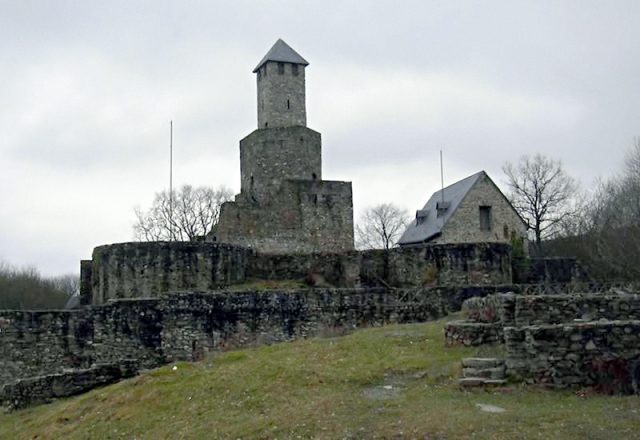
Grimburg Castle, also simply called Grimburg, is a spur castle in the area of the municipality of Grimburg in the Verbandsgemeinde Hermeskeil in the Rhineland-Palatinate district of Trier-Saarburg.
Grimburg Castle is located in the Saar-Hunsrück Nature Park, 1.8 km south-southwest of the municipality of Grimburg on the Kittelaufberg (460.1 m above sea level), a southern mountain spur of the Hasenknopf (497 m). It is situated at an altitude of 448 m. South of the spur, the Mühlenbach, which passes it to the east, flows into the Wadrill, which flows past to the west.
Grimburg was built around 1150 by the noble lords of Saarbrücken. It was destroyed during the warlike conflicts over the occupation of the Trier episcopal see – the Trier Schism from 1183 to 1190 – and rebuilt after the appointment of the imperial chancellor Johann I as Archbishop of Trier (1190–1212) – de novo construxit. Since then, Grimburg has been one of the seven Trier state castles first mentioned in the Liber annalium: Arras, Ehrenbreitstein, Manderscheid, Neuerburg, Saarburg, Welschbillig, and Grimburg itself.
Grimburg was the administrative seat and court location of the Trier electoral office of Grimburg, named after it and first mentioned in 1328.
It remains to be investigated who or which family built the first Grimburg Castle – it was probably the original residential tower, later hollowed out and fitted with a new pentagonal tower – and whether the castle dates back to a foundation by the then cathedral sacristan as the holder of manorial rights in Grenderich-Sauscheid-Gusenburg or by the St. Paulin Abbey as the landlord in and around Wadrill. For both, the cathedral sacristan and St. Paulin Abbey, are involved with ¼ in Grimburg Castle, as stated in a judgment of April 4, 1258. The castle garrison must pay homage not only to the Archbishop of Trier but also to the two co-owners, and these can use them as needed. Ownership obliges, and so the two co-owners of the castle complex must also bear certain burdens.
The dignity of the cathedral sacristan has been held by Simon von Warsberg since 1242; he is thus the beneficiary or prebendary of the cathedral sacristy of Grenderich-Sauscheid-Gusenburg. In 1252, Simon von Warsberg was also elected cathedral provost, thus holding the highest dignity within the cathedral chapter. The efforts of the cathedral sacristan and cathedral provost Simon von Warsberg to expand and solidify his rights – patronage and tithe rights in 1248 and share rights in Grimburg in 1258 – become understandable against the background of his close kinship with the family of the noble lords of Saarbrücken, who held the office of burgrave for a hundred years after Grimburg was elevated to a Trier state castle shortly after 1190. Boemund von Saarbrücken (called von Grimburg), who later – around 1270 – would build Dagstuhl Castle and call himself Boemund von Grimburg, Lord of Dagstuhl, is Simon von Warsberg's nephew. These and other familial interconnections not to be examined in detail here, and the attempts to expand and solidify power and influence, should be kept in mind in further research.
Emperor Maximilian I, ruler of the Holy Roman Empire from 1508 to 1512, visited the castle with his entourage in 1512 – allegedly for falconry. In 1522, Imperial Knight Franz von Sickingen occupied the castle without a fight. Elector Johann von Schönenberg, who lived in the castle, renewed and expanded the castle chapel in 1585. The castle suffered heavy damage in the Thirty Years' War (1618–1648) and was set on fire by French soldiers in the Reunions Wars in 1683. Around 1690, the administration of the Grimburg office was moved to the escheated archiepiscopal Lascheider Hof near Hermeskeil, and the castle was abandoned. The mighty castle complex was left to decay and served as a convenient quarry for the surrounding villages.
In 1978, the Burg Grimburg Support Association was founded, which, in cooperation with and support from the Verbandsgemeinde Hermeskeil and the municipality of Grimburg, endeavors to uncover, excavate, secure, and partially rebuild the castle ruins. Since then, the castle complex has been restored: the castle house was rebuilt from 1978 to 1988, the keep from 1978 to 1990, the witch and kitchen tower from 1981 to 1987, and the entrance tower from 1999 to 2000.
Current Use+
Today, Grimburg presents itself as a tourist attraction and serves as a backdrop for cultural events such as castle festivals and castle plays. Since 2001, civil weddings of the Hermeskeil registry office have also been performed in the castle house.
Layout+
The castle complex extends over a length of about 300 meters and a width of about 90 meters. This made Grimburg, if not the most important, then at least the most spacious of the former Trier electoral state castles. It consists of an outer bailey, a rectangular keep, a palas, and a chapel. The lower church served the residents of the outer bailey for worship, while the upper church, as a gallery with its own access, remained reserved for the archbishop and his officials.
Take Mobile History with you
You are reading this text for free. Premium adds what matters on the road: descriptions read aloud, sites found through your camera, whole regions taken offline.
- Every description, including the ~17,700 Premium sites
- Audio guide: have descriptions read to you on location
- AR finder: see sites through your camera, with distance and bearing
- Unlimited saved sites
14 days free, then from €2.99 a month. Cancel anytime.
Location: 49.6056, 6.8750