The remains of the Castle can be visited
CastleGrebenstein
Grebenstein Castle
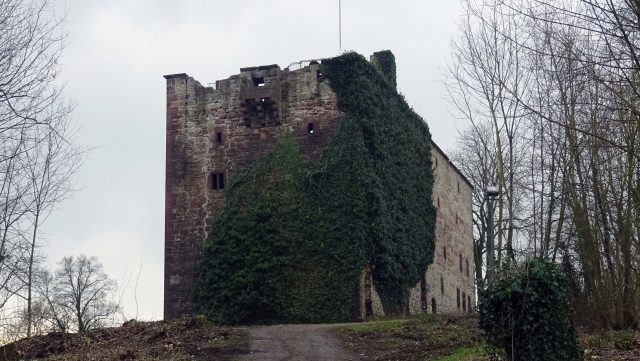
Grebenstein Castle, also known as Grafenstein, Greuensteyn, Grevenstein, is the ruin of a hilltop castle above the core town of Grebenstein in the district of Kassel in Hesse.
The castle ruin stands on the 249 m above sea level Burgberg (Castle Hill), a basalt cone half-encircled by the Diemel tributary Esse, on the southern edge of Grebenstein – about 56 m above the town.
A historically rather insignificant original castle complex was already built in the second half of the 11th century. From 1266 or soon after, Count Ludolf V of Dassel expanded the castle to protect his surrounding property. In 1272, this castle was first mentioned in a document – in connection with disputes between the Diocese of Paderborn and Landgrave Heinrich I of Hesse, concerning the border regulations of the castles of Schartenberg and Grebenstein as well as the court at Hainbuche.
Through marriage, the castle and town of Grebenstein, which were Mainz fiefs, probably passed to Ludolf's son-in-law, Otto von Everstein, around 1279. In the same year, the Paderborn Bishop-Elect Otto von Rietberg promised Archbishop Werner of Mainz, in an agreement concerning the former Dassel Mainz fief castles of Schartenberg and Grebenstein, to have Grebenstein Castle razed. However, this did not happen, as Landgrave Heinrich of Hesse apparently already held at least partial possession of the castle from 1282. Otto von Everstein himself entered the service of the Landgrave as a castellan in 1293 and opened all his castles to him, including those to be acquired in the future. Thereafter, the Hessian castellans Tammo von Alnhausen, Willekin Hase and Johann Riedesel were trustees at the castle. On August 28, 1297, Otto von Everstein sold the castle and town of Grebenstein with court and all appurtenances to Landgrave Heinrich I and was replaced as castellan. Until 1529, the castle was occupied by Hessian bailiffs.
As a Hessian outpost against Mainz's Hofgeismar, Grebenstein initially fulfilled an important function in the Diemelland, although the heavily fortified town after 1282, with its Landwehr directed against Hofgeismar, was more important than the castle, which was less suitable for military purposes.
In 1328, with the accession of Heinrich II as Landgrave of Hesse, his brother Ludwig the Junker (1305–1345) received Grebenstein Castle with its associated land as a paragium. In 1341, his son Hermann II, later Landgrave of Hesse, was born at the castle. From 1349 to 1368, the castle was then in the possession of Hermann I, "the Elder" († 1368/1370), another brother of Landgrave Heinrich II.
In 1385, the castle was unsuccessfully besieged by troops of Archbishop Adolf I of Mainz during a renewed feud with the Landgraves.
After all Mainz possessions between the Weser and Diemel had been pledged to Landgrave Ludwig due to war debts from the Mainz Diocesan Feud (1461–1463) and subsequently definitively passed into Hessian possession, the castle lost its strategic importance. Already in 1471, probably only a scribe lived in the castle. From about 1540, it was probably no longer inhabited and instead served as a harvest store.
During the Thirty Years' War, Grebenstein Castle and town were destroyed in 1631. Thereafter, the townspeople used the castle ruins as a quarry for the reconstruction of the town and left the rest to decay. Only at the end of the 20th century were the ruins structurally secured.
Complex+
The Grebenstein castle ruin is dominated by the 37-meter-long and 12-meter-wide palas, whose outer walls are almost completely preserved and still reach a height of over 13 meters. The palas had a basement and three upper floors. Remains of oriels and fireplaces, the kitchen in the basement, and the former Kemenate (women's chamber) have also remained. On the first floor, the wall has a thickness of almost 3 meters. The complex is surrounded by a still partially preserved moat, but the dimensions of the outer bailey and the moats can only be guessed at. The restored facilities are now freely accessible and can be visited at any time.
After ascending the "Burgberg" via one of the educational trails, a steel staircase can now be climbed to a viewing platform on the upper masonry of the castle ruin. From here, there is an overview of the historic old town of Grebenstein as well as, among other things, the Habichtswald and as far as the Reinhardswald.
Below the castle lies a small Jewish cemetery.
Bailiffs+
Documented bailiffs included:
- 1336 Ludwig von Grebenstein
- 1339 Johann von Schachten
- around 1350 Hermann von Uffeln
- 1355 Willekin Hase the Elder
- 1375 Friedrich II von Hertingshausen, Ditmar von Hanstein
- 1383 Dietrich von Schachten (?)
- 1385–1399 Mainz interim administration – Konrad von Spiegel zum Desenberg
- 1414 Friedrich III von Hertingshausen
- 1417 Johann von Wolmeringhausen, called the Bold
- 1421, 1426, 1436 Eckebrecht von Schachten
- 1426 Heinrich Hase
- 1428 Werner von Uffeln
- 1455-before 1466 Eckebrecht von Schachten
- 1472–1482 Werner von Elben
- 1485–1487, 1496–1498 Dietrich von Schachten
- 1493–1494 Friedrich Trott the Younger
- 1498 Eberhard Hake
- 1499–1514 Dietrich von Schachten the Younger
- 1528, 1530 Jorg von Schachten
- 1529 Heiderich von Kalenberg
Take Mobile History with you
You are reading this text for free. Premium adds what matters on the road: descriptions read aloud, sites found through your camera, whole regions taken offline.
- Every description, including the ~17,700 Premium sites
- Audio guide: have descriptions read to you on location
- AR finder: see sites through your camera, with distance and bearing
- Unlimited saved sites
14 days free, then from €2.99 a month. Cancel anytime.
Location: 51.4417, 9.4153