The remains of the Castle can be visited
CastleFrankenstein
Frankenstein Castle
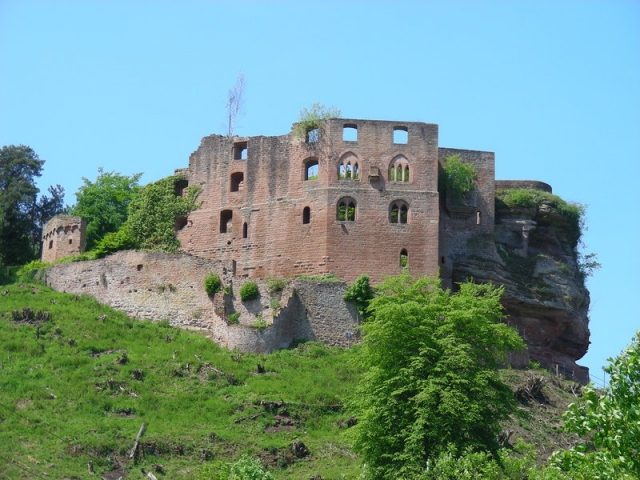
Frankenstein Castle is the ruin of a spur castle in the Palatinate Forest in Rhineland-Palatinate. It received its name from the noble family of Frankenstein.
The hilltop castle above the municipality of Frankenstein is located 300 m above sea level on the northeastern spur of the Schlossberg (423 m) to the right above the Hochspeyerbach, a left tributary of the Speyerbach. Here, still parallel to the Hochspeyerbach, runs Bundesstraße 37 (Kaiserslautern–Bad Dürkheim). The Schlossberg Tunnel of the Saarbrücken–Mannheim railway line, which is just over 200 m long, passes under the mountain spur. Its eastern portal, completed in 1849 and made of red sandstone, is a protected monument due to its stepped crenellated gable.
Layout+
The ruin largely consists of the remains of the three-part palas from the 13th century, which once belonged to the lower castle and predominantly dates from the late Staufer or early Gothic period. Its lancet windows and the preserved multi-story chimney system of its central part are particularly valuable from a building history perspective.
The remains of the upper castle can be reached via a rock staircase. They primarily consist of the ruin of the watchtower from the 12th century, which originated from the original defensive structure.
Towards the end of the 20th century, foundation remains of a shield wall were uncovered during excavations.
The name Frankenstein was first mentioned in a document in 1146 with the noble Helenger von Frankenstein. However, historians assume that the castle was founded earlier, as individual writings report the construction of a tower around 1100.
The owner of this keep was Limburg Abbey, which had to ensure the security of the roads to Speyer, Dürkheim, and Worms. In 1205, the abbey entrusted the Counts of Leiningen, who were already responsible for the abbey's protective vogtei, with this task. They had the complex expanded at the beginning of the 13th century, with the narrow rocky terrain leading to the castle complex having to be built in steps. During this time – from 1204 to 1231 – the knights Marquard, Friedrich, and Helenger von Frankenstein are mentioned in documents as administrators and castellans of the Leiningen counts.
Around 1390, Frankenstein Castle became a Ganerbenburg (jointly inherited castle) when the monastery pledged half of the castle complex to the Lords of Einselthum. Parts of this pledge were taken over in 1414 (other sources report 1404) and 1416 by the Counts of Nassau-Saarbrücken and Leiningen-Hardenburg. The three parties agreed by lot how the building parts of the castle should be precisely divided as individual property and which buildings should remain in common ownership.
In the second half of the 15th century, the castle complex was affected during conflicts between Elector Frederick I of the Palatinate and Count Louis I of Palatinate-Zweibrücken, but in 1504 it was at least partially still habitable. Further destruction probably followed in 1512, when Emperor Maximilian I imposed the imperial ban on Count Emich VIII of Leiningen-Hardenburg, and the Count of Nassau, on behalf of the emperor, captured the castle complex.
During the German Peasants' War in 1525, the castle was again destroyed and was considered uninhabitable from 1560. Five years earlier, after the extinction of the Einselthum family, their share had passed to the Lords of Wallbrunn. Although the complex no longer served residential purposes, it continued to be used militarily due to its advantageous location.
During the Thirty Years' War, the Spanish commander Ambrosio Spinola conquered the castle. This is evidenced by preserved pamphlets documenting the course of the warlike events in the Electoral Palatinate region. The descriptions suggest that the conquest of the complex took place at a relatively early stage of the war, around September or October 1620. The cartouche of the castle, reproduced a total of 20 times, is its oldest known depiction. Probably, the buildings, which were initially undamaged, were surrendered without a fight. The Spanish possibly stationed a small garrison in the complex to enforce their tribute demands. In the further course of the war, the complex was then severely damaged.
During the War of the Spanish Succession, French troops used Frankenstein Castle as accommodation. A church service was demonstrably held for the French soldiers in the castle chapel in 1703; this suggests that the chapel was still in a usable condition at that time. In 1706, the Nassau-Saarbrücken share of ownership passed to the Electoral Palatinate.
The left-bank territories of the Electoral Palatinate occupied during the French Revolutionary Wars – and thus also Frankenstein Castle – came back into the possession of the Kingdom of Bavaria as a result of the Congress of Vienna. This had the ruin renovated and structurally secured in the years 1883/84 and 1938/39.
After the ruin became the property of the state of Rhineland-Palatinate, its state castle and palace administration (today: Castles, Palaces, Antiquities Rhineland-Palatinate) carried out archaeological investigations, restoration, and preservation measures from 1971 to 1974 and 1988/89, during which the foundations of a previously unknown shield wall were uncovered. In the course of the work, among other things, the two upper floors of the hall building were rebuilt and the oriel of the chapel building was reconstructed.
Take Mobile History with you
You are reading this text for free. Premium adds what matters on the road: descriptions read aloud, sites found through your camera, whole regions taken offline.
- Every description, including the ~17,700 Premium sites
- Audio guide: have descriptions read to you on location
- AR finder: see sites through your camera, with distance and bearing
- Unlimited saved sites
14 days free, then from €2.99 a month. Cancel anytime.
Source: Wikipedia · Licence: CC BY-SA 4.0 · Image: http://www.wehrbauten.de/thread.php?threadid=1326
This description draws on the facts documented in the linked Wikipedia article; Wikipedia content is licensed under CC BY-SA 4.0. Wording and editing: Mobile History.
Location: 49.4387, 7.9746