The remains of the Castle can be visited
CastleForchtenberg
Forchtenberg Castle
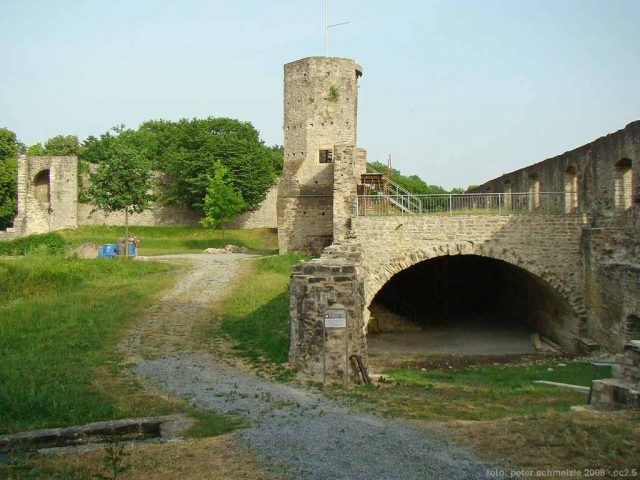
The Forchtenberg ruin is a medieval castle ruin near Forchtenberg in the Hohenlohe district in northern Baden-Württemberg.
Konrad von Dürn is considered the builder of the castle. In 1210, through marriage to a daughter of the Count of Lauffen, he came into possession of the town of Wülfingen on the Kocher near the mouth of the Kupfer, and also owned other property in the surrounding area. To consolidate his property, Konrad built the castle on a mountain spur on the opposite bank of the Kocher, which was completed by 1234. The founding of the town of Forchtenberg, located below the castle and first mentioned in 1298, is also related to the construction of the castle, in favor of which the older Wülfingen was abandoned. Castle and town were further expanded under Konrad's descendants and came into the possession of Kraft II von Hohenlohe shortly before the childless death of Konrad's grandson Ruprecht in 1323. The House of Hohenlohe used the 92-meter-long and up to 50-meter-wide castle only temporarily as a residence (briefly after 1367 for Ulrich von Hohenlohe) and as a widow's seat, and then established there the seat of the Hohenlohe bailiffs and the storage facilities for the tithe. During the Renaissance, the castle was expanded into a palace-like structure.
The complex was presumably set on fire and largely destroyed by Swedish troops during the Thirty Years' War. The official seat was then moved to the town of Forchtenberg; only the surviving large vaulted cellar was extended after 1680 and continued to be used for storing the wine tithe. The tower, which still stands today, dates from the time of this cellar extension and was built with stones from the castle walls. In addition to the tower, there were once also granaries on the cellar.
Around 1800, the complex was already in a state of disrepair. In 1806, the Principality of Hohenlohe came to Württemberg through the Reichsdeputationshauptschluss, which also led to the closure of the Hohenlohe office in Forchtenberg. The necessary repairs were now even more neglected; ultimately, the House of Hohenlohe lost all interest in the complex and sold it around 1850 to the court cooper Carl Müller for 33 guilders. Subsequently, the ownership changed several times, the complex was used as a quarry and increasingly fell into disrepair.
In 1929, Chamber President Kurt von Kleefeld acquired the complex and invested around 10,000 marks in its restoration. Kleefeld intended to transfer the complex to the city of Forchtenberg in an inheritance contract after his death, but then emigrated due to his Jewish ancestry and died in 1934. The ruin came into the possession of a Mr. Schöppler from Esslingen. In 1937, the Forchtenberg saddler master Wilhelm Riehmann acquired the ruin and carried out further safeguarding measures. In the 1960s, the State Office for Monument Preservation supported safeguarding measures on the endangered south wall.
In 1989, the city of Forchtenberg acquired the complex and, with financial support from the State Office for Monument Preservation amounting to 1.3 million marks, carried out extensive renovation and safeguarding until 1995. The ruin has since been publicly accessible and used for various events. Since a part of a wall broke off in July 2012, the castle has been closed to visitors until further notice.
Take Mobile History with you
You are reading this text for free. Premium adds what matters on the road: descriptions read aloud, sites found through your camera, whole regions taken offline.
- Every description, including the ~17,700 Premium sites
- Audio guide: have descriptions read to you on location
- AR finder: see sites through your camera, with distance and bearing
- Unlimited saved sites
14 days free, then from €2.99 a month. Cancel anytime.
Source: Wikipedia · Licence: CC BY-SA 4.0 · Image: https://commons.wikimedia.org/wiki/File:Forchtenberg-burg1.jpg
This description draws on the facts documented in the linked Wikipedia article; Wikipedia content is licensed under CC BY-SA 4.0. Wording and editing: Mobile History.
Location: 49.2879, 9.5651