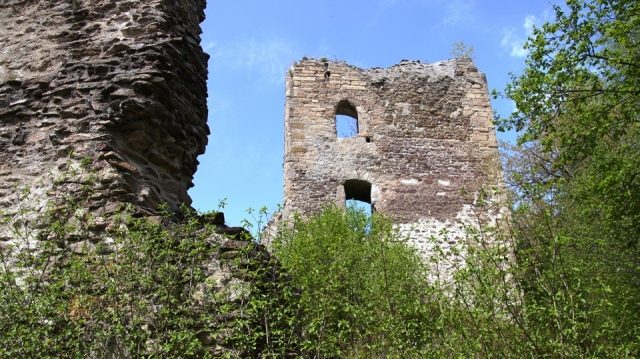
The remains of the Castle can be visited
CastleFohnsdorf
Fohnsdorf Castle
The area around Fohnsdorf came into the possession of the Diocese of Salzburg as early as the 9th century. The settlement and the small wooden fortified building were then called Undrima. By 1141, the name had already changed to "Fanestorf".
From the lightly fortified farmstead of the 9th century, a significant castle had developed by 1252. It was granted to burgraves who named themselves after Fohnsdorf. In 1281, Archbishop Friedrich II von Walchen had Rudolf von Fohnsdorf and his three nephews temporarily imprisoned. In 1285, a reconciliation took place between Rudolf and the Archbishopric. However, this pleased the Habsburg Duke Albrecht I little. He commissioned Offo von Massenburg with the destruction of Fohnsdorf Castle, which only succeeded in 1292 after several attempts.
A threatening Hungarian invasion a few years later forced King Adolf von Nassau to allow the Archbishop to rebuild the castle. In 1302, the disputes between the Fohnsdorfers and the Archbishops of Salzburg flared up again. However, Rudolf had already relinquished the administration of the castle around 1300. The castle guard was taken over by the Steurer (Steyrer) family. In 1350, Niklas der Galler followed as administrator. In 1365, Fohnsdorf was temporarily pledged to the Prankher. In 1371, a renewed pledging took place, this time to Leo der Galler. Around 1420, Maritz Welzer was the administrator of the castle. In 1440, Fohnsdorf was left to Konrad Pfannauer as a life annuity.
In the Hungarian War of 1479 to 1480, the Archbishop handed over the castle to the Hungarians allied with him against Emperor Frederick III, which finally led to its conquest by King Maximilian I in 1490. The Prince-Archbishop had to pay high war reparations in 1494 to regain Fohnsdorf. In the 16th century, its military significance was over. The administration was moved to the Fohnsdorf Amthof around 1550, and the castle was abandoned. By 1647, it had long since become a ruin. After the Peace of Pressburg, the lordship passed to the Austrian state in 1805. In 1827, it was acquired by Josef Seßler. Today, the ruin belongs to the municipality of Fohnsdorf.
Take Mobile History with you
You are reading this text for free. Premium adds what matters on the road: descriptions read aloud, sites found through your camera, whole regions taken offline.
- Every description, including the ~17,700 Premium sites
- Audio guide: have descriptions read to you on location
- AR finder: see sites through your camera, with distance and bearing
- Unlimited saved sites
14 days free, then from €2.99 a month. Cancel anytime.
Source: Wikipedia · Licence: CC BY-SA 4.0 · Image: http://www.wehrbauten.at
This description draws on the facts documented in the linked Wikipedia article; Wikipedia content is licensed under CC BY-SA 4.0. Wording and editing: Mobile History.
Location: 47.2116, 14.6739