The remains of the Castle can be visited
CastleBopfingen - Schloßberg
Flochberg Castle
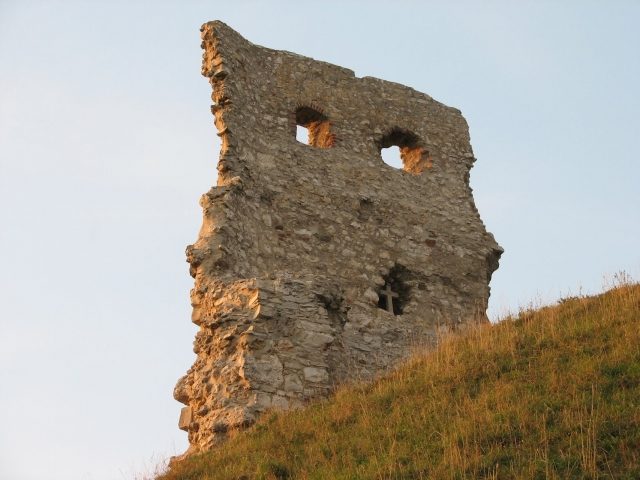
Flochberg Castle is a ruin above the Bopfingen district of Schloßberg in the Ostalbkreis in Baden-Württemberg. Today, only larger wall remnants of the large High Medieval hilltop castle remain.
The hilltop castle is prominently and widely visible at an altitude of 579 meters on a limestone cone at the edge of the Ries near Bopfingen.
A Reginhardus de Vlochperch was already mentioned in documents in 1138 and again in 1152. The castle on the Schlossberg is referred to as castellum nostrum Flochperhc (German: our Flochberg Castle) in a letter written in Würzburg on April 16/20, 1150, by King Conrad III to his sister-in-law, the Byzantine Empress Irene. In it, he reports on the Battle of Flochberg, in which Conrad's thirteen-year-old son Henry Berengar won a victory over Welf VI, which ultimately led to the end of a decades-long conflict between the Staufer and Welf families.
In the High Middle Ages, both ministeriales and noble free aristocrats bore the surname von Flochberg. For example, in 1153, the noble free Willingus named himself after the castle, in 1270 a Marquard appears, and in 1293 the noble free brothers Albert and Konrad von Flochberg.
In 1330, the fief was granted to the Counts of Oettingen. King Ludwig permitted the refortification of the "Burgstall" Flochberg, which was already inhabited again by 1338. This refortification naturally presupposes a previous destruction of the fortress. The castle likely fell victim to the disputes over the Staufer inheritance between Louis the Bavarian and Frederick of Austria.
Emperor Charles IV pledged Flochberg to the counts in 1347. The pledge was never redeemed by the Empire, so the dominion was effectively completely in the possession of the Oettingers. The castle then served as the seat of the Oettingen bailiffs. In 1547, Emperor Charles V stayed at the fortress during the Schmalkaldic War.
During the Thirty Years' War, Flochberg was occupied by imperial troops and severely damaged during the subsequent conquest by the Swedes. These destructions probably mainly affected the core castle, but the keeps and the chapel are said to have remained largely intact.
In 1682, the roof of the castle chapel of Saint Nicholas was renewed. In 1722, the counts founded the settlement "Schloßberg" at the foot of the castle hill. Already in 1689, the castle estate had been divided into smaller parcels and sold. The settlers – mostly "peddlers and traveling folk" – exploited the castle as a welcome quarry. In 1743, the chapel's organ was sold to the Heiligkreuz monastery in Donauwörth; it was probably dismantled around this time.
The year 1806 brought the transition to the Kingdom of Bavaria, but already in 1810, Flochberg became an object of exchange with Württemberg and was integrated into the Oberamt Neresheim. In 1938, the village and castle became part of the Aalen district, which was incorporated into the Ostalbkreis in 1973.
Description+
The rectangular core castle, with an area of about 33 × 70 meters, was formerly surrounded by three "outer bailey" and was protected in the northwest and northeast by two approximately square "keeps". In the south, remnants of the outer wall of the palas still stand up to the window openings, and at the southeast corner, the stump of an oval gun tower has been preserved.
Opposite on the west side was another residential building with the castle chapel. Here, too, only parts of the outer walls are still visible. After a gap in the wall, the ruin of a building and the partially preserved northwestern keep, with a side length of 7.6 × 6.8 meters, adjoin to the north; its wall thickness is 2.05 meters. The eastern keep has completely disappeared above ground.
To the north, the third outer bailey is located in front of the core castle. The enclosing walls are partially preserved.
The former main gate was in the west below the core castle and was flanked by a corner tower. The castle path ran from the west in the zwinger around the castle. Only terrain traces and minor wall remnants bear witness to these outer fortifications.
The zwinger wall was fortified by two semicircular projecting towers. The north side of the castle is surrounded by a low rampart.
Take Mobile History with you
You are reading this text for free. Premium adds what matters on the road: descriptions read aloud, sites found through your camera, whole regions taken offline.
- Every description, including the ~17,700 Premium sites
- Audio guide: have descriptions read to you on location
- AR finder: see sites through your camera, with distance and bearing
- Unlimited saved sites
14 days free, then from €2.99 a month. Cancel anytime.
Source: Wikipedia · Licence: CC BY-SA 4.0 · Image: Peter Schneider
This description draws on the facts documented in the linked Wikipedia article; Wikipedia content is licensed under CC BY-SA 4.0. Wording and editing: Mobile History.
Location: 48.8519, 10.3608