The remains of the Castle can be visited
CastleKönigstein im Taunus-Falkenstein
Falkenstein Castle
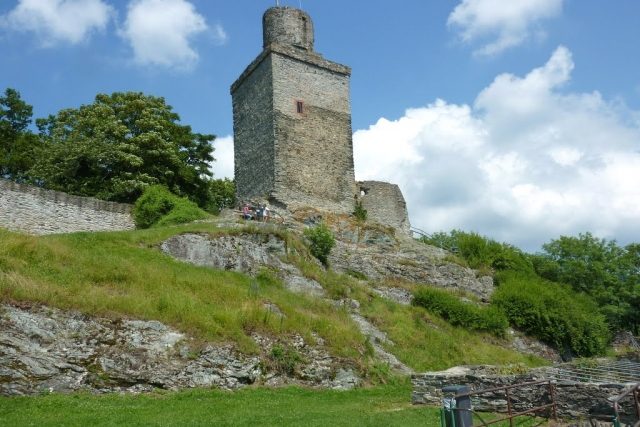
Falkenstein Castle, also known as Neu-Falkenstein, is the ruin of a hilltop castle at 450 m above sea level in the eponymous climatic health resort of Falkenstein, a district of Königstein im Taunus in the Hochtaunuskreis in Hesse.
The castle ruin is widely visible, both from Königstein im Taunus and from the direction of Kronberg im Taunus. From the castle ruin, Frankfurt am Main and large parts of the Rhine-Main plain can be overlooked. Nevertheless, the complex is not overrun by tourists, partly because it is not signposted outside the village. The ascent is located near the Catholic church, branching off from Reichenbachweg; there is a sign there. The castle can only be reached on foot. The path from the Catholic church is about 330 meters long and leads uphill. Neighboring castles are Königstein to the southwest at about 1.5 kilometers as the crow flies and Kronberg to the southeast at about three kilometers as the crow flies.
The castle was built in the middle of the 14th century by the Lords of Bolanden-Falkenstein, who had their main seat on the Donnersberg at Falkenstein Castle in the Palatinate, as Neu-Falkenstein Castle, directly next to Nürings Castle, which presumably dates back to the 11th century. In 1364, it was first mentioned in connection with the Imperial War against Philipp VI of Falkenstein.
From the end of the 14th century, the castle changed owners in rapid succession. The Counts of Sponheim were followed by Philipp of Nassau (1385) and the Lords of Hattstein as well as the Lords of Kronberg, who were first vassals and then owners. Around 1500, the curtain wall was reinforced by flanking towers and the late Gothic keep in butter-churn shape (similar to that in Idstein) was added. At the beginning of the 17th century, the castle came into the possession of the Lords of Staffel.
By deed of January 18, 1680, Adolf Johann Karl Freiherr von Bettendorf (as successor to the childless Gerhard Adam von Staffel) received Falkenstein Castle and village as a Nassau-Weilburg fief.
The end of the castle came after the Thirty Years' War. It lost its importance and fell into disrepair. Parts were still inhabited by the Lords of Bettendorf until about 1780, but were then demolished. The gradual demolition of the remaining complex was only stopped in 1842. The entrance gate visible today is a reconstruction from this period.
In 1945, the castle complex became the property of the then municipality of Falkenstein. Due to the lack of a "castle restaurant", a water connection and sanitary facilities, celebrations, theater plays and overnight stays at the castle are not possible. The Falkenstein Local History Association is committed to the preservation of the local landmark both ideologically and materially through donations. Once a year in summer, a public festival of the Falkenstein Men's Choir (MGV Falkenstein) takes place there. This association also uncovered the only cellar inside the castle in the 1970s.
The castle ruin was immortalized in literature by the poet Stefan George (1868-1933) in his last volume of poetry, Das Neue Reich (1928), with the poem Burg Falkenstein: "To the wooded peak / I ascended beside you / Where on a rough-straight corner tower / the round tower rises [...]"
Complex+
The curtain wall, part of the shield wall, the 18-meter-high keep on a base area of 6.75 by 6.75 meters with its elevated entrance at a height of four meters, remains of buildings on the east side, and two cannon towers are well preserved. The size of the core castle was about 90 by 30 meters. The rectangular keep dates from the 14th century with its round turret from the 15th century.
The entire castle ruin is currently (as of: end of 2013) open daily from March to October from 10:00 to 19:00. From November to February, the castle complex is only open on weekends from 10:30 to 16:30. As a rule, access is controlled by members of the Falkenstein Local History Association and an entrance fee of two euros per person is charged. The Dettweiler Tempel, located in the immediate vicinity, is freely accessible as a viewpoint at all times.
The keep cannot currently be visited, but is opened irregularly during festivities. In the summer months, it is also generally open to the public once a month - usually on a Saturday. Beyond the Opel Zoo and Kronberg Castle, the castle offers a very beautiful view of the Rhine-Main plain.
The castle is integrated into the 3-Castle Trail Königstein – Falkenstein – Kronberg, created in 2013 by the Taunusklub e.V.
Take Mobile History with you
You are reading this text for free. Premium adds what matters on the road: descriptions read aloud, sites found through your camera, whole regions taken offline.
- Every description, including the ~17,700 Premium sites
- Audio guide: have descriptions read to you on location
- AR finder: see sites through your camera, with distance and bearing
- Unlimited saved sites
14 days free, then from €2.99 a month. Cancel anytime.
Source: Wikipedia · Licence: CC BY-SA 4.0 · Image: Joachim Schneeleopard
This description draws on the facts documented in the linked Wikipedia article; Wikipedia content is licensed under CC BY-SA 4.0. Wording and editing: Mobile History.
Location: 50.1903, 8.4767