The remains of the Castle can be visited
CastleHofkirchen im Mühlkreis
Falkenstein Castle
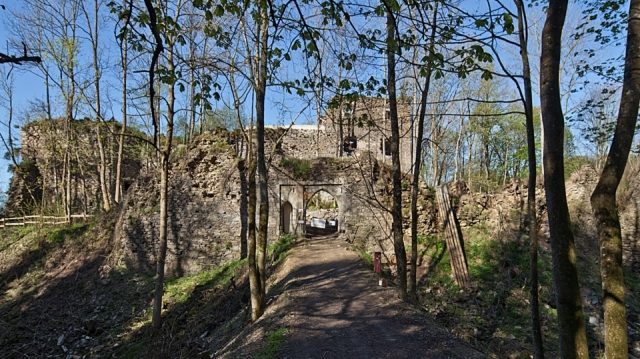
The castle ruin Falkenstein is located above the Ranna valley near Hofkirchen im Mühlkreis in the district of Rohrbach in Upper Austria. It was first mentioned in a document in 1140. Falkenstein was a large castle complex and an important noble seat, for whose possession fierce disputes were fought in the Middle Ages. A historically significant personality from Falkenstein was Zawisch von Falkenstein († 1290). From Falkenstein, Schlägl Abbey and the district capital Rohrbach were founded.
The present castle ruin lies on a rock ridge steeply sloping on three sides towards the Ranna river flowing past to the west, at an altitude of 490 m above sea level, and is located near the village of Falkenstein of the same name in the municipality of Hofkirchen. From the Hofkirchen town center, the linear distance is approx. 2.3 km; from the mouth of the Ranna into the Danube, the complex is 2.2 km away.
The castle ruin can be reached by driving from Hofkirchen im Mühlkreis towards Altenhofen and following the signposted path to Falkenstein castle ruin at the Meierhof located on the road (100 m from this path to the left is the castle site of Peilenstein castle ruin).
Description+
The structurally very extensive castle complex comprised a total built-up area of 2,960 square meters. At the tip of the rock formation converging to the west above the Ranna valley, the keep was located on the outermost rock plate, to which the main castle with the palas was connected, dominated by two towers. In front of it, the outer bailey, consisting of an elongated building including the gate entrance, was later built to improve the security of the complex against the hillside to the east. From there, a bridge led over a 25-30 m wide neck ditch into the open.
Approximately 80 m opposite the entrance, a squat, approx. 17 m high round defensive tower was finally erected in 1489. The purpose of this building was to secure the drinking water supply: the tower was built over a spring and housed a well in its deepest floor, from which an underground pipeline led into the castle. The tower, with a total of five floors inside, could be entered through an access point to the middle floor at a height of 4.5 m.
The first documentary mention of the castle dates back to 1140. The high-noble family of the Falkensteiner (referred to as Valchenstain in 1140) already owned the complex at that time and derived its name from the castle. The first to name himself after this castle was Adelram de Valchenstain. Kalhoch von Falkenstein, the founder of Schlägl Abbey (1218), also came from the ranks of the Falkensteiner. The place name Kollerschlag (= Kalhochschlag) commemorates the clearing activities of this Falkensteiner.
Through the marriage of the last heiress of Falkenstein to Budiwoy von Skalitz, the Falkenstein dominion passed to the Rosenberg family, a collateral line of the Witigonen. Their son was Zawisch von Falkenstein († 1290), who named himself after the Falkenstein inheritance and rose to become a leading figure in Bohemia after 1277 following an uprising against the Bohemian King Ottokar II Přemysl. Zawisch was captured in 1290 and declared dispossessed of his estates by King Wenzel II, which Duke Albrecht I of Habsburg took as an opportunity to besiege Falkenstein Castle in 1289 and force the occupiers to surrender by starvation. The Duke granted the Falkenstein dominion as a fief to a ministerial noble family, who from then on also called themselves von Falkenstein.
In 1331, the castle was pledged by Duke Albrecht II to the Walseer family. The Rosenberg family, who continued to claim the Falkenstein inheritance, went to war against the Walseer, and in a surprise attack, Leutwin Ursel von Rovenich succeeded in taking Falkenstein in 1355. Only through a high ransom payment did the castle return to the ownership of the Habsburgs, who in turn granted the pledged property to noble families, who changed several times throughout history. The Walseer held the pledged property over the dominion until 1440, then the Oberhaimer until 1490, then the Prüschenk until 1515, then the Willinger until 1527, then Jörg von Herberstein. In 1572, a fire caused devastating damage to the castle, which had by then been converted into a palace. In 1591, Heinrich Salburg redeemed the Falkenstein dominion, and in 1605, the dominion passed into the ownership of the Salburger family. He combined Falkenburg with the dominions of Altenhof and Hochhaus, which he owned, into an administrative unit, whose seat was moved to Altenhof. Falkenstein Castle was left to decay. Until 1887, the complex was still occasionally inhabited by hunting personnel. In 1860, the palas and the keep collapsed, and a strong storm in 1911 uncovered the last buildings. Through an initiative in the 20th century, at least the water tower was saved from decay. Efforts are currently underway to save the ruin from further decay and make it accessible to visitors again.
The castle ruin still belongs to the counts Salburg of Altenhof today.
Legend of the Water Nymph Lilofee+
The legend of the nymph Lilofee is associated with the water tower of Falkenstein: Othmar der Oberhaimer is said to have fallen in love with a beautiful woman, who was a nymph, on his way back from the imperial palace on the Rhine. She was willing to move with him to his castle, but only on the condition that she could spend every full moon night alone in the water tower. This went well for a long time, until envious people incited Othmar to check what his wife was doing in the tower. Made curious, he crept to the tower and peeked through a crack in the door. He saw his wife sitting by the water, but instead of feet, she had a fin. Thereupon, a thunder crashed, and the nymph Lilofee was gone forever, and Othmar was left to regret.
Take Mobile History with you
You are reading this text for free. Premium adds what matters on the road: descriptions read aloud, sites found through your camera, whole regions taken offline.
- Every description, including the ~17,700 Premium sites
- Audio guide: have descriptions read to you on location
- AR finder: see sites through your camera, with distance and bearing
- Unlimited saved sites
14 days free, then from €2.99 a month. Cancel anytime.
Source: Wikipedia · Licence: CC BY-SA 4.0 · Image: http://www.wehrbauten.at/ooe/oberoesterreich.html
This description draws on the facts documented in the linked Wikipedia article; Wikipedia content is licensed under CC BY-SA 4.0. Wording and editing: Mobile History.
Location: 48.4942, 13.7841