The remains of the Castle can't be visited
CastleWabern-Falkenberg
Falkenberg Castle
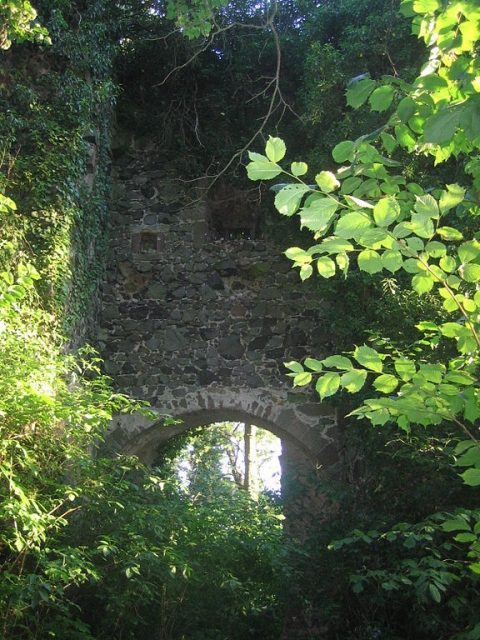
The Falkenberg ruin, also known as Alte Burg and Oberburg, is the ruin of a hilltop castle at 255 m above sea level in the Falkenberg district of the municipality of Wabern in the Schwalm-Eder district in North Hesse. It stands on a basalt cone 255 m above sea level and is surrounded by a nature-protected elm forest.
Construction History
The Oberburg was probably built around the middle of the 13th century by Konrad von Hebel at a strategically important point on the road from Hersfeld to Fritzlar, Gudensberg and Kassel. It was first mentioned in 1250 as Valkenberc in a document of Count Gottfried I of Ziegenhain, in which Konrad von Hebel is listed as the first witness. Around 1270, Konrad's descendants, starting with his son Otto I, adopted the family name "von Falkenberg", while Konrad's brother Heinrich, who continued to live in Hebel, retained the name "von Hebel". The Falkenberg branch of the family split in the 14th century with the three sons of Otto I into the three lines of Falkenberg, Densberg and Herzberg.
Hessian-Mainz Dispute
In 1309, Johann and Konrad von Falkenberg enfeoffed their castle, which had previously been in their own possession, and the villages of Falkenberg, Uttershausen, Hebel and Mardorf to Landgrave Johann of Lower Hesse and subsequently received these estates back from him as a fief. The Falkenberg family subsequently tried to avoid being crushed in the disputes between Kurmainz and the Landgraviate of Hesse by acting tactically. The Lower Castle was therefore a Hersfeld fief of the Lords of Hebel. On the other hand, the scholastic Hermann von Gruna and the Fritzlar canon Hermann von Falkenberg, the knight Johann von Falkenberg, and the squires Konrad Hebel and Thilo Hebel became hereditary burgmannen of the nearby Mainz city of Fritzlar in 1321. For this, the Falkenberg and Hebel families made their Falkenberg Castle available to the Archbishop of Mainz as an open house. In 1322, the Lords of Falkenberg renewed their agreement with Archbishop Matthias. The Mainz official and burgmann Johann Gruszing von Falkenberg again opened Falkenberg Castle to the Mainz archiepiscopal administrator Balduin von Luxemburg in 1336. Likewise, the squires Tile (Thilo) and Hermann von Falkenberg renewed this opening obligation in 1338. In the same year, however, the Falkenbergers were also enfeoffed by the Landgrave of Hesse with the villages of Rockshausen, Wolfshausen, Beisheim and Kleinbeisheim; in return, they had to commit to opening their castle to the Landgrave against all enemies, except Mainz.
In 1347, the Hessian Landgrave Heinrich II insisted on the feudal lordship over the castle and finally achieved that the Archbishop of Mainz Gerlach committed not to use the castle militarily against the Landgraviate of Hesse. In 1354, Archbishop Gerlach formally ceded the castle to Hesse.
In 1354, Johann Gruszing von Falkenberg pledged half of Jesberg Castle, located further southwest, which he himself held as a pledge castle from the Mainz archdiocese, to his relative, the knight Thile von Falkenberg. Archbishop Gerlach then summoned Johann Gruszing to Densberg, where he partially rebuilt Densberg Castle in 1355, but against the will of Landgrave Heinrich. In 1356, Archbishop Gerlach showed understanding that Thile and Hermann von Falkenberg could no longer support him with their castle, as they had lost it to the Landgrave in service of the archdiocese.
In 1358, Archbishop Gerlach settled a dispute between the brothers Otto and Johann Gruszing von Falkenberg on the one hand and Thile von Falkenberg on the other. This family feud nevertheless escalated, and military actions are documented in the area of Falkenberg Castle in 1358.
In 1359, Johann Gruszing von Falkenberg was commissioned to finally build a castle for Archbishop Gerlach in Densberg.
In 1362, numerous complaints were addressed to the Archbishop and the Landgrave from Löwenstein Castle, Falkenberg Castle and Kogelberg Castle. In June 1364, Archbishop Gerlach's persistent attempts finally succeeded. Heinrich von Hanstein occupied Falkenberg Castle in the service of the Archbishop. However, he acted selfishly and drove out the Mainz burgmann Konrad IV von Falkenberg and his servants. Thus, the castle was again not in the possession of the Archbishop.
The dispute between the Landgrave and the Archbishop over Falkenberg Castle was negotiated again without result in August 1364. In May 1365, Archbishop Gerlach demanded from Landgrave Heinrich that Johann Gruszing von Falkenberg should help him regain his castle, as this agreement had already been made in 1354.
In the Sternerbund 1372/74, the Falkenbergers again joined an alliance directed against Landgrave Heinrich, and their influence was significantly strengthened during this time by further Mainz appointments and enfeoffments. In 1374, Werner II von Falkenberg became Mainz's chief official for Hesse, Thuringia and Eichsfeld. On September 29, 1391, four Falkenbergers became founding members of the Benglerbund.
Konrad von Falkenberg, Werner's son, also known as "Kunzmann", was involved in the murder of Duke Friedrich of Braunschweig-Lüneburg, who was proposed as a candidate for king at the Frankfurt Princes' Day, on June 5, 1400. Friedrich was on his way home from Frankfurt to Braunschweig when Count Heinrich VII von Waldeck, Konrad ("Kunzmann") von Falkenberg, Friedrich III von Hertingshausen and a knight von Löwenstein ambushed him and killed him in a skirmish near the present-day village of Kleinenglis.
The castle, in which the families Falkenberg, Hebel, Holzsadel, Riedesel and Urff now had shares, suffered considerable damage during this period of feuds and wars and was repaired and reinforced between 1437 and 1454. It fell into disrepair after the Falkenbergers inherited and moved to Falkenberg Castle, which was built by the von Hebel family around 1510 about 500 m further south in Falkenberg, in 1521, with the extinction of the von Hebel family. After 1621, the castle was demolished.
Current State+
Of the castle built on a steep conical hill, only the square substructure of the residential tower-like keep and the overgrown enclosing walls of the core castle on the northeast side remain. The ruin is not accessible.
Take Mobile History with you
You are reading this text for free. Premium adds what matters on the road: descriptions read aloud, sites found through your camera, whole regions taken offline.
- Every description, including the ~17,700 Premium sites
- Audio guide: have descriptions read to you on location
- AR finder: see sites through your camera, with distance and bearing
- Unlimited saved sites
14 days free, then from €2.99 a month. Cancel anytime.
Source: Wikipedia · Licence: CC BY-SA 4.0 · Image: http://de.wikipedia.org/wiki/Ruine_Falkenberg_%28Wabern%29#mediaviewer/Datei:Burgruine_Falkenberg.JPG
This description draws on the facts documented in the linked Wikipedia article; Wikipedia content is licensed under CC BY-SA 4.0. Wording and editing: Mobile History.
Location: 51.0727, 9.3957