Museum
CastleEppstein
Eppstein Castle
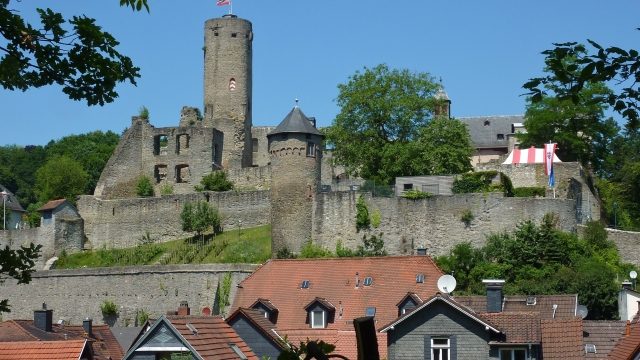
Eppstein Castle is the ruin of a hilltop castle at 200 m above sea level, above the Hessian town of Eppstein in the Main-Taunus district. Built on the rock spur of a ridge and separated from the ridge by a neck ditch, it represents a typical spur castle. It was the main residence of the Lords of Eppstein, who named themselves after their ancestral castle.
By the beginning of the 14th century, a settlement had formed at the foot of the castle, which was granted town rights in 1318. From it grew the present-day town of Eppstein.
Inhabitants and Owners+
Recent building archaeological investigations in the vicinity of the palas confirm the 10th century as the founding period of the castle. It was built as an imperial castle for border security and first mentioned in a document in 1122. Only two years after its first mention, Emperor Henry V donated half of it to the Archbishopric of Mainz, which shortly thereafter was able to acquire the other half as well.
At the end of the 12th century, the castle came as a fief to the Lords of Hainhausen. They subsequently named themselves Lords of Eppstein after their new residence and made the complex the center of their territory.
After the division of the Eppstein family into two lines, the complex was in the possession of the Eppstein-Münzenberg line from 1433.
Already in 1492, due to financial difficulties, the Lords of Eppstein had to sell the western half of the castle to the Landgraviate of Hesse. The latter had its part expanded and rebuilt in the style of a palace and established an administrative center there.
When Eberhard IV von Eppstein-Königstein, the last male representative of the family, died in 1535, the remaining eastern half of Eppstein Castle first fell to the Counts of Stolberg and then in 1581 to Kurmainz, which administered its numerous possessions from the Eppstein inheritance from here.
After the reorganization of Germany in 1803, Eppstein Castle fell to the Duchy of Nassau. Since the formerly Hessian half had been vacant since 1776, these buildings had fallen into disrepair and were no longer habitable. Nassau therefore auctioned off the complex for demolition in 1804. The new private owner had the buildings demolished by 1823 - with the exception of a building in the east, which had previously housed, among other things, the armory and at that time served as a Catholic church - to use the stones as building material.
In 1824, the Austrian Baron Franz Maria von Carnea-Steffaneo di Tapogliano zu Kronheim und Eppenstein acquired the ruin, mistakenly believing himself to be a descendant of the Lords of Eppstein. A descendant - Franz Maria von Carnea-Steffaneo died in 1825 - sold it in 1869 to Count Otto zu Stolberg-Wernigerode. His son had the remains excavated and secured from 1906 onwards, to donate them to the town of Eppstein in 1929.
Supported by the Main-Taunus district, the Hessian State Office for Monument Preservation, as well as sponsors and the Eppstein Castle Association e.V., Eppstein's landmark has been continuously renovated by the city since 1968 to preserve it.
Description+
The building fabric of Eppstein Castle preserved today dates primarily from the 14th and 15th centuries.
Particularly striking is the round keep of the complex. It has a square substructure and flat dome vaults are preserved inside. In the Middle Ages it was 33 meters high, of which 24 meters are still preserved today. Its two original high entrances are still visible. They were accessible via the roofs of the eastern adjoining buildings and via the attic of the palas adjoining to the south.
This palas had four stories and, like the keep, dates from the 14th century. Only a few remains of the two lower stories are preserved.
Better preserved is the so-called kitchen building, which adjoins to the east of the keep. Of the building built around 1500 by Kurmainz directly on the curtain wall, its outer facade and the ground floor of the courtyard-side facade are still standing. The ground floor originally housed the Kemenate, the women's quarters.
The castle complex has two entrances. The eastern one is accessible via a neck ditch bridge, while the main gate in the west is reachable via a steep castle path.
The former defensiveness is documented by the remains of large Zwinger (outer bailey) systems around the core castle. Components of these were also two flanking towers in the south, of which today the so-called Bettelbub is still preserved. The tower received its name from the use of its cellar as a debtors' prison.
The only completely preserved part of the castle is located in its east. The Mainz Castle was built by Kurmainz and also had a chapel since 1765. It is thanks to the fact that this was still used until 1903 that the building was not used as a quarry like the other buildings.
The Castle Today+
The preserved building of the castle now houses the Town and Castle Museum, which was initially located in the Bettelbub and moved to the current building in 1926. In 2007, it counted 8,825 visitors.
In addition, numerous cultural events take place in the ruin, such as the Eppstein Castle Festival, held annually since 1913.
Furthermore, the Kemenate, made usable again by a new roof and windows, can be rented for private events.
Legends+
A number of legends surround the founding of the noble family of Eppstein and Eppstein Castle. In a chronicle from 1583, the Eppsteiners themselves trace their lineage back to a Roman family Appia Claudia. Since 1843, it has been speculated that the Eppstein family descends from Duke Eberhardt. The story of the knight Eppo, who is said to have founded the castle, is often cited. This figure, first mentioned by the Darmstadt historian Helfrich Bernhard Wenck, is said to have, according to a version first printed in 1828, freed the beautiful maiden Bertha von Bremthal from the clutches of a giant and thrown him to his death into a gorge. The giant's rib was displayed in the castle above the castle gate until 1854. Today, the bone is in the collection of Nassau Antiquities in Wiesbaden. However, it is not the bone of a giant but of a whale from the 7th or 8th century AD. A copy of the bone is displayed at the castle.
Take Mobile History with you
You are reading this text for free. Premium adds what matters on the road: descriptions read aloud, sites found through your camera, whole regions taken offline.
- Every description, including the ~17,700 Premium sites
- Audio guide: have descriptions read to you on location
- AR finder: see sites through your camera, with distance and bearing
- Unlimited saved sites
14 days free, then from €2.99 a month. Cancel anytime.
Source: Wikipedia · Licence: CC BY-SA 4.0 · Image: Joachim Schneeleopard
This description draws on the facts documented in the linked Wikipedia article; Wikipedia content is licensed under CC BY-SA 4.0. Wording and editing: Mobile History.
Location: 50.1404, 8.3931