The remains of the castle can be visited
CastleSchöningen
Elmsburg Castle
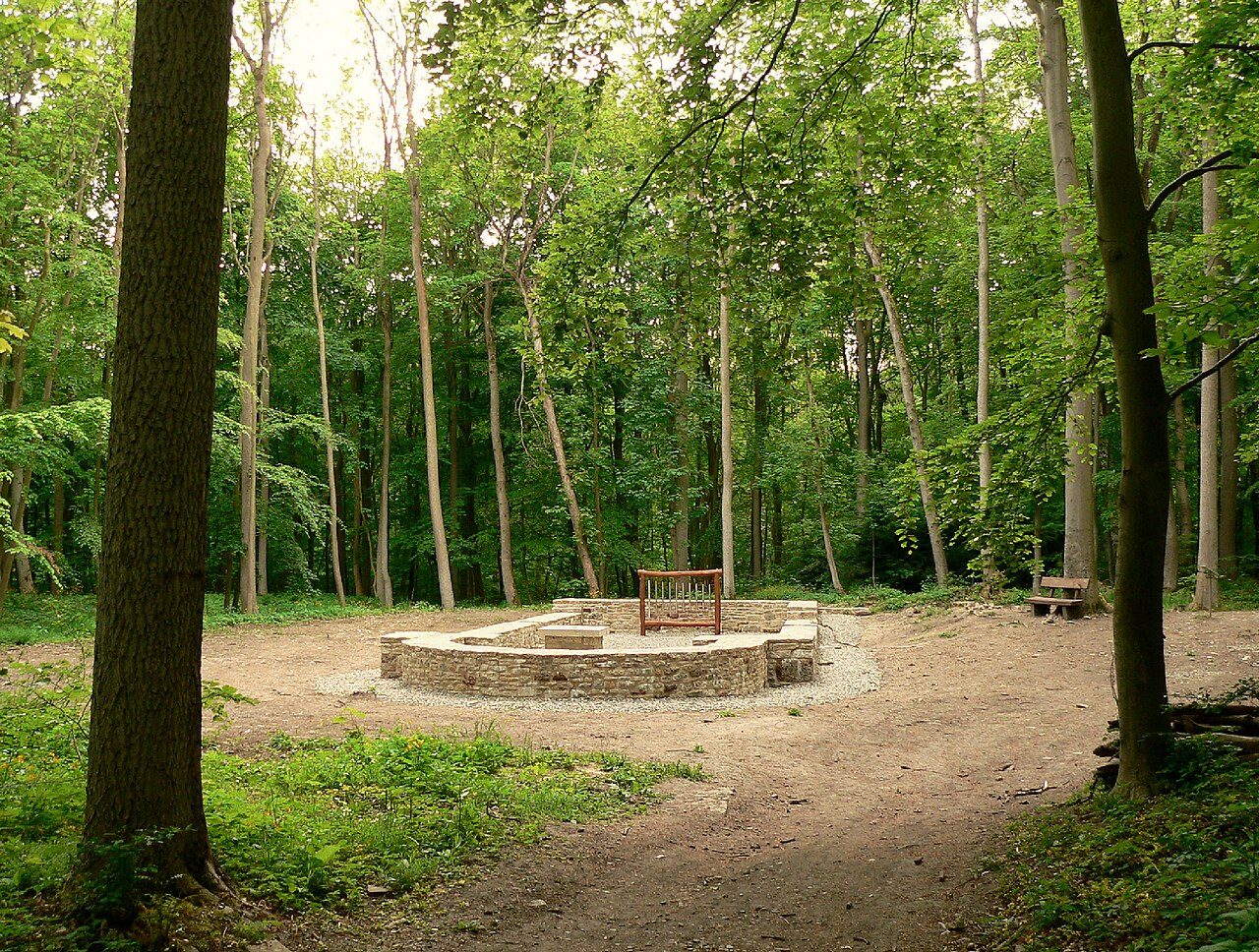
Elmsburg was a medieval hillside castle from the 11th century onwards, located amidst a prehistoric ring fort in the Elm. Its remains lie in the Schöningen Forest at an altitude of about 270 m above the village of Twieflingen in the Helmstedt district. Only foundation parts of the castle, which was abandoned in the 16th century, remain, uncovered during excavations in the 20th century.
Documentary evidence about the castle complex states that Emperor Otto IV bequeathed the church located within it to the monastery in Scheverlingenburg of Walle in 1213. As the monastery did not last, the emperor donated both institutions to St. Blasius Abbey in Braunschweig in 1218. In 1221, Count Palatine Heinrich transferred the castle to the Teutonic Order, which established a commandery there. Under Duke Otto the Child, the Order's complex was expanded around 1240 with forest, land, and soil. The commandery's possessions continued to grow, and in 1264, it was probably moved to Lucklum due to spatial constraints. A small house commandery with its own commander remained in Elmsburg until 1318. In 1364, Elmsburg was last mentioned as an Order castle before it was enfeoffed to the noble family von Ampleben and later to bourgeois families. Its decay began after a major fire in 1572, leading to its abandonment. Subsequently, the stones of the complex were removed to improve forest roads and for building construction in Twieflingen.
Description and Excavation+
The remains of Elmsburg were already surveyed around 1840 by a forester. He compared the complex with other castles in the Elm. Excavations on the castle grounds took place between 1959 and 1962.
The outer ring fort from prehistoric times has a diameter of about 137 by 114 m and a height of 2 m. It was investigated at several points during excavations. It consists of earth without a stone core. The builders of the medieval castle grounds used it as an outer fortification.
The medieval castle was built within the outer wall on a slightly elevated spot, surrounded by a low wall. During the excavations, the foundations of the former castle chapel were uncovered. The church had dimensions of about 16 x 8 m. The building materials reveal that the church was built twice. The first church dates from the 11th century and formed a T-shaped building with a large central apse and two smaller side apses. Later, an axially shifted rectangular building with only one apse was added over this, and a partition wall was installed in the west. It consisted of red Keuper sandstone and was razed to its foundations. On top of this, with a slightly shifted floor plan, a new church with walls of Elm limestone was built in the 13th century during the time of the Teutonic Order. 8 graves with skeletons were found in the church floor. On the castle grounds, there are larger earth holes, which are collapsed cellars of former buildings. A well, restored during the excavations, is also present.
Near the prehistoric wall on the outside, there are 11 burial mounds of the Unetice culture from the Early Bronze Age. Skeletal remains of children were found inside them. Today, the historical sites around Elmsburg are marked with signs and are easy to find.
Take Mobile History with you
You are reading this text for free. Premium adds what matters on the road: descriptions read aloud, sites found through your camera, whole regions taken offline.
- Every description, including the ~17,700 Premium sites
- Audio guide: have descriptions read to you on location
- AR finder: see sites through your camera, with distance and bearing
- Unlimited saved sites
14 days free, then from €2.99 a month. Cancel anytime.
Location: 52.1443, 10.9194