The remains of the Castle can be visited
CastleÜxheim - Ahütte
Dreimühlen Castle
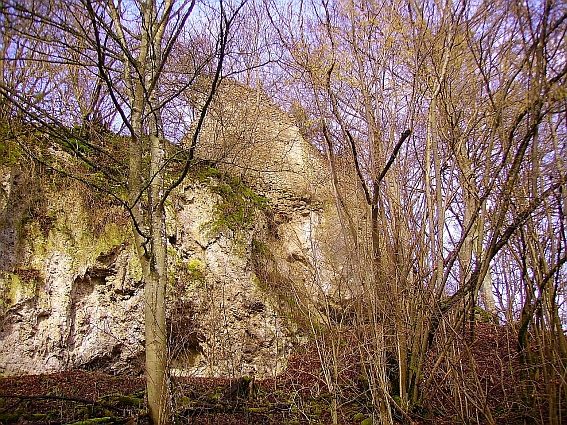
The Dreimühlen ruin, also known as Haus Dreimühlen, is the ruin of a small hilltop castle in the Eifel. The castle is located at 380 m above sea level in the Kalkeifel, a natural sub-region of the North Eifel between the High Fens and the Volcanic Eifel in Rhineland-Palatinate, near the state border with North Rhine-Westphalia. It is situated in the municipality of Üxheim (Vulkaneifel district) between the districts of Ahütte and Niederehe, and the neighboring municipality of Nohn. The complex stands on a tuff hill to the left (west) of the Ahbach stream.
Since there have been no excavations at the castle to date, little is known about its history from written sources. However, nothing is known about its appearance. The noble family of the Lords of Dreimühlen first appeared in 1218, when an Oda v. Drimollen is mentioned in a document by the Archbishop Engelbert of Cologne in connection with a donation to the Niederehe monastery. In 1282, the castle was sold to Gerhard IV von Blankenheim for a price of 60 Cologne Marks, which corresponded to the equivalent of a good 14 kilograms of silver at the time. This suggests that the castle was not particularly significant or large. The acquirer, in turn, transferred the complex back to the sellers as a fief. In 1343, the Blankenheims gave Haus Dreimühlen as a fief to Bernhard V (Lippe), who assigned it to his wife Richarda as a dower. In 1400, it was last held as a fief by the Blankenheims until Werner von Dreymüllen's death. In 1431, Count Gerhard von Blankenheim assigned the castle Dreimölen to his wife Margareta, Countess of Mors, as a dower. In 1468, the castle came into the possession of Count Dietrich III von Manderscheid through an inheritance from his wife Elisabeth von Schleiden. In 1473, he had it devastated during a feud so that the liege lord Gerhard von Jülich und Berg could not take possession of it. In the same year, he described his house Dreimühlen as "burnt and wasted". The ruin was not rebuilt in the following centuries and changed owners several times. Through the childless marriage of Dietrich IV von Manderscheid with Margareta von Sombreff-Kerpen, the property came under the rule of Kerpen. After Dietrich's death, Philipp von der Mark seized the rule of Kerpen and thus also the ruin. A long-standing inheritance dispute followed between the House of Mark and the Dukes of Arenberg, to whom the rule of Kerpen and thus also the ruin were awarded in 1674 by a judgment of the Imperial Chamber Court.
Probably before 1740, they had a stone house built on the site of the ruin. In 1774, Duke Karl von Arenberg had the "Maison de Dreymiihlen," now used as an agricultural estate and forester's house, inspected by an architect. He described it as follows: "The two-story house Dreymühlen was built about 30 years ago from ashlar. However, everything is in poor condition and on the verge of collapsing. Because the walls have sunk in two places and are cracked from top to bottom, repair is useless." In another report from 1780 to Duke Ludwig Engelbert, the condition was described as even more dilapidated. However, no repair was ever carried out, nor was a proposed new building erected. After the Duchy of Arenberg and its possessions passed to the French state at the beginning of the 19th century due to the provisions of the Peace of Lunéville, Haus Dreymühlen was auctioned off "for demolition" in 1807. This took place in the following years, leaving only the wall remnant that still exists today.
Current State+
The now only minor remains of Haus Dreimühlen essentially consist of a rubble stone wall still rising a few meters. The complex is neither inhabited nor managed and is freely accessible at all times. Due to its only minor state of preservation, a visit is actually only worthwhile in connection with the neighboring Dreimühlen Waterfall, which was named after the ruin, or for true castle enthusiasts.
Marked hiking trails, including the Geo-Pfad Hillesheim and the Eifelkrimi-Wanderweg, lead through the Ahbach valley in the immediate vicinity of the ruin. Furthermore, the Kalkeifel Cycle Path and the Mineralquellen Route (with a connection to the Ahr Cycle Path in the north) run along here as sections of a supra-regional long-distance cycle path network, utilizing parts of the former railway line of the dismantled (upper) Ahrtalbahn in the section between Ahrdorf and Niederehe/Lissendorf.
Monument and Nature Protection+
The ruin is designated as a cultural monument and is therefore under monument protection. It is located in the Ahbachtal nature reserve with the Ahbach stream, valley floor, and wooded valley slope, covering an area of over 56 hectares, and the Dreimühlen Waterfall natural monument.
Legend+
A legend about the witch on Dreimühlen Castle surrounds the ruin.
Take Mobile History with you
You are reading this text for free. Premium adds what matters on the road: descriptions read aloud, sites found through your camera, whole regions taken offline.
- Every description, including the ~17,700 Premium sites
- Audio guide: have descriptions read to you on location
- AR finder: see sites through your camera, with distance and bearing
- Unlimited saved sites
14 days free, then from €2.99 a month. Cancel anytime.
Location: 50.3265, 6.7693