The remains of the Castle can be visited
CastleJesberg-Densberg
Densberg Castle
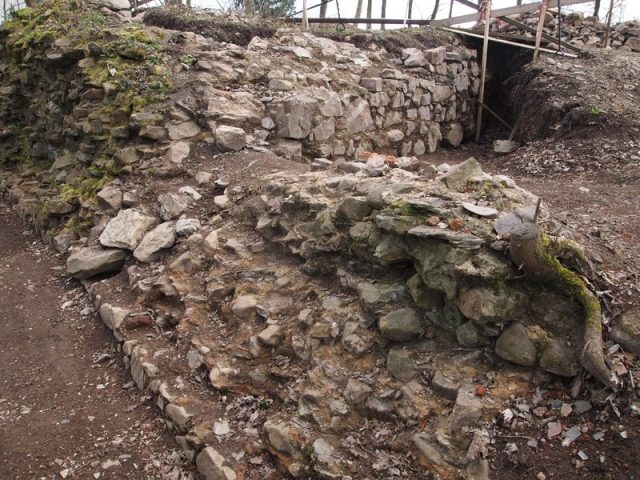
The castle ruin Densberg is located in Densberg, a present-day district of the municipality of Jesberg in the Schwalm-Eder district in North Hesse. Of the former small motte-and-bailey castle, only some wall remains are found today on the castle hill near the village church, surrounded by a mighty neck ditch with a ring wall. The former castle moat now houses an open-air stage, where theater performances take place annually in summer.
Mainz Electoral Property
The village of Densberg (Denisburc) is first mentioned in 1085 in a document of the Archbishop of Mainz, Wezilo, as property of Mainz. The castle, which was probably only a small complex with a tower and a residential building, was first mentioned around 1190 as the seat of Mainz and Ziegenhain castellans ("castellani"), and around 1230–1240 a villicus (administrator) Ortmarus von Densberg is named.
Due to its strategically important location, there were repeated armed conflicts in the 13th and 14th centuries between the Archbishopric of Mainz and the Landgraves of Hesse over its possession, as well as over that of the neighboring castles of Jesberg and Schönstein. As early as 1232, the castle was first destroyed by Landgrave Konrad of Thuringia during his campaign of devastation against Mainz possessions in Lower Hesse. After that, the security of the roads and the protection of Mainz property became the task of the castle in Jesberg.
Densberg was not mentioned again until 1346, when Archbishop Gerlach redeemed the Mainz castle of Jesberg, including its appurtenances (except for the villages of Densberg and Rommershausen), from the pledge of the knight Johann von Falkenberg, also known as Gruszing (or Grüßing), from the Densberg branch of the Falkenberg family. Densberg remained pledged to the Falkenberg. Soon after, probably in 1349, Johann Gruszing received permission from the Mainz diocesan administrator Kuno von Falkenstein (with the consent of the Archbishop) to build a new castle in Densberg and to serve there as a castellan. Already in 1350, the castle was again destroyed by Hessian troops due to a border dispute, but despite the feud lasting until 1353, it was soon rebuilt by Johann Gruszing.
In 1354, the castle was supposed to be demolished due to a peace treaty concluded between Mainz and Hesse on May 10, 1354, but it did not come to a total demolition. To regain his castle Haldessen, which he had lost to Landgrave Heinrich II in 1350, Archbishop Gerlach von Nassau had committed to hand over Sababurg to the Landgrave and to besiege Densberg Castle and not withdraw until it was broken. Gerlach's men took the castle, but without causing too much damage.
In 1354, Johann Gruszing von Falkenberg had pledged half of Jesberg Castle, which he held in pledge from Mainz, to his relative Tile von Falkenberg. Archbishop Gerlach then ordered Johann back to Densberg, where he rebuilt the castle in 1355. This caused considerable displeasure with Landgrave Heinrich II, who insisted on its demolition, and the Archbishop had to commit a second time in 1355 to demolish the castle. This again happened only partially, and the damage was practically immediately repaired.
Jesberg Castle, pledged to Johann Gruszing von Falkenberg, was redeemed by Archbishop Gerlach in 1359, but Densberg Castle remained Johann Gruszing's pledged property and was further expanded by Tile von Falkenberg, who may have been a partial pledge holder. In December 1359, Johann Gruszing received renewed permission from Archbishop Gerlach to build a castle, which, as in 1349, made him and his descendants hereditary castellans of the castle; it is not clear whether the castle had been destroyed again or whether the building permit was related to an attack by Hessian people under Johann Doring, who had set fire to the Densberg church (Doring was sentenced in 1362 to compensation to the Archbishop for this act). Johann Gruszing's descendants now called themselves "von Falkenberg zur Densburg".
The dispute between Mainz and Hesse continued, and around 1365/67 the castle seems to have been damaged anew, because in 1367 Johann Gruszing and his sons began a renewed reconstruction. In 1380, troops of Landgrave Hermann II besieged the castle during a renewed feud with Mainz, but in vain; they devastated the village.
Through the marriage of one of Johann Gruszing's daughters, half of the castle came to the von Dernbach family, who held their part until 1427. The last male descendant of Johann Gruszing was Hans von Falkenberg zur Densburg. His daughter Elisabeth was married to Henne von Linsingen. Hans, who had no male heirs, bequeathed his share of the castle in 1426 to his cousin Hermann von Falkenberg, leading to a long inheritance dispute. This was only settled when Elisabeth ceded her rights to Hermann's son, Hans von Falkenberg, for a payment of 160 guilders.
Meanwhile, Archbishop Konrad III of Mainz had probably enfeoffed Ebert von Dernbach with the castle (and even in 1455 there was a dispute about this between Ebert von Dernbach and Hans von Falkenberg), but it probably came into the possession of the von Urff family, at least temporarily, as a pledge as early as 1426.
After the Mainz defeats in the Mainz-Hessian War of 1427 in the battles of Fritzlar and Fulda, which finally secured Hessian supremacy in Lower and Upper Hesse, Mainz had to cede most of its possessions in North Hesse to Landgrave Ludwig I. Thus, Densberg Castle also nominally came to the Landgraviate, but remained pledged to the von Urff family. Hans von Urff enfeoffed it to the Landgrave in 1458, but he and his son Heinrich held it as pledged property until 1483.
In the Hessian Fratricidal War of 1469 between Landgraves Ludwig II of Hesse-Kassel and Heinrich the Rich of Hesse-Marburg, Densberg Castle was destroyed by Bohemian mercenaries of Landgrave Ludwig II, as were Schönstein Castle and Jesberg Castle.
Landgravial-Hessian Property
In 1483, Landgrave Wilhelm I redeemed the pledge on the ruin of Densberg Castle for 600 Rhenish guilders. After partial reconstruction, he gave it in 1489 for life to his bailiff in Schönstein, Hermann Huhn von Elkershausen, to whom he owed 400 guilders and 50 guilders annual service money.
The last mention of Densberg Castle dates from 1506. Hermann Huhn had died, and the Landgrave sold Densberg and Schönstein castles, which had reverted to him, to Otto Hund for 400 guilders. After that, the castle fell into disrepair and was used as a quarry.
Take Mobile History with you
You are reading this text for free. Premium adds what matters on the road: descriptions read aloud, sites found through your camera, whole regions taken offline.
- Every description, including the ~17,700 Premium sites
- Audio guide: have descriptions read to you on location
- AR finder: see sites through your camera, with distance and bearing
- Unlimited saved sites
14 days free, then from €2.99 a month. Cancel anytime.
Source: Wikipedia · Licence: CC BY-SA 4.0 · Image: http://www.wehrbauten.de/thread.php?threadid=1367
This description draws on the facts documented in the linked Wikipedia article; Wikipedia content is licensed under CC BY-SA 4.0. Wording and editing: Mobile History.
Location: 50.9917, 9.0894