The remains of the Castle can be visited
CastleDorfprozelten-Kollenberg
Collenburg Castle
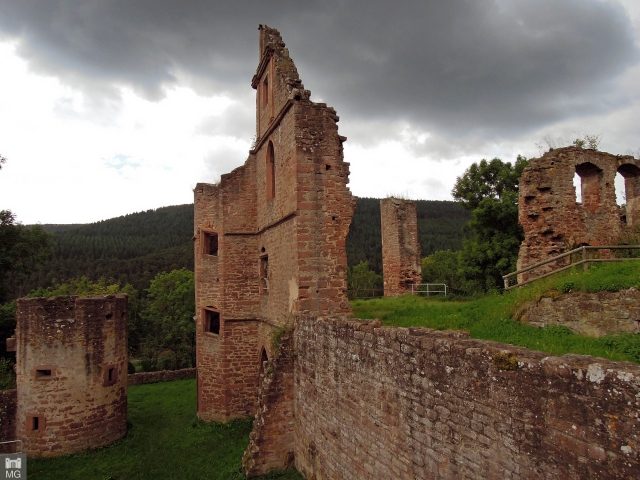
The Collenburg, also written Kollenburg, is a medieval hilltop castle of the Schenken von Limpurg and the Rüdt von Collenberg on the right bank of the Main river in the Kollenberg district of the municipality of Dorfprozelten in the Miltenberg district in Bavaria, Germany.
The ruins of Collenburg, extending in an east-west direction, are located about one kilometer east of Fechenbach, a district of Collenberg on the right bank of the Main, 50 to 60 meters above the Main valley on the southern edge of the Spessart on a sandstone spur of the Fechenberg. The sandstone rock was partly incorporated into the building structure. The ruins, surrounded by dense vegetation, are only visible from the valley in the winter months and are difficult to access. A narrow, steep serpentine footpath leads up to the castle from the Fechenbach forester's lodge. There is no access road, but the Main Valley Heights Ring Road, marked with an "R", touches the ruins.
Name+
The name Collenburg, or originally Collenberg, consists of the personal name Colbo (from Walter de Colbo) and the Middle High German word bërc for mountain or castle. The original castle name was used for the new name of the municipality of Collenberg.
The Schenken von Limpurg
In connection with the first mention of Fechenbach in 1214, the Collenburg was also first documented. Walter von Schüpf, also called Walter de Colbo after his ancestor Conradus de Colbo, the builder of the nearby Clingenburg in Klingenberg am Main and Henneburg in Stadtprozelten, is named as the builder and owner. Walter von Schüpf, who belonged to the family of the Schenken von Limpurg and whose main seat was Limpurg Castle near Schwäbisch Hall, gave the castle near Fechenbach the name Collenburg in reference to the names of his ancestors. Walter von Schüpf married Elisabeth von Königstein Reicheneck around 1250 and moved with her to the Nuremberg Hersbruck area. He remained owner of the Collenburg until Walter's death in 1268.
The Rüdt von Collenberg
Walter's widow soon after her husband's death transferred the Collenburg to the Teutonic Order, from whom Wipertus Rüde de Rüdenau took the castle as a fief and inheritance. He is the builder of Bödighheim Castle near Buchen in the Odenwald and at the time of his death in 1306 calls himself Wipertus von Bödighheim. The ancestral seat of the widespread Rüdt family was Amorbach until the end of the 13th century. However, the branch of the family from which Wipertus descended had already settled in Rüdenau near Kleinheubach near Miltenberg. Wipertus is considered the progenitor of the Rüdt von Bödighheim and the Rüdt von Collenberg. The latter designation subsequently became the name for both lines.
Wipertus' descendants on the Collenburg acquired the allod Fechenbach and Reistenhausen in 1450 and transformed it into a knightly estate. Even though around 1500 the Collenburg passed from the Teutonic Order to the Archbishopric of Mainz through territorial exchange, this did not change the feudal relations and the Knights of Rüdt remained on the castle. Their imperial immediacy was confirmed in 1541. However, the Rüdt line residing on the Collenburg died out in the male line of succession in 1635.
The Counts of Reigersberg
After the extinction of the Rüdt line of succession, the Archbishopric of Mainz was free to dispose of the Collenburg and in 1648 again granted it as a fief and inheritance to the Electorate of Mainz Chancellor Nikolaus Georg von Reigersberg, co-signer of the Peace of Westphalia. His wife was a granddaughter of the last Rüden von Collenburg. The Counts of Reigersberg resided on the Collenburg for about 100 years, until it no longer seemed befitting of their status and they moved into their newly built Fechenbach Castle on the Main in 1750. A small part of the castle served as an official residence and forester's dwelling for a few more decades. The complex, which had always been spared from war damage, began to fall into disrepair.
Barons von Bethmann
Around 1840, the forestry office moved to a newly built official building in the valley below the castle. The now uninhabited and ruinous Collenburg was increasingly used as a quarry. The Frankfurt banker Karl Freiherr von Bethmann acquired the entire Reigersberg estate in 1842. While Fechenbach Castle continued to be inhabited, his son Freiherr Alexander von Bethmann sold most of the property, some of the buildings belonging to the castle, and the Collenburg ruins to the municipalities of Fechenbach and Reistenhausen after 1918.
Current Use+
The progressive decay of the Collenburg ruins was halted by stabilization measures in the 1980s. A use similar to that of its sister castles in Klingenberg (theater festivals) and Stadtprozelten (visitor castle) was not pursued. From 2005 to 2007, the ruins were fundamentally stabilized and partially restored based on the original construction.
Description+
Within the complex, surrounded by a closed curtain wall with square towers from the 16th to 17th centuries, parts of the residential building with stair towers from the 14th to 16th centuries are preserved in the outer bailey, as are remnants of the north front of the palas and its towering east gable wall in the core castle. The access bridge and gatehouse with archways from 1589 and 1609 are almost completely intact. The deep well and a chamber carved into the rock from the 13th century are also preserved.
On the mountain side, a deep defensive ditch, sealed off by a flanking defense, can still be seen, while the steeply sloping Main side received terracing as a vineyard in its lower part in 1830. After the abandonment of viticulture around 1918, the terraces were used for planting fruit trees.
Take Mobile History with you
You are reading this text for free. Premium adds what matters on the road: descriptions read aloud, sites found through your camera, whole regions taken offline.
- Every description, including the ~17,700 Premium sites
- Audio guide: have descriptions read to you on location
- AR finder: see sites through your camera, with distance and bearing
- Unlimited saved sites
14 days free, then from €2.99 a month. Cancel anytime.
Source: Wikipedia · Licence: CC BY-SA 4.0 · Image: Mobile Geschichte
This description draws on the facts documented in the linked Wikipedia article; Wikipedia content is licensed under CC BY-SA 4.0. Wording and editing: Mobile History.
Location: 49.7736, 9.3544