The remains of the Castle can be visited
CastleBirkenfeld
Birkenfeld Castle
The name Birkenfeld points to a Frankish settlement at a location notable for its birch trees. Birkenfeld was first mentioned in 981 in a church document which indicates that the place Birkenfeld already existed around 700. During this time, the Archbishopric of Trier held the manorial rights, but the area was administered by the Counts of Sponheim. Meginhard (1118 – 1145) was the first Sponheimer to bear the title Count. Around 1232, a division occurred into the Anterior County with its seat at Kauzenburg near Bad Kreuznach and a Posterior County with its seat at Starkenburg on the Mosel. From then on, Birkenfeld belonged to the Posterior County.
In the 13th century, disputes arose between the Counts of Sponheim and the Archbishops of Trier, reaching their peak in the first half of the 14th century. It was during this period that Birkenfeld Castle was first mentioned in a document dated 26.2.1293. Balduin, a brother of the German Emperor Henry VII from the House of Luxembourg, was Archbishop from 1307 - 1345. The Archbishops of Trier were among the seven Electors and held a powerful position in the German Empire. Since 1324, the Countess of Sponheim was Loretta, née von Salm, widow of Heinrich II, who had died in 1322. In 1328, she succeeded in capturing Balduin and forcing him to renounce the Birkenfeld area after five weeks of captivity at Starkenburg.
In 1331, her son and successor Johann III (1331 – 1398) married Countess Palatine Mechthild from the House of Wittelsbach. She was a great-granddaughter of the former German King Rudolf of Habsburg and a niece of the then-reigning German Emperor Ludwig the Bavarian, also a Wittelsbacher. Probably out of favor for his relative, he granted Birkenfeld city rights in 1332.
The Sponheim official for the Birkenfeld district resided at Birkenfeld Castle, while the Counts continued to have their seat at Starkenburg. In 1417, the Anterior and Posterior Counties were reunited under Johann V (1411 – 1437). As he had no descendants, the county fell after his death to his cousin Count Friedrich of Veldenz on the Mosel and the son of his deceased Baden cousin, Margrave Jakob I of Baden. Both henceforth jointly assumed rule. After the death of Friedrich of Veldenz in 1444, his inheritance fell to his son-in-law, the Wittelsbacher Stephan from the Duchy of Pfalz-Zweibrücken, or to his son Friedrich I (1444 – 1480).
In 1584, Birkenfeld became the seat of government for a Palatine-Wittelsbach Duke. Karl, the youngest son of Duke Wolfgang of Pfalz-Zweibrücken, founded the collateral line Pfalz-Zweibrücken-Birkenfeld and called himself Karl von Birkenfeld. From this line later descended all Bavarian Kings reigning from 1806 onwards, including the fairy tale king Ludwig II. Karl von Birkenfeld is also the direct ancestor of the later Empress Elisabeth of Austria, known as Sisi. Over the next few years, he had the medieval Sponheim Castle expanded into a mighty Renaissance palace. Under his son Georg Wilhelm (1600 – 1669), the Birkenfeld region experienced a further upswing, which was, however, interrupted by the Thirty Years' War.
After the death of Christian II (1671 – 1717), his son and successor Christian III inherited the Duchy of Zweibrücken and left Birkenfeld. Birkenfeld Castle thereby lost its significance, especially since the court was dissolved around 1720. From this point on, the buildings served only as residences for officials and as storage for taxes in kind.
In 1776, the joint rule of the Margraves of Baden and the Dukes of Pfalz-Zweibrücken ended. The Posterior County of Sponheim was divided, and only the Margraves of Baden were responsible for Birkenfeld. The last ruler of this dominion, which lasted until 1795, was the later Elector Karl Friedrich of Baden. He ended serfdom, and under his reign, the Birkenfeld region experienced a tremendous economic and cultural boom. When the French were granted the left-bank territories of the Rhine - including Birkenfeld - in 1795, the Baden officials had to leave Birkenfeld.
For the next few years, Birkenfeld was under French control, and in 1798, its incorporation into the French state was celebrated. During this time, Birkenfeld Castle primarily served as accommodation for French troops and officials. In the summer of 1799, there was an unsuccessful raid on the castle by the so-called Birkenfeld Gang. Eight members of the robber gang, who were after public revenues, were later executed in Trier.
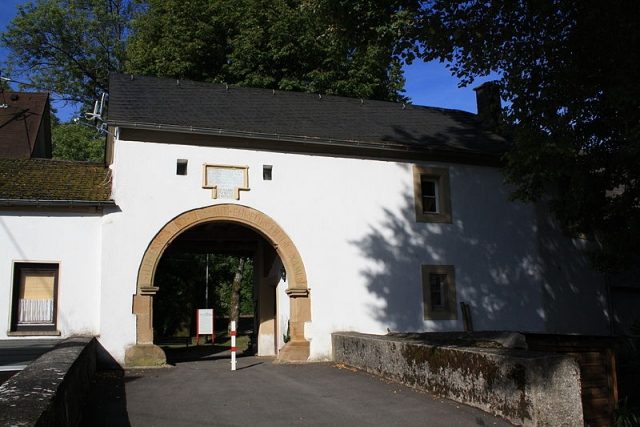
The buildings of Birkenfeld Castle were auctioned off by the French in 1807. The buyer, a Parisian merchant, resold them to locals. The stones of the decaying structures were used to build houses in Birkenfeld, and the castle fell into ruin over the next few years. Today, only a few ruins, the former castle inn "Zum ledigen Waidsack," and the castle gate remain of the once mighty Renaissance building. A youth hostel was built on the foundations of the former rectory at the beginning of the 20th century; after its closure in 1976, the building now serves as a community center.
Take Mobile History with you
You are reading this text for free. Premium adds what matters on the road: descriptions read aloud, sites found through your camera, whole regions taken offline.
- Every description, including the ~17,700 Premium sites
- Audio guide: have descriptions read to you on location
- AR finder: see sites through your camera, with distance and bearing
- Unlimited saved sites
14 days free, then from €2.99 a month. Cancel anytime.
Source: Wikipedia · Licence: CC BY-SA 4.0 · Image: http://de.wikipedia.org/wiki/Datei:Birkenfeld-nahe-torhaus.jpg
This description draws on the facts documented in the linked Wikipedia article; Wikipedia content is licensed under CC BY-SA 4.0. Wording and editing: Mobile History.
Location: 49.6397, 7.1656