The remains of the Castle can be visited
CastleKaiserslautern
Bilenstein Castle
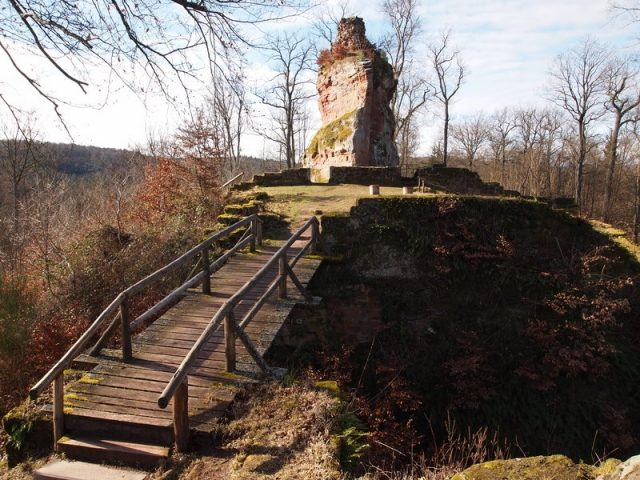
The natural and cultural monument Beilstein Castle Ruin is one of the smaller imperial ministerial castles. The rock castle is located approx. 2 km east of Kaiserslautern on the B37 (towards Hochspeyer), 313 m above sea level. Its name probably comes from the axe shape of the castle rock.
Presumably in the 12th century, Duke Frederick II of Swabia ("Duke Frederick the One-Eyed") had the castle built. In 1185, it was mentioned that the castle was in the possession of the ministerialis Merbodo von Beilstein.
In 1212, Merbodo von Beilstein, together with his brother Wernher von Wartenberg, sealed as a witness in the Wilenstein renunciation, and in 1234 King Henry VII allowed the reconstruction of Castrum Bylenstein.
Between 1420 and 1455, the castle was violently destroyed. No reconstruction followed. The ruin passed into Flörsheim and Palatinate ownership. In 1464, Hans von Bilenstein, the master chef of the Speyer bishopric, was mentioned as a Beilsteiner for the last time. After the extinction of the Flörsheim family in 1665, the castle completely passed into Palatinate ownership.
Around 1900, the Palatinate Beautification Association cleared part of the area and carried out securing measures. However, this partly destroyed archaeological find zones. At the end of the 1950s, excavations proved that a complex must have existed even before the first mention, whose dimensions were apparently much larger than the currently preserved part of the complex, which essentially consists of the masonry of the keep.
Since about 1990, Beilstein Castle has been owned by the city of Kaiserslautern.
Complex+
Of the former rock castle, only parts of the castle wall, a portal, and the rock needle with the depressions for holding the roof beams, around which buildings were formerly erected, have been preserved today.
Legend+
According to legend, a beautiful and proud knight's daughter lived in the castle who did not want a man. The young Junker Hanno still wanted her and decided to abduct her. With two of his servants, he broke into the castle, but when they entered the castle hall, they were startled. The maiden was guarded by two spirits who sat to her left and right. The servants fled, the Junker fainted. When he awoke again, the spirits were gone and he could complete his deed. However, the maiden quickly escaped him again and fled back into the castle. He followed her back into the castle and in the castle hall, she was again protected by the two spirits. This time he was not startled and approached the maiden. Then one of the spirits touched him and the Junker was immediately dead. For many years, no man dared to go to the castle until one day three journeymen made a bet while drinking in a tavern in Lautern. One wanted to dare to run around the castle and just see the young maiden. With a torch, he ran to the castle and three times around it, when one of the spirits met him, touched him, and he died.
Take Mobile History with you
You are reading this text for free. Premium adds what matters on the road: descriptions read aloud, sites found through your camera, whole regions taken offline.
- Every description, including the ~17,700 Premium sites
- Audio guide: have descriptions read to you on location
- AR finder: see sites through your camera, with distance and bearing
- Unlimited saved sites
14 days free, then from €2.99 a month. Cancel anytime.
Source: Wikipedia · Licence: CC BY-SA 4.0 · Image: http://www.wehrbauten.de/thread.php?threadid=1502
This description draws on the facts documented in the linked Wikipedia article; Wikipedia content is licensed under CC BY-SA 4.0. Wording and editing: Mobile History.
Location: 49.4331, 7.8456