The remains of the Castle can be visited
CastleSylda-Harkerode
Arnstein Castle
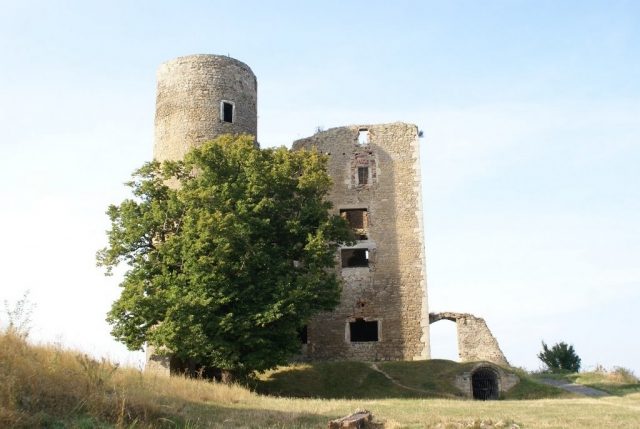
Arnstein Castle is a castle ruin on the edge of the Harz mountains, located in the Mansfeld-Südharz district in Saxony-Anhalt. The ruin stands on an elevation 210 m above sea level between the villages of Sylda and Harkerode, south of Aschersleben and northwest of Hettstedt. From the medieval fortification, the castle of the Lords of Arnstein emerged in the 12th century with its impressive, widely visible tower-like palas building. Since the 19th century, it has been known nationwide as a "romantic ruin".
The medieval castle was the ancestral seat of the Lords of Arnstein. They originated from the Swabian noble family of the Lords of St(r)eußlingen. Walther II named himself after the castle in 1156, which was its first documented mention. During this time, the first Romanesque castle must have been built. The two eastern round towers and the curtain wall between them can be attributed to this construction phase. Further buildings from the Romanesque period have not yet been proven.
Walther III of Arnstein was connected to the Ascanians and Wettins through marriage. This made the Arnsteins among the great Saxon nobility. They were able to acquire large estates in the Harz foreland. Around 1294, Walther IX joined the Teutonic Order. He handed over his property to his brother-in-law Otto von Falkenstein, who had the castle administered by bailiffs. With the extinction of the Falkensteins in 1334, the lordship fell to the Counts of Regenstein, who sold it to the Counts of Mansfeld in 1387. In the Mansfeld inheritance division of 1420, the castle came to the Mansfeld-Vorderort line. The construction of the Gothic residential tower-like hall building is to be dated to around 1400 (cf. Burgk, Ziegenrück, Kapellendorf). In its original form, it had four floors.
In 1442, the Counts of Mansfeld had to recognize the feudal sovereignty of the Saxon Elector for the Arnstein lordship. After destruction in the Peasants' War, Count Hoyer IV rebuilt the castle around 1530. The northeastern curtain wall tower was demolished and the central house was erected.
In 1563, Johann Albrecht, founder of the Mansfeld-Vorderort-Arnstein line, had the castle further expanded for residential purposes, so that it was referred to as a palace. The palas was raised by two floors, and the castle church and the kitchen house were completely rebuilt. The central and gate houses also underwent alterations. The still partially preserved spiral staircases were created.
After the extinction of the Arnstein line of the House of Mansfeld-Vorderort in 1615, the palace was used as a residential palace by the Mansfeld-Vorderort line until 1637. In inventories of the 17th and 18th centuries, the need for repairs to the buildings was repeatedly lamented; in 1723, a report to the Elector of Saxony described it as "everywhere in a ruinous state". Tenants who used the castle grounds economically repeatedly carried out makeshift repairs, but these did not prevent many buildings from continuing to decay.
In 1780, the last members of the comital line died, and the lordship fell to Electoral Saxony and in 1815 to the Kingdom of Prussia.
In the mid-19th century, the castle began to receive greater attention as a monument. The owners, the Barons Knigge, took preservation measures and initiated tourist development. Further repair work was carried out until the 1930s. Since 1992, a local heritage association has been dedicated to securing the ruin.
The thesis put forward by Hermann Wäscher and Helmut Wolf, that the Romanesque castle was a castellum with four corner towers, is rather unlikely.
Directions+
Take the A14 motorway to the Könnern exit. Continue to Hettstedt on the federal highway. In Hettstedt, orient yourself towards Harzgerode. After 5 km, turn onto the country road to Ritterode. Via Ritterode, Willerode and Sylda, you will reach the castle after approximately another 5 km. From the car park, a footpath leads left along the castle hill to the castle.
Miscellaneous+
The castle complex served as the backdrop for the 1975 Till Eulenspiegel film adaptation by Rainer Simon, starring Winfried Glatzeder.
In 2009, some scenes for the British feature film Black Death (Film) were shot below the ruin.
Take Mobile History with you
You are reading this text for free. Premium adds what matters on the road: descriptions read aloud, sites found through your camera, whole regions taken offline.
- Every description, including the ~17,700 Premium sites
- Audio guide: have descriptions read to you on location
- AR finder: see sites through your camera, with distance and bearing
- Unlimited saved sites
14 days free, then from €2.99 a month. Cancel anytime.
Source: Wikipedia · Licence: CC BY-SA 4.0 · Image: Roland Neubert, Halle (Saale)
This description draws on the facts documented in the linked Wikipedia article; Wikipedia content is licensed under CC BY-SA 4.0. Wording and editing: Mobile History.
Location: 51.6844, 11.4108