The remains of the Castle can be visited
CastleNaas-Sturmberg
Alt-Sturmberg Castle
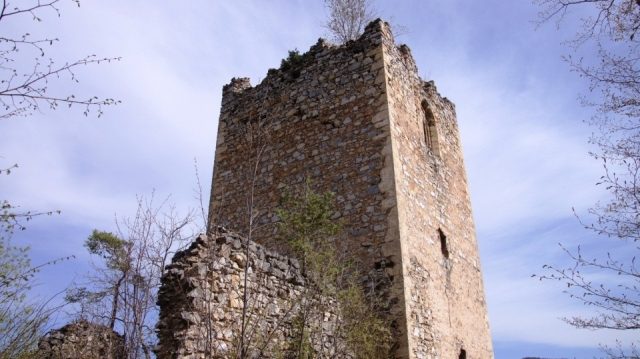
In the 12th century, the people of Feistritz built the fortress Alt or Unter Sturmberg to block the road. Although the relevant literature states that the fortress Neu or Ober Sturmberg was only built at the beginning of the 15th century, masonry examinations revealed that both castles must have been built at the same time.
When Juta von Feistritz bequeathed the fortress Alt Sturmberg to her son Leutold von Gutenberg towards the end of the 12th century, he transferred the property to his daughter, who subsequently passed it on to the Göss Abbey in Leoben. Around 1200, Göss Abbey granted Alt Sturmberg as a fief to the Sturmbergers. Neu Sturmberg was probably built on its own land.
No document has ever surfaced that could prove that Neu Sturmberg was a fief to the Sturmbergers. The first documented Sturmberger was Gebhardus von Sturmberg around 1216. The two castles were most likely populated by very closely related families. In 1393, Elisabeth Hafner inherited the fortress Neu Sturmberg. However, she left the castle to her brother's stepson, Otto I von Ratmannsdorf. The two castles were then owned by the Ratmannsdorf family.
In 1610, it came into the possession of Magdalena Paradeiser (née Ratmannsdorf), who left it to her son from her first marriage, Friedrich Freiherr von Herbersdorf. His widow Maria, as a Protestant, had to leave Styria in 1629. Shortly before, she had sold the castle to Balthasar Fettauer. Under him, the estate was severely neglected. By his death in 1644, Alt-Sturmberg was already so dilapidated that only a few rooms were habitable. Around 1653, the castle, along with part of the estate, was sold to Ott Gottfried Freiherr von Kollonitsch. The later owners, the Counts Khevenhüller, incorporated Alt-Sturmberg into their Thannhausen dominion.
In 1718, Ober Sturmberg, which had long been uninhabited and was very dilapidated, was sold to the owner of Thannhausen, Johann Josef Graf Wurmbrand. The castle was henceforth left to decay and remained united with the Thannhausen dominion. From him, the dominion of Neu Sturmberg passed to the Counts of Webersberg, who also owned Wachsenegg. Through liquidation, Neu Sturmberg came to Johann Graf Khevenhüller-Metsch in 1761. Ober Sturmberg Castle had been quite well preserved until then. Franz Anton Khevenhüller sold the iron of both castles in 1780, sealing the final decay of the formerly splendid knight's castles. The dominion of Neu Sturmberg came into the hands of August Fürst von Bretzenheim in 1799.
In 1806, both castles came into the possession of the Imperial and Barons of Gudenus. Since then, the ruinous knight's castles have belonged to the Thannhausen dominion. The decay has been slow but incessant since that time. In 2010, the Alt Sturmberg ruin was somewhat maintained and illuminated externally.
Take Mobile History with you
You are reading this text for free. Premium adds what matters on the road: descriptions read aloud, sites found through your camera, whole regions taken offline.
- Every description, including the ~17,700 Premium sites
- Audio guide: have descriptions read to you on location
- AR finder: see sites through your camera, with distance and bearing
- Unlimited saved sites
14 days free, then from €2.99 a month. Cancel anytime.
Source: Wikipedia · Licence: CC BY-SA 4.0 · Image: http://www.wehrbauten.at
This description draws on the facts documented in the linked Wikipedia article; Wikipedia content is licensed under CC BY-SA 4.0. Wording and editing: Mobile History.
Location: 47.2334, 15.6069