The remains of the castle can be visited
CastleWinzenburg
Winzenburg Castle
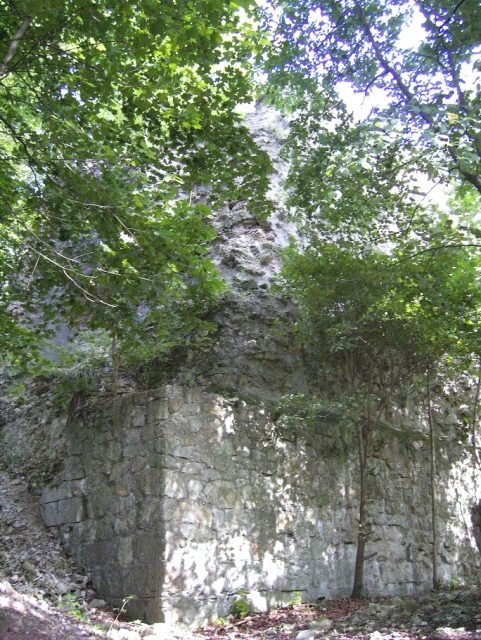
Winzenburg Castle was a spur castle on a mountain spur of the Sackwald above Winzenburg, southeast of Alfeld (Leine). Today, the complex is a castle ruin, consisting mainly of the remains of the pentagonal keep.
Architectural Description+
The castle consisted of the main castle on a residential mound, a large courtyard, and the projecting pentagonal keep. It was a particularly strongly fortified fortress with a pointed oval layout measuring 200 m in length and 80 m in width. The main castle at the southwest end consisted of one or more residential buildings, a cistern, and a church. In the eastern part of the complex today are the remains of the pentagonal keep, which was built between 1130 and 1150. In 1230, the tower was raised by one story. On the former residential mound, the castle well has been reconstructed, which was a cistern. Water was brought up to the castle from the Apenteich springs below by donkey on the Eselssteig (Donkey Path). The springs fed the Apenteiche (Apen Ponds), which were created in 1220. The springs were a pagan cult area where sacrificial offerings approximately 5,000 years old were found.
When it was built in the mid-9th century, the castle was originally a ring fort. During the time of Hildesheim Bishop Otto I of Braunschweig-Lüneburg (1260–1279), it was walled. The first major expansion took place in the 12th century.
The castle was first mentioned in a document in 1109, when Hermann I of Formbach received it as a fief from his uncle, Hildesheim Bishop Udo of Gleichen-Reinhausen, and named himself after it. He fell into dispute with his vassal Burchard I of Loccum over the latter's castle construction and had him murdered in 1130. As a result, Hermann I lost all his fiefs.
At the instigation of Emperor Lothair III, the castle was destroyed and fell to Bishop Bernhard I of Hildesheim, who subsequently had it rebuilt.
In 1150, Hermann II managed to regain the castle as a fief, but in 1152 he was murdered at Winzenburg along with his wife by one of his castle knights. This extinguished the Winzenburg family line. The ownerless castle reverted to the Bishop of Hildesheim, who made it the strongest castle in his dominion. In 1522, the castle was completely destroyed in the Hildesheim Diocesan Feud and fell into disrepair. Through the Quedlinburg Recess of 1523, the ruin came into the possession of Duke Heinrich the Middle of Braunschweig. He had an administrative court built in the valley near the former village of Hasekenhusen, today's Winzenburg. He had the necessary stone material broken from the masonry of Winzenburg.
Take Mobile History with you
You are reading this text for free. Premium adds what matters on the road: descriptions read aloud, sites found through your camera, whole regions taken offline.
- Every description, including the ~17,700 Premium sites
- Audio guide: have descriptions read to you on location
- AR finder: see sites through your camera, with distance and bearing
- Unlimited saved sites
14 days free, then from €2.99 a month. Cancel anytime.
Source: Wikipedia · Licence: CC BY-SA 4.0 · Image: https://de.wikipedia.org/wiki/Datei:Winzenburg_Bergfried02.jpg
This description draws on the facts documented in the linked Wikipedia article; Wikipedia content is licensed under CC BY-SA 4.0. Wording and editing: Mobile History.
Location: 51.9432, 9.9450