The remains of the Castle can be visited
CastleHohnstein-Goßdorf
Schwarzberg Castle
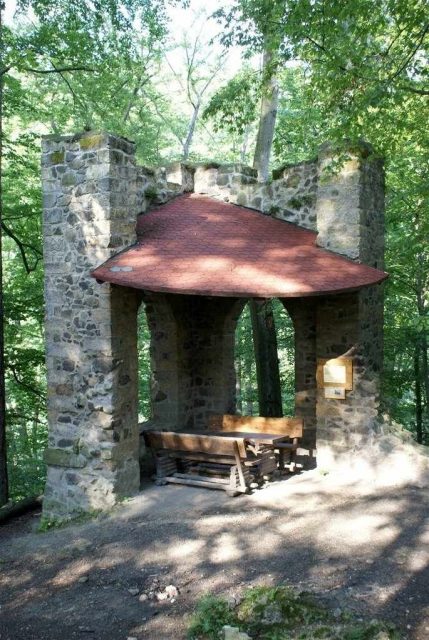
Ulbersdorf, founded during the East German colonization, is a typical forest-strip village. The so-called Goßdorf Robber Castle once belonged to the Ulbersdorf estate district.
The Goßdorf Robber Castle, located between Goßdorf and Altendorf, north of Bad Schandau, can be reached via various scenic hiking trails. These remains of the old castle complex are situated on a 50-meter-high hill above the confluence of the Schwarzbach and Sebnitz rivers.
Mentioned in a document in 1372, on the occasion of an inheritance settlement by Emperor Charles IV, the complex is identical with the old Schwarzberg Castle, which had been built near formerly important road routes. Like many other castles in the area, it belonged to the sphere of influence of the Bohemian noble family Berken von der Duba.
Around the Schwarzberg, there are other small medieval castle sites: the "Raschgärtner's Robber Castle" on the edge of the Ulbersdorf fields, the "Nasenbergwarte", the "Schwarzbergwarte", the "Moulbergwarte" and the "Pinsenbergwarte". Their existence seems to be confirmed by isolated medieval pottery shards found (except on the Pinsenberg). They were probably small spur castles with a residential tower.
There is little information about the origin and use of the complexes. Written records only exist with the mention of Schwarzberg Castle in 1372, when the castles of Schwarzberg and Hohnstein are named as being in the possession of the Berken von der Duba. Archaeological investigations have not been carried out. A precise chronological classification of their origin and use is therefore not possible. However, it can be assumed that the Schwarzberg and the castle sites could have originated with or immediately after the peasant settlement of the land between 1200 and 1275 under German rule. When and under what circumstances they later came into the possession of the Berken von der Duba is unclear. At the latest, in the course of the Berken's inheritance division around 1409, the Schwarzberg was abandoned. The associated villages fell under Hohnstein administration.
There are also different opinions about the former functions of Schwarzberg Castle and its surrounding castle sites. Escort purposes are mentioned, as is the blocking of the Schwarzbach and Sebnitz valleys for the collection of a toll. However, more recent statements by Christian Maaz deny a primary connection between road and castle and assume a Schwarzberg manor, which also included representative and defensible residences of vassals aspiring to knighthood. However, it remains unclear which villages belonged to this manor.
Today, however, only a few remains and an artificial ruin from 1858 are left of the legendary medieval fortification on the Schwarzberg. Even in the 19th century, farmers used the Schwarzbach valley to get to their fields. To keep the memory of the former castle complex alive, the then manor owner Lüttichau from Ulbersdorf had the artificial ruin erected on its wall remains. Today, the castle hill serves as an excursion destination and rest area for hikers.
Take Mobile History with you
You are reading this text for free. Premium adds what matters on the road: descriptions read aloud, sites found through your camera, whole regions taken offline.
- Every description, including the ~17,700 Premium sites
- Audio guide: have descriptions read to you on location
- AR finder: see sites through your camera, with distance and bearing
- Unlimited saved sites
14 days free, then from €2.99 a month. Cancel anytime.
Source: Wikipedia · Licence: CC BY-SA 4.0 · Image: Roland Neubert, Halle (Saale)
This description draws on the facts documented in the linked Wikipedia article; Wikipedia content is licensed under CC BY-SA 4.0. Wording and editing: Mobile History.
Location: 50.9465, 14.1847