Museum
CastleEuskirchen - Kuchenheim
Upper Castle Kuchenheim
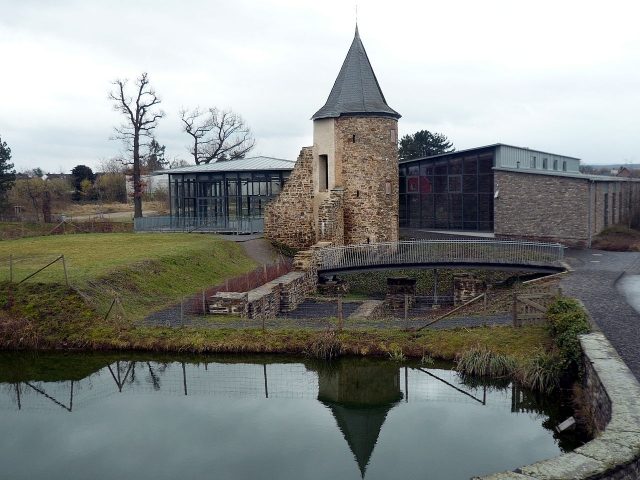
The Obere Burg (Upper Castle) in Euskirchen's Kuchenheim district was a lowland castle from the 14th century. Of it, the three-story corner tower from the 15th century, as well as wall foundations, a historic bridge foundation, and the moat, are still preserved. Today, in the immediate vicinity of the castle's remains, is the "Museum Guesthouse Mottenburg" of the LVR-Industriemuseum Euskirchen – Tuchfabrik Müller.
On the grounds of the LVR-Industriemuseum are fragments of the "Obere Burg," which was mentioned in 1259 as "castrum Cugenheim." Archaeological excavation finds suggest that a so-called motte existed here even earlier, namely in the 11th/12th century: a motte-and-bailey castle, a wooden defensive tower on an artificial mound – surrounded by a moat.
In the Middle Ages, the castle – now built of quarry stone – with its border location near the Duchy of Jülich, had important strategic significance. The castle complex originally consisted – like many moated castles in the Rhineland from this period – of two parts separated by a moat. During an excavation by the Rhenish Office for Archaeological Heritage Preservation in 2004, several wall sections were uncovered, showing the tower as part of a masonry manor house. The presumed tower on the left side of the front was not verifiable. In front of the house facade ran a moat about nine meters wide and up to 2.40 meters deep, which was used as a "dump" for a long time. Numerous finds were recovered from it: shards of tableware from the 14th to 18th centuries, animal bones, small bronze parts, window glass, leather, and shells from the Atlantic. The finds suggest a high standard of living at the small Rhenish noble seat. A stone bridge led over the moat to the manor house, of which three pillars are preserved. These are based on mighty oak timbers of a predecessor bridge. The oldest wood dates the bridge construction to 1442, two slightly younger timbers (felling year around 1470) probably belong to a repair phase.
The castle property was a Cologne fief until 1755 and changed hands between various noble families; since 1755, the property passed into bourgeois hands. In 2001, the Landschaftsverband Rheinland acquired the site to carry out extensive excavations and to build a museum guesthouse for the neighboring "Rhenish Industrial Museum" (today: LVR-Industriemuseum).
Excavation and Current Use+
After the excavations in 2004 by the Rhenish Office for Archaeological Heritage Preservation, the Landschaftsverband Rheinland secured the wall foundations in 2006, refilled the moat, restored the castle mound in the typical shape of a motte, and erected a modern, narrow bridge over the historic bridge foundation. In this way, the largely destroyed castle complex became partially legible again.
In the immediate vicinity of the LVR-Industriemuseum's Tuchfabrik Müller site, the "Museum Guesthouse Mottenburg" was built, allowing school classes a multi-day stay with an educational program around the museum's themes. The bricks for the modern guesthouse come from the demolition of the ruinous buildings of the former Koenen cloth factory, which previously stood on this site.
Take Mobile History with you
You are reading this text for free. Premium adds what matters on the road: descriptions read aloud, sites found through your camera, whole regions taken offline.
- Every description, including the ~17,700 Premium sites
- Audio guide: have descriptions read to you on location
- AR finder: see sites through your camera, with distance and bearing
- Unlimited saved sites
14 days free, then from €2.99 a month. Cancel anytime.
Source: Wikipedia · Licence: CC BY-SA 4.0 · Image: http://de.wikipedia.org/wiki/Datei:Obere_Burg_Euskirchen-Kuchenheim_Gesamtansicht_mit_Burggraben.jpg
This description draws on the facts documented in the linked Wikipedia article; Wikipedia content is licensed under CC BY-SA 4.0. Wording and editing: Mobile History.
Location: 50.6488, 6.8248