The remains of the Castle can be visited
CastleAhrweiler
Neuenahr Castle
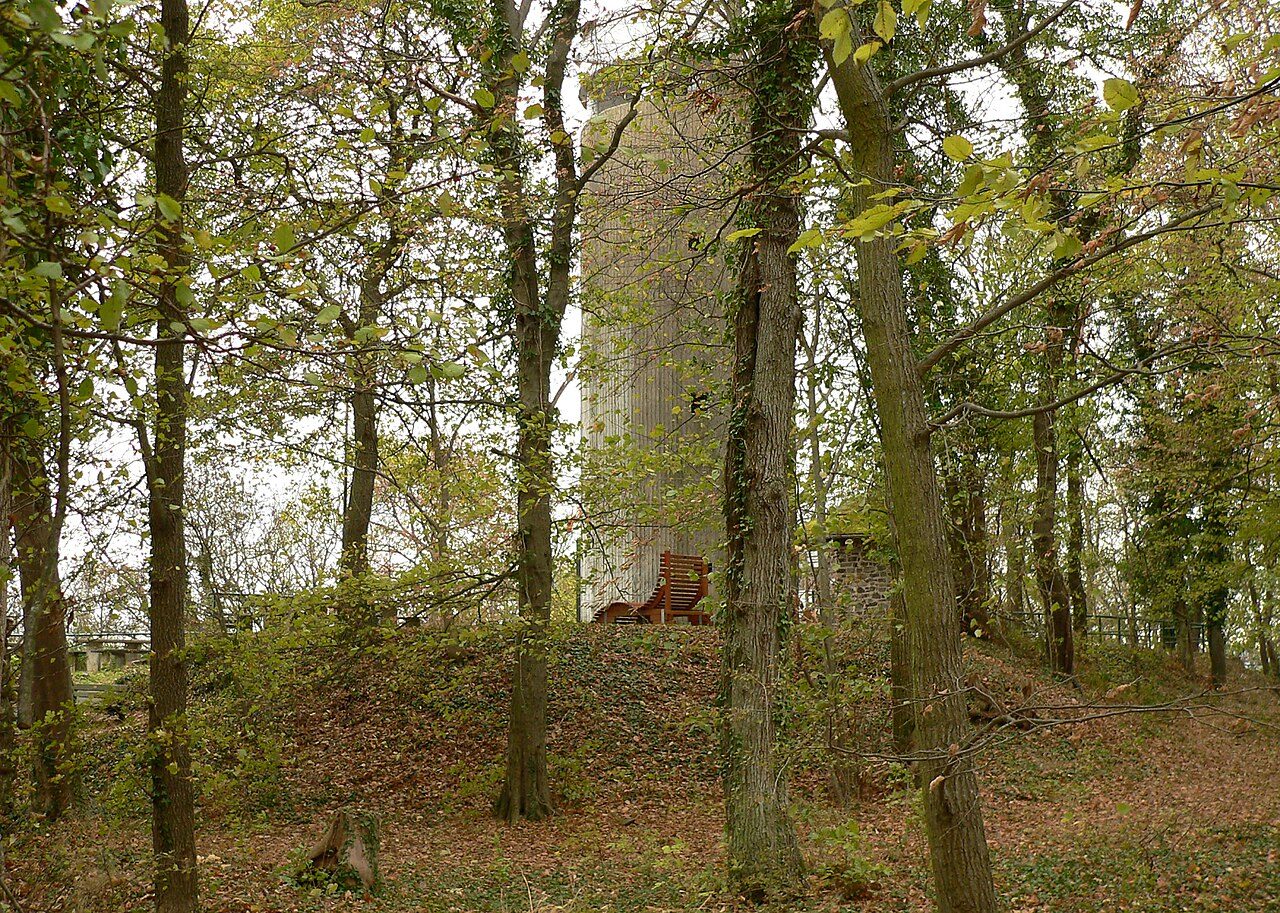
Neuenahr Castle is the ruin of a hilltop castle at 337 m above sea level on the Neuenahrer Berg in the lower Ahr valley in Bad Neuenahr-Ahrweiler in the district of Ahrweiler in northern Rhineland-Palatinate.
The castle, built around 1225 by Count Otto von Neuenare, was the official seat of the County of Neuenahr. At that time, he still called himself Ottonis Comitas (Count) de Landahr, and in 1231, a Count Otto von Neuenahr was mentioned. Otto, the son of Gerhard von Are and Nürburg, was the first to name himself after the newly built castle.
Genealogy
Otto left two sons, Gerhard and Ludwig. Gerhard's wife was Elisabeth von Sponheim. His son Theodorich succeeded him and left four children, Wilhelm I, Johann I, Ludwig, and Sophie, when he died in 1276. His widow Hedwig and her children pledged the county, with the exception of the castle, the villages of Wadenheim, Ramersbach, and the Grevel farm in Scheidt, to Archbishop Siegfried of Cologne. Wilhelm I was unable to redeem the county and therefore enfeoffed it to the Archbishop as a fief and open house. As a participant in the Battle of Worringen on the side of the Archbishop, he gave his vineyards in Wadenheim as a fief to Count Adolf von Berg to free himself from captivity. He was succeeded by his sons Krafto and Wilhelm II with his wife Bonizetta, who later administered the county for her underage son Wilhelm III around 1327. In 1343, Wilhelm III was enfeoffed with Neuenahr Castle by the Cologne Archbishop Walram von Jülich. His wife was Johanna von Elslo; they had only one daughter, Katharina, so his uncle Krafto, canon in Cologne, succeeded him in the county. In 1353, he arranged the marriage between Katharina and Johann III, son of Johann II von Saffenburg. The father declared his eldest son the sole heir of Saffenburg, and Krafto declared the daughter of his deceased nephew Wilhelm, Katharina, also the sole heiress of the County of Neuenahr.
After Krafto's death, significant inheritance disputes arose between the Saffenburgers Johann III and Katharina and the agnates from the Neuenahr line, some of which ended in open feuds. These were Johann III von Neuenahr zu Rodensberg (Roesberg between Bonn and Brühl), Gottfried von Neuenahr zu Hackenbroich, both grandsons of Johann I von Neuenahr, the brothers Johann and Diedrich, sons of Johann III von Neuenahr, and Gerlach von Isenburg, who claimed rights due to his wife Demudis von Neuenahr. The attempt by Cologne Archbishop Wilhelm von Gennep to mediate in the settlements of 1360 and 1362 was unsuccessful. In the renewed feud, Johann and Dietrich drove the rightful heirs from the castle and demanded 20,000 guilders in gold for their withdrawal as a condition. During the years of occupation of Neuenahr Castle, they inflicted highway robbery, arson, manslaughter, and other damage on lords, knights, servants, citizens, and merchants. To take possession of their inheritance, the Saffenburger Johann III with his wife Katharina von Neuenahr sought help from Archbishop Friedrich III von Saarwerden.
Destruction of the Castle
In 1372, the castle was destroyed by order of the Archbishop of Cologne, Friedrich III von Saarwerden, with the support of the citizen militia of Ahrweiler, to end the robber baron activities emanating from this castle. This help came at a high price for the Saffenburgers; Archbishop Friedrich demanded 50,000 guilders for his "military deployment," as well as the castle hill, with the condition that no castle should ever be rebuilt there, and the County of Neuenahr should henceforth belong equally to both. At the end of the 17th century, the ruins of the castle complex were demolished, and stones and building materials were largely removed; they served, among other things, for the new construction of the Rentmeisterei building, today's Beethovenhaus, at the foot of the castle hill.
Description of the Castle
The castle hill consists of basalt covered by a mantle-shaped layer of greywacke. On the eastern castle hill, a beautiful quartz rock is still visible, which probably also served as building material there. The castle complex is still surrounded on three sides by an artificial deep neck ditch, which, despite rubble, is still 10 m deep in places today. The demolition material served as building material; the smaller rock particles still pile up today as two huge spoil heaps on the sides of the neck ditch. On the steeply sloping side of the mountain towards the Ahr, where the old access road to the castle was located, there was natural security. Today, the foundations of the triangular curtain wall, a rectangular central tower building, and other building remains are still preserved. A round observation tower was built on the castle grounds in 1972 (unfortunately made of ugly reinforced concrete). Furthermore, there is also a modern pavilion of the Eifelverein to protect hikers and visitors.
Take Mobile History with you
You are reading this text for free. Premium adds what matters on the road: descriptions read aloud, sites found through your camera, whole regions taken offline.
- Every description, including the ~17,700 Premium sites
- Audio guide: have descriptions read to you on location
- AR finder: see sites through your camera, with distance and bearing
- Unlimited saved sites
14 days free, then from €2.99 a month. Cancel anytime.
Source: Wikipedia · Licence: CC BY-SA 4.0 · Image: Axel Hindemith / CC BY-SA 3.0 via Wikimedia Commons
This description draws on the facts documented in the linked Wikipedia article; Wikipedia content is licensed under CC BY-SA 4.0. Wording and editing: Mobile History.
Location: 50.5311, 7.1383