To be privately owned
CastleStamford
Burghley House
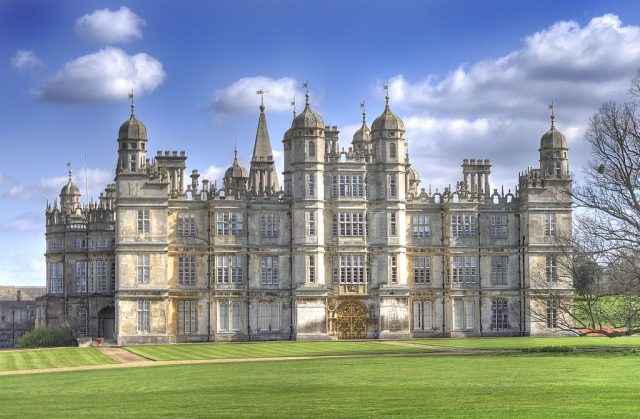
Burghley House is a grand 16th-century country house in Cambridgeshire 0.9 miles (1.4 km) south of Stamford, Lincolnshire, England and 10 miles (16 km) northwest of the city of Peterborough. Its park was laid out by Capability Brown.
Burghley was built for Sir William Cecil, later 1st Baron Burghley, who was Lord High Treasurer to Queen Elizabeth I, between 1558 and 1587 and modelled on the privy lodgings of Richmond Palace. It was subsequently the residence of his descendants, the earls and, since 1801, marquesses of Exeter, since 1961 owned by a charitable trust established by the family.
Lady Victoria Leatham, antiques expert and television personality, followed her father, Olympic gold-medal winning hurdler and runner, IAAF President and MP David "Burghley", the 6th marquess by running the house from 1982 to 2007. Her daughter Miranda Rock is now the most active, live-in trustee.
The house is one of the main examples of stonemasonry and proportion in 16th-century English Elizabethan architecture, reflecting the prominence of its founder and rich agricultural wool trade of the Cecil estates and has a suite of rooms remodelled in the baroque style, with carvings by Grinling Gibbons. The main part of the house has 35 major rooms on the ground and first floors. There are more than 80 lesser rooms and numerous halls, corridors, bathrooms and service areas.
In the 17th century, the open loggias around the ground floor were enclosed. Although the house was built in the floor plan shape of the letter E in honour of Queen Elizabeth, it is now missing its north-west wing. During the period of the 9th earl's ownership, and under the guidance of Capability Brown, the south front was raised to alter the roof line, and the north-west wing was demolished to allow better views of the new parkland.
Paintings+
in the Pagoda Room there are portraits of the Cecil family, Queen Elizabeth I, her father Henry VIII and Oliver Cromwell. Many delicately painted walls and ceilings of the house were done by Antonio Verrio.
Lost village+
The Domesday village of Burghley was abandoned by 1450. The national history body field investigator in 1968 suggests that failure to locate it by archaeology is because it is below Burghley House.
Parkland+
The avenues in the park were all laid out by Capability Brown, paying due respect to pre-existing plantings, some of which were from the 16th century or earlier. Brown also created the park's man-made lake in 1775–80. He discovered a seam of waterproof "blue" clay on the grounds, and was able to enlarge the original 9-acre (36,000 m²) pond to the existing 26-acre (105,000 m²) lake. Its clever design gives the impression of a meandering river. Brown also designed the Lion Bridge at a cost of 1,000 guineas (£1,050) in 1778. Originally, Coade-stone lions were used as ornamentation. After these weathered, the existing stone examples were made by local mason Herbert Gilbert in 1844. Queen Victoria and her husband Prince Albert also planted two trees to commemorate their visit. The spade that was used is on show in the bedroom that they stayed in.
As well as the annual Burghley Horse Trials, Burghley plays host to the famous "Burghley Run" for Stamford School and an annual meet for the Cambridge University Draghounds.
Recent developments have included starting a sculpture garden around the old ice house and, in 2007, a "garden of surprises" was created using traditional ideas of water traps, shell grottos and a mirror maze, but in a 21st-century style. The Burghley House trust has commissioned thoughtful, contemporary artwork in the grounds from leading artists.
Today+
The Lincolnshire county boundary crosses between the town and the house. Located in the ancient Soke of Peterborough, once a part of Northamptonshire but now for postal/ceremonial purposes in Cambridgeshire, for planning and other municipal functions the house is in the City of Peterborough, a unitary authority. The house is a Grade I listed building, with separately Grade I listed north courtyard and gate. The site is open to the public. A number of restoration projects are under way.
Filming+
Burghley House has been featured in several films. Its virtually unaltered Elizabethan façades and a variety of historic interiors make it an ideal location for historical and period movies.
Films and programmes made at Burghley include:
- The Da Vinci Code
- Pride & Prejudice
- Elizabeth: The Golden Age
- BBC Two filmed a 15-part series about Burghley broadcast in the Castle in the Country programmes 2006.
- Featured in the 2007 BBC series How We Built Britain
- Burghley House was one of fifteen structures featured in the 2010 BBC series Climbing Great Buildings
- In 2011 Burghley House featured on the TV programme Royal Upstairs Downstairs.
- Housefull 2: The Dirty Dozen Indian Movie 2012
- Antiques Roadshow, Season 20, Episode 18
Take Mobile History with you
You are reading this text for free. Premium adds what matters on the road: descriptions read aloud, sites found through your camera, whole regions taken offline.
- Every description, including the ~17,700 Premium sites
- Audio guide: have descriptions read to you on location
- AR finder: see sites through your camera, with distance and bearing
- Unlimited saved sites
14 days free, then from €2.99 a month. Cancel anytime.
Source: Wikipedia · Licence: CC BY-SA 4.0
This description draws on the facts documented in the linked Wikipedia article; Wikipedia content is licensed under CC BY-SA 4.0. Wording and editing: Mobile History.
Location: 52.6424, -0.4525