Museum
Restaurant
CastleWolkenstein
Wolkenstein Castle
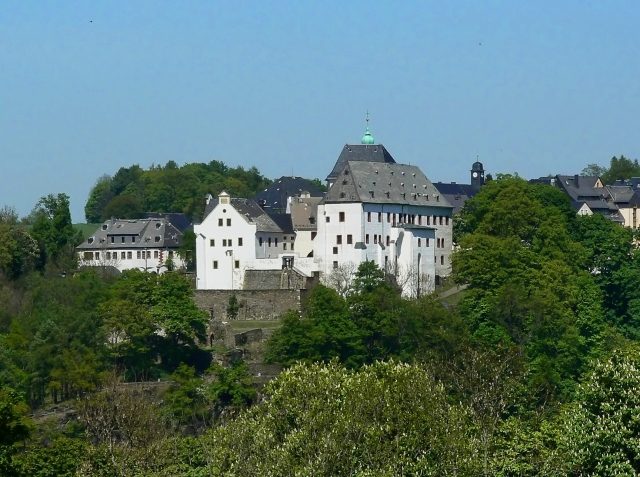
Wolkenstein Castle, today mostly called Wolkenstein Palace, is a high medieval castle in the town of Wolkenstein in the Erzgebirgskreis district in Saxony (Germany).
The hilltop castle is located about 80 meters above the Zschopau valley near the mouth of the Preßnitz on a rocky outcrop. Its strategic function was to protect a trade route to Bohemia.
Wolkenstein Castle was first mentioned in a document in the 13th century. The Lords of Waldenburg resided as ministeriales on behalf of the German king in the castle in the Pleißenland, which had come under German rule in the course of the Ostkolonisation. From 1378, Wolkenstein was the main seat of the Waldenburgers. After the death of the last Waldenburger in 1473, the property fell as an escheat to the regional lords, the Wettins. After 1500, it was owned by Henry the Pious, who, as a younger son, received the offices of Wolkenstein and Freiberg for his upkeep. He had the castle expanded and used it as a hunting lodge. His son August furnished the complex around 1550 as a Renaissance-style palace for his residence, but after his appointment as Elector of Saxony in 1553, he only used it as a secondary residence. Due to the damage of the Thirty Years' War and gradual neglect, some parts of the complex fell into disrepair. Until the 19th century, the main buildings were used as the electoral Saxon administrative seat and royal Saxon district court; later, a penal institution was housed there, which existed until 1951. Until the mid-1960s, the palace was used for residential purposes, after which a local history room with craft workshops was established there in 1964, and from 1984, a regional studies cabinet with a folk art school.
Current Use+
Today, the palace houses the town's local history museum, a historic wedding room used by the registry office, and a restaurant. The Fürstensaal, a restored banqueting hall in the south wing, commemorates the period of Wettin rule and is used as an event hall.
Complex+
The appearance of the original complex is unknown. The oldest existing parts of the historically grown complex are the residential tower and the kitchen house, both dating from the 14th century. In the 16th century, the south and north wings with the gatehouse were added. Although the castle-like, defensive character of the entire complex dominates, the complex was already referred to as "slosz Wolkenstein" in 1372.
Take Mobile History with you
You are reading this text for free. Premium adds what matters on the road: descriptions read aloud, sites found through your camera, whole regions taken offline.
- Every description, including the ~17,700 Premium sites
- Audio guide: have descriptions read to you on location
- AR finder: see sites through your camera, with distance and bearing
- Unlimited saved sites
14 days free, then from €2.99 a month. Cancel anytime.
Source: Wikipedia · Licence: CC BY-SA 4.0 · Image: Thomas Eichler
This description draws on the facts documented in the linked Wikipedia article; Wikipedia content is licensed under CC BY-SA 4.0. Wording and editing: Mobile History.
Location: 50.6551, 13.0646