Vine school
CastleAbstatt
Wildeck Castle
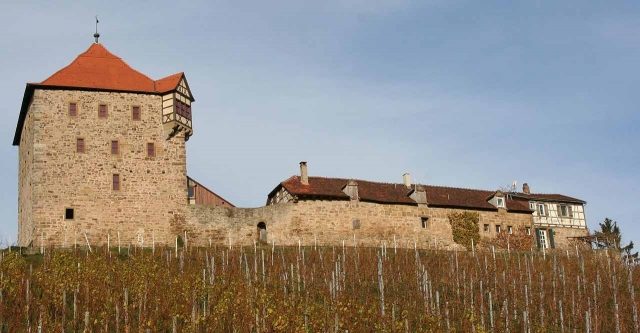
Wildeck Castle, also known as Wildeck Palace, is a castle in Abstatt in the district of Heilbronn in Baden-Württemberg. The castle was probably built in the High Middle Ages by the Lords of Heinriet and came into the possession of Ludwig in 1492, ancestor of the third line of the Counts of Löwenstein, who demonstrably cultivated wine there as early as the 16th century. In 1933, the castle and surrounding vineyards came into the possession of the Württemberg state. Since 1940, the much-rebuilt castle has housed an experimental farm of the Weinsberg Viticulture School, which bred the Samtrot and Dornfelder grape varieties there.
The hilltop castle is located on a mountain spur above Abstatt on the edge of the Löwenstein Mountains. From the castle, one gets a good overview of Abstatt. In addition to Abstatt, one can also see the villages of Vohenlohe and Happenbach, which belong to Abstatt, and the neighboring communities of Beilstein, Ilsfeld with Auenstein and Helfenberg, as well as Untergruppenbach with Unterheinriet. The ruins of Helfenberg Castle are only about one kilometer away.
The origins of the castle are largely unknown. It emerged during the late land development phase in the High Middle Ages. There are no documents about the early history of ownership, but it is assumed that the castle was built between 1250 and 1330 as the second castle of the Lords of Heinriet and served as the residence of the Wildeck branch line of these lesser nobles. Between 1336 and 1364, Abstatt was separated from Heinriet and remained the sole seat of the Heinrieters. Through the last male descendant of the family, Philipp von Heinriet († 1462), the castle came into the possession of his son-in-law Peter Harrant von Hohenberg († 1490) in 1450. After his death, it reverted to the liege lord and was granted to Wilhelm von Neipperg, who sold Wildeck Castle and the village of Abstatt in 1492 to Ludwig, son of Friedrich the Victorious and, from 1494, Count of Löwenstein. In 1504, the feudal sovereignty passed from Baden to Württemberg, which again granted the lordship of Wildeck to the Counts of Löwenstein as a fief in 1510, but from then on, only the economic use remained with them, while Abstatt and Wildeck were placed under the sovereignty of the Württemberg office of Beilstein. With Württemberg, the castle briefly came under Austrian administration in the early 16th century. In 1525, Wildeck Castle was destroyed in the German Peasants' War, and according to a building inscription from 1533, it was probably rebuilt in that year. In the turmoil of the Thirty Years' War, Abstatt with Wildeck Castle came into the possession of Anton Wolfradt in 1622 after the Battle of Wimpfen, and later with Helfenberg to the Möckmühl Colonel Peter Pflaumer. After the Peace of Westphalia in 1648, the castle came into the possession of Count Carl zu Löwenstein in 1653 through a legally regulated repurchase.
Due to the climatically favorable elevated location, viticulture already played a significant role in the 16th century on the surrounding associated elevated areas and in the castle. In 1589, 16 Morgen (acres) of vineyards are mentioned, and in 1653, 28 Morgen. The ecclesiastical administration also had a share in some good princely locations. The highest quality variety cultivated there at that time was probably Muscatel, which is explicitly mentioned in 1653.
During the reorganization of Southwest Germany as a result of the Confederation of the Rhine Act of 1806, the Lordship of Wildeck was abolished. The castle with its vineyards and lands remained in the private possession of the House of Löwenstein-Wertheim and became the seat of a forest ranger, while the administration of the estate and lands was carried out by the Löwenstein Rentamt in Abstatt.
Karl Hereditary Prince of Löwenstein-Wertheim-Rosenberg sold the Abstatt forest district and the Wildeck winery in July 1932 to the Jewish merchant Salman Schocken, but the purchase was denied by the Fideikommissgericht in Stuttgart, so that in July 1933 the Württemberg state acquired the property.
The Weinsberg Viticulture School sought to acquire the winery for several years, was assigned it on August 1, 1939, and finally began rebuilding a winery on the existing areas in 1940. The acquisition of the remaining, partly heavily parceled vineyard areas in private hands around the castle dragged on until 1972.
During World War II, the castle was damaged by artillery fire. For a long time, the castle buildings only had emergency roofs; the current structures of the castle are the result of more recent construction measures. The training rooms on the upper floors of the tower, which was particularly damaged in World War II, were only set up in 1995. Old farm buildings from the 19th and early 20th centuries, such as the well house, the press extension on the tower, the press house, the day laborer's house, and others, were demolished, and a new machine hall was built. The area around the castle was also changed several times in the 20th century, both by road construction and by the creation of reservoirs or the filling of depressions with the excavation from the lakes. This leveled the vineyard area in places in 1954. In 1982, the state also acquired the newly created vineyard areas there.
The experimental farm in Wildeck played a significant role in the development of the Samtrot and Dornfelder grape varieties. Since 1992, the experimental farm has been managed according to the guidelines of organic viticulture. In 1996, the total operating area was 21.1 hectares, of which 8.6 hectares were productive vineyard area, with the remainder consisting of young plantings, fallow land, meadows, water areas, as well as buildings and paths. About a quarter of the area was occupied by Riesling, with Samtrot, Müller-Thurgau, Spätburgunder, Weißburgunder, and Grauburgunder also having significant shares.
Take Mobile History with you
You are reading this text for free. Premium adds what matters on the road: descriptions read aloud, sites found through your camera, whole regions taken offline.
- Every description, including the ~17,700 Premium sites
- Audio guide: have descriptions read to you on location
- AR finder: see sites through your camera, with distance and bearing
- Unlimited saved sites
14 days free, then from €2.99 a month. Cancel anytime.
Source: Wikipedia · Licence: CC BY-SA 4.0 · Image: https://commons.wikimedia.org/wiki/File:Abstatt_Burg_Wildeck_01_20061126.jpg
This description draws on the facts documented in the linked Wikipedia article; Wikipedia content is licensed under CC BY-SA 4.0. Wording and editing: Mobile History.
Location: 49.0695, 9.3205